
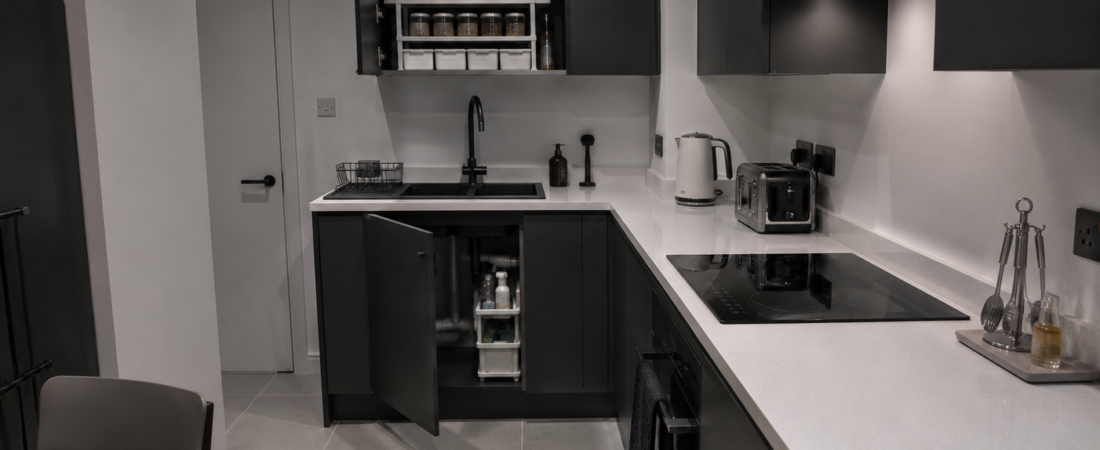
Most small kitchen reorganisations fail within three weeks. Not because the kitchen is too small, and not because the person reorganising it lacked effort — but because the same predictable mistakes are made every time, and without identifying them specifically, they repeat indefinitely.
The mistakes below are not unusual. They appear in almost every small flat kitchen that has been reorganised without a clear system. Recognising them is the first step to fixing them permanently.
Each mistake below is followed by a specific fix — not a general principle, but a concrete action that addresses the root cause directly.
Mistake #1: Buying Storage Products Before Defining a System
A new shelf riser, a set of containers, or a kitchen trolley arrives and gets placed wherever it fits rather than where it serves a defined purpose. Without a zone system in place first, every product becomes an addition to the existing clutter rather than a solution to it. The kitchen looks different for two weeks — tidier, more considered — and then it looks exactly the same as before, with more objects in it. The products did not fail. They were applied to the wrong problem, or to no specific problem at all.
The fix is to define zones before buying anything. Empty the kitchen completely, assign each category of item to a specific cupboard or area, and only then identify which products are needed to support that allocation. The full process — audit, zone allocation, cupboard-by-cupboard structure — is covered in how to organise a small kitchen with limited cupboard space. Products bought after a system is defined solve a real problem. Products bought before it solve an imaginary one.
Mistake #2: Ignoring the Space Under the Sink
The under-sink cupboard is the most consistently wasted space in a small flat kitchen. The waste pipe and siphon make it look unusable — so most people push cleaning products in without a system and shut the door. In practice, the under-sink area in a standard UK flat kitchen has enough usable space for all cleaning supplies, cloths, sponges, and carrier bags if it is configured correctly around the pipe rather than treated as an obstacle that cannot be worked around. The pipe is fixed, but its position is measurable and predictable — which means it can be planned for.
The fix starts with measuring the usable width on each side of the pipe separately, checking the siphon clearance height from the floor, and choosing a product designed for this specific configuration rather than a standard organiser bought without those measurements. How to maximise under-sink storage in a small flat covers the full measurement process and the two-zone approach. An adjustable-width caddy in the main zone and a door-mounted carrier bag holder on the cupboard door solve the majority of under-sink problems in UK flat kitchens for under £30.
Mistake #3: Using the Worktop as Permanent Overflow Storage
A cluttered worktop is not a storage problem — it is a system problem. Items end up on the worktop permanently because they have no designated home elsewhere in the kitchen. In a small flat kitchen with 120 to 150cm of worktop run, a kettle, a toaster, and a handful of displaced items can reduce the usable prep area to less than 60cm. That is not a small kitchen problem. It is a worktop management problem — and it is entirely fixable without changing the kitchen’s physical dimensions. The items on the worktop that do not belong there are a symptom of cupboards that have not been properly allocated.
The fix is the daily-use rule: only items used every single day stay on the worktop. Everything else goes into a cupboard, even if that means reaching slightly further. Applying this rule at the point of reorganisation — and reviewing it monthly — prevents worktop creep, the gradual accumulation of individually reasonable items that collectively eliminate the prep area. The guide to how to organise kitchen cupboards in a small flat covers how to create enough internal cupboard structure to absorb the items currently displaced onto the worktop.
Mistake #4: Not Using the Inside of Cupboard Doors
Every kitchen cupboard has an inside door panel that is flat, vertical, and almost always empty. In a kitchen where every shelf is at capacity, this is the most consistently overlooked storage surface in the room. The inside of the overhead food cupboard door alone can hold a full set of spice jars, freeing an entire shelf section for tins and larger items. The inside of the base cupboard door can hold pan lids vertically, removing them from a shelf tier entirely. The under-sink door can hold daily cleaning products, making them accessible without reaching to the back of the cupboard.
The fix requires one measurement before buying anything: the gap between the inside of the door and the nearest shelf edge when the door is closed. For most overhead cupboards in UK flat kitchens, this is 3 to 6cm — which limits options to shallow over-door racks. A spice rack on the food cupboard door and a cleaning caddy on the under-sink door cost under £30 combined and immediately increase effective storage capacity without modifying a single shelf. The full range of options for each cupboard is covered in the guide to best cupboard door organisers for small kitchens.
Mistake #5: Choosing Open Shelving for the Wrong Reasons
Open shelving is chosen because it looks considered in photographs and makes a small kitchen feel more open. Both things are true — but only when the shelves are consistently maintained and curated. In a small flat kitchen used for regular daily cooking, open shelves collect grease and airborne cooking residue faster than closed cupboards, require items to be stored neatly at all times to avoid visual clutter, and create a maintenance burden that compounds with every cooking session. The version of open shelving that works in a kitchen and the version that appears in interior photographs are not the same thing — and confusing the two is what leads to a reorganisation that looks good for a week and then becomes harder to maintain than what it replaced.
The fix is to make the choice based on actual habits rather than aesthetics. If dishes go back in exactly the same place after every wash and the kitchen surfaces are wiped down thoroughly after every cooking session, open shelving can work for a curated selection of frequently used items. If neither of those habits is already established, closed storage does the same job with a fraction of the maintenance. The criteria for making this decision are covered in open shelving vs closed cabinets in small kitchens.
Mistake #6: Dismissing a Kitchen Trolley Because the Kitchen Feels Too Small
The most common objection to a kitchen trolley in a small flat is that there is simply no room for one. In most cases this is a perception based on standard trolley widths — typically 50 to 60cm — rather than the actual range of products available. A trolley of 30 to 35cm in width adds both a worktop surface and storage below it without reducing a 90cm kitchen corridor below safe passage width. In a kitchen where the worktop is the primary constraint, this is a meaningful addition that no cupboard organiser can replicate. A trolley is the only product that solves a worktop problem and a storage problem simultaneously.
The fix is to measure the narrowest point of the kitchen corridor before dismissing the option. Subtract 90cm for clear passage — the remaining figure is the maximum trolley width the kitchen can accommodate. If the result is 35cm or more, a trolley fits without restricting movement. If it is less, a mini trolley used as a dedicated single-category zone — a tea and coffee station, a condiment zone — still adds usable storage without blocking the corridor. The full width assessment and trolley options are covered in best kitchen trolleys for small apartments.
Mistake #7: Storing Food Without a Rotation System
In a small flat kitchen with one food cupboard and no pantry, the absence of a rotation system means the same tins and packets end up at the back of the shelf every time a new shop is unpacked. The newest items sit at the front because they were placed there last. Older items accumulate behind them, go out of date without being used, and take up space that current stock needs. Over time the food cupboard becomes a mix of items in active use and items that have effectively been forgotten — and the total volume of both together consistently exceeds the available space, forcing overflow onto the worktop.
The fix is a rule applied every time shopping is unpacked: new items always go behind existing items of the same category. Combined with a monthly audit to remove expired or unused stock, this keeps the food cupboard at a manageable capacity without requiring a full reorganisation. The zone-based approach to food storage — including where to put bulk and backup items that do not fit in the main cupboard — is covered in how to store food without a pantry in a small flat.
Mistake #8: Reorganising Without a Maintenance System
A reorganised kitchen without a maintenance routine lasts approximately three weeks. The zones work, the cupboards are structured, the worktop has prep space. Then one item goes back in the wrong place. Then another. The wrong place becomes the default place, and within a month the kitchen is back to its original state — except now there are also shelf risers, organisers, and containers mixed into the clutter. The reorganisation itself was not the problem. The absence of a system to maintain it is. Products do not maintain themselves, and a zone system without a return habit is a zone system that will be dismantled gradually by daily use.
The fix is two habits applied consistently. First: the return-to-zone rule — every item goes back to its designated zone after use, not to the nearest available space. This takes no additional time and prevents the gradual drift that undoes the system. Second: a monthly five-minute check — every cupboard opened, items that have drifted returned to their zone, expired stock removed. Neither habit is significant in isolation. Together they prevent the reorganisation cycle from repeating. For a complete overview of the products that support each zone in a small flat kitchen, best kitchen storage solutions for small flats covers the full picture.
The Kitchen Setup That Actually Works
For a typical small UK flat kitchen — one overhead food cupboard, one overhead cupboard for cookware and equipment, one or two base cupboards, and an under-sink cupboard — a functioning system looks like this.
The overhead food cupboard holds dry goods, tins, and condiments only, with a shelf riser in the lower zone to create a third storage level and a spice rack on the inside of the door for small jars and bottles. The second overhead cupboard holds cookware, bakeware, and equipment — nothing from the food zone crosses into it. The base cupboard nearest the hob holds pans and lids, with the lids stored vertically on the inside of the door and the pans accessible without stacking using vertical dividers. The under-sink cupboard holds cleaning products, cloths, sponges, and carrier bags only — configured around the pipe using the two-zone approach, with a cleaning caddy on the door for daily-use items.
The worktop holds the kettle and the toaster. Everything else is assessed against the daily-use rule before it is allowed to stay. Bulk or backup food supplies — spare tins, large bags of dry goods — go into under-bed storage elsewhere in the flat rather than onto the worktop or into an already-full food cupboard.
Maintenance runs on two habits: items return to their zone immediately after use, and a five-minute monthly check catches drift before it compounds. Neither requires effort beyond what putting something away already involves.
This is not an aspirational setup — it is the minimum viable system for a small flat kitchen that works consistently without requiring constant reorganisation.
Frequently Asked Questions
Why does my small kitchen always end up messy even after I tidy it?
Because tidying and organising are different actions. Tidying moves items to a cleaner-looking position — it does not assign them a fixed home. Without zones, every item that is tidied away has no specific place to go, so it ends up wherever seems reasonable in the moment. The next time it is used and put back, it goes somewhere slightly different. Over several cycles, the kitchen returns to disorder because nothing was ever given a permanent location. Organising assigns fixed zones. Tidying within those zones then maintains the system rather than temporarily masking the absence of one.
How do I stop my kitchen cupboards from becoming disorganised again?
Two habits hold the system: the return-to-zone rule and the monthly check. The return-to-zone rule means every item goes back to its designated cupboard after use — not to the nearest flat surface. The monthly check means opening every cupboard once a month, returning anything that has drifted, and removing anything expired or unused. If these two habits are applied consistently and the zone allocation was correct in the first place, the cupboards do not require reorganisation — they require only maintenance. If items consistently end up outside their zone, the zone allocation needs adjustment, not more willpower.
What is the single most impactful change I can make to a small kitchen?
Define zones before buying anything. Not a specific product, not a specific organiser — a decision about where each category of item belongs in the available space. Every other improvement in a small kitchen — shelf risers, door racks, trolleys, turntables — works only when the zone system tells it where to sit and what problem it is solving. Without zones, products are additions. With zones, they are solutions.
Related Guides
Every article in this cluster addresses a specific aspect of small kitchen organisation. For the complete zone-based system — audit, zone allocation, worktop management, and maintenance — how to organise a small kitchen with limited cupboard space is the starting point before any product decisions are made.
For the internal structure of the cupboards themselves — shelf risers, pull-out trays, turntables, and vertical pan storage — how to organise kitchen cupboards in a small flat covers every cupboard type in a standard UK flat kitchen.
The under-sink cupboard has its own dedicated system guide. How to maximise under-sink storage in a small flat covers the pipe and siphon configuration, the two-zone approach, and the measurement process that determines which products will actually fit. For specific product recommendations, best under-sink organisers for small kitchen flats covers the four organiser types suited to UK flat under-sink cupboards.
The food storage system — zones within the food cupboard, rotation habits, and overflow storage elsewhere in the flat — is covered in how to store food without a pantry in a small flat.
For the open versus closed storage decision — when open shelving works and when it creates more problems than it solves — open shelving vs closed cabinets in small kitchens covers the criteria for making the right call based on actual habits rather than aesthetics.
For kitchen trolley options across five configurations and the corridor width assessment that determines which type fits a specific kitchen, best kitchen trolleys for small apartments covers the full range. For door-mounted storage across every cupboard in the kitchen, best cupboard door organisers for small kitchens covers what to measure and which products work in standard UK flat kitchen configurations. For a complete overview of every product category that addresses the most common structural problems in small flat kitchens, best kitchen storage solutions for small flats brings the full cluster together in one place.
Conclusion
The mistakes are predictable and the fixes are specific. A small flat kitchen that works consistently is not the result of better products or more storage — it is the result of a zone system defined before anything is bought, supported by the right products in the right places, and maintained with two simple habits applied daily and monthly. Every solution in this cluster works within the constraints of a rented UK flat: no drilling, no permanent modifications, no landlord permission required. The system either works or it does not — and if it does not, one of the eight mistakes above is the reason.