
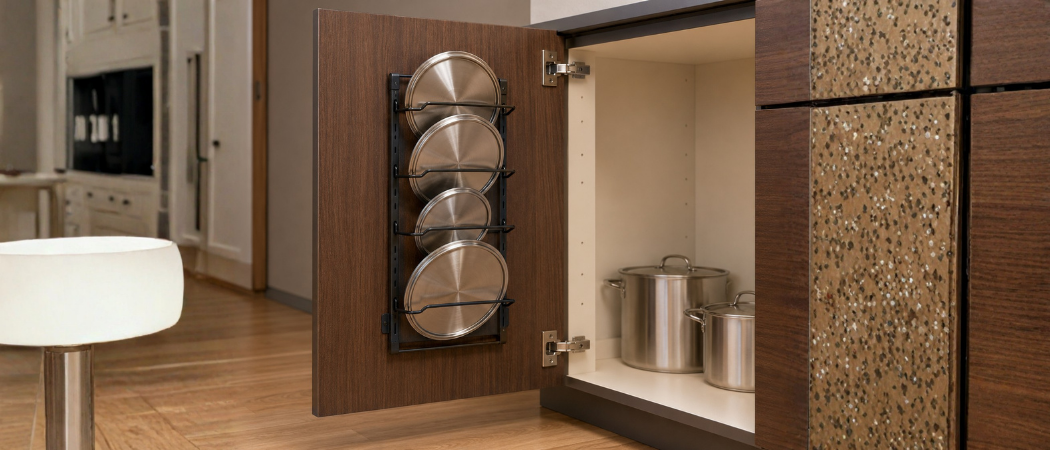
Every kitchen cupboard has an inside door panel that is flat, vertical, and almost always empty. In a small flat kitchen where every centimetre of shelf space is occupied, this surface is the most consistently wasted storage opportunity in the room — present in every cupboard, visible every time a door opens, and almost universally ignored.
Door-mounted organisers add storage without taking space from any existing shelf, without drilling, and without any modification to the kitchen. The total cost of organising every cupboard door in a small flat kitchen is typically under £60.
This guide covers the four most useful types of cupboard door organiser for UK flat kitchens, what to check before buying, and which type works for which cupboard and which contents.
What to Know Before You Buy
- Measure the gap between the door and the nearest shelf edge before buying anything. When an overhead cupboard door closes, the inside of the door passes within a few centimetres of the front edge of the shelf behind it. In most UK flat kitchen overhead cupboards, this gap is between 3 and 6cm. Any organiser mounted on the inside of the door must be shallower than this gap — otherwise the door will not close fully. This measurement takes thirty seconds and eliminates the most common reason door organisers get returned.
- Check the door thickness before choosing an over-door hook product. Most over-door hooks are designed for doors between 16mm and 20mm thick, which covers the majority of UK flat kitchen cupboard doors. Some older kitchens have thicker doors that fall outside this range and require an adjustable hook with a wider opening. Check the door thickness against the product specification before ordering.
- Keep door-mounted storage to lightweight items only. Kitchen cupboard door hinges are not designed to carry significant loads — they support the door itself, not the door plus the contents of an organiser. A practical test: if the loaded organiser would be uncomfortable to carry with one hand, it is too heavy for the door. Spice jars, foil rolls, small pan lids, and cleaning cloths are appropriate. Heavy glass jars, full sauce bottles, and cast iron lids are not.
- Removable adhesive works on smooth surfaces only — and many UK flat kitchen doors are not smooth. Adhesive-mounted rails and hooks require a clean, smooth, painted surface to bond reliably. Textured laminate and wood-grain laminate finishes — both common in UK rental flat kitchens — do not hold adhesive consistently, particularly under the temperature and humidity of an active kitchen. Over-door hooks are more reliable in most UK flat configurations because they do not depend on surface adhesion.
- All products in this guide require no drilling and no permanent modification to the cupboard door. Every organiser here uses either an over-door hook or removable adhesive, and all are fully removable without leaving marks — suitable for renters under standard UK tenancy agreements.
The 4 Best Types of Cupboard Door Organiser for Small UK Flat Kitchens
The four types below address the most common door storage needs in a small flat kitchen. Each is suited to a specific cupboard and a specific category of contents.
Best for Overhead Cupboards — The Over-Door Spice and Jar Rack
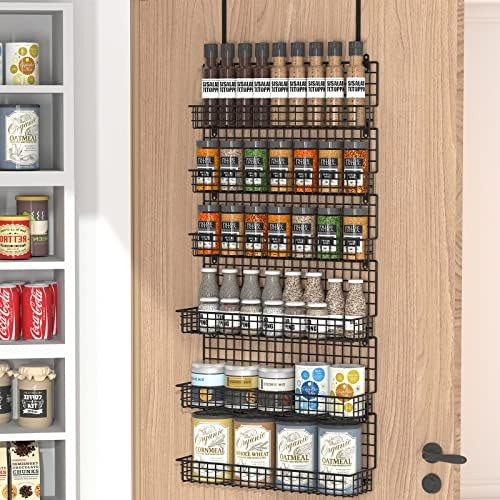
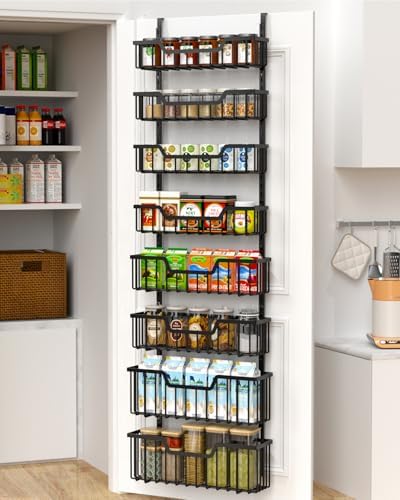
A slim rack that hooks over the top edge of an overhead cupboard door and hangs on the inside face. Most models have two or three tiers, each between 4 and 6cm deep — shallow enough to clear the shelf behind the door when it closes. The purpose is specific: spice jars, small condiment bottles, and sauce sachets are the category of items that most consistently clutter a food cupboard shelf without justifying the space they occupy. Moving them to the door frees an entire shelf section for larger items — tins, cereal boxes, pasta packets — that cannot go anywhere else. No drilling required and the rack lifts off without leaving marks.
Pros:
- The shallow tier depth of 4 to 6cm clears the shelf inside most UK flat overhead cupboards when the door closes — the critical measurement for this type of organiser, and one that most models in this category are specifically designed to meet.
- Hooking over the door top edge requires no drilling, no adhesive, and no surface preparation — it can be installed in under a minute and removed just as quickly when moving out.
- Moving small jars and spice bottles off the food cupboard shelf immediately frees a disproportionate amount of shelf space relative to the cost and complexity of the product.
Cons:
- The weight limit is genuinely low — lightweight plastic spice jars and small bottles only. Heavy glass jars or large sauce bottles put excessive cumulative load on the door hinge and should stay on the shelf.
- Tier depth of 4 to 6cm accommodates small jars and bottles only — anything wider than approximately 6cm will not sit securely on the tiers.
Best for: the overhead food storage cupboard where spice jars and small condiment bottles are occupying shelf space that larger items need.

Best for Base Cupboards — The Over-Door Pan Lid Holder
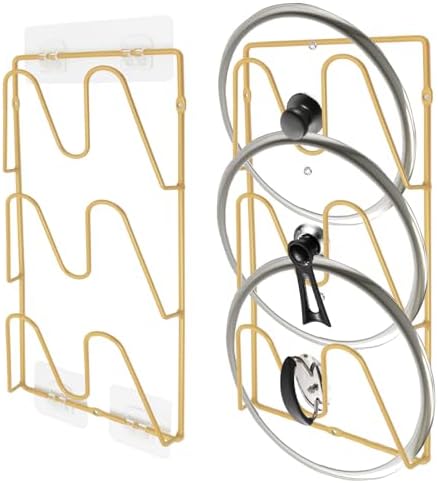
A rack that mounts on the inside of a base cupboard door and holds pan lids vertically rather than flat. Pan lids stored flat on a shelf occupy an entire tier for what is effectively dead space — the lid sits there doing nothing until the matching pan is needed. Stored vertically on a door rack, the same lids take up zero shelf space. Most over-door lid holders use adjustable horizontal bars that accommodate lids of different diameters, which means one rack handles a mixed set without requiring separate solutions for different sizes. The depth constraint is less critical on base cupboard doors than overhead doors, but the weight limit still applies — a full set of heavy lids spread across a single rack pushes the load on the hinge.
Pros:
- Removing pan lids from the shelves entirely frees a full shelf tier in the base cupboard — typically the most valuable storage real estate in the kitchen for items like large pots or a blender that have nowhere else to go.
- Adjustable horizontal bars accommodate lids of different sizes within the same rack, which means the product works across a mixed cookware set without requiring precise sizing before purchase.
- The over-door fixing requires no drilling or adhesive — the rack hooks over the base cupboard door top edge and holds in position under the weight of the lids.
Cons:
- A large set of heavy pan lids — particularly cast iron or thick stainless steel — pushes the cumulative weight the door hinge is designed to support. If the full set is heavy, distribute across two racks rather than loading one.
- The rack protrudes further into the cupboard interior than overhead door racks — check that pots and pans stored inside still clear the rack when the door is closed.
Best for: the base cupboard used for pots and pans, where lid storage is currently consuming a full shelf tier with no better alternative.


Best for the Under-Sink Door — The Over-Door Cleaning Product Caddy
A caddy that hooks over the inside of the under-sink cupboard door and holds cleaning products, cloths, and sponges vertically. The under-sink door is the most useful door in the kitchen for this organiser type — it has the largest panel, the most available depth between the door and the nearest obstacle inside, and the contents it serves are used daily. Moving washing-up liquid, surface spray, and sponges from the cupboard floor to the door places them at the front of the under-sink space, immediately accessible without opening the door fully or reaching to the back. The cupboard floor is then freed for items used less frequently — spare bottles, cloths in rotation, the carrier bag holder.
Pros:
- Daily-use cleaning items placed on the door are accessible immediately when the door opens, without bending to the floor or moving other items out of the way — a meaningful reduction in friction for tasks done multiple times per day.
- The under-sink door has more available depth than overhead cupboard doors, which accommodates taller cleaning product bottles that would not fit on an overhead door rack.
- The over-door fixing requires no drilling and no adhesive — consistent with the renter-friendly approach required across all under-sink solutions.
Cons:
- Some under-sink cupboard hinge configurations position the hinge high on the door panel, reducing the usable panel area below it. Check that the full panel below the hinge line is accessible before buying.
- Cleaning products with pump mechanisms or spray triggers may exceed the tier height on some caddy models — check the product dimensions against the tallest item being stored before purchasing.
Best for: the under-sink cupboard where daily cleaning products currently sit on the floor mixed in with less frequently used items, making both harder to access.

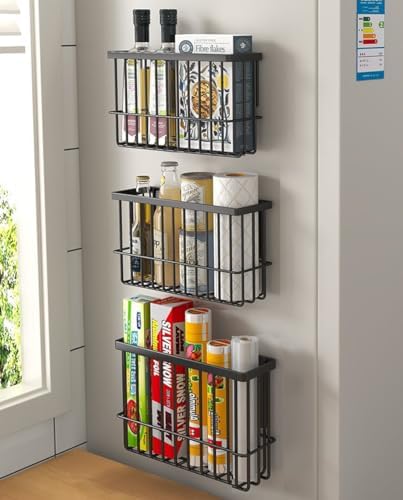

Best for Foil, Cling Film and Bags — The Over-Door Wrap Organiser
A rack designed to hold rolls of foil, cling film, and baking parchment horizontally on the inside of a cupboard door. These items are consistently awkward on a standard shelf — they roll, take up more linear space than their contents justify, and end up at the back of a drawer where the serrated cutting edge damages the box. A door-mounted wrap organiser holds each roll in a dedicated horizontal slot, keeping them accessible and contained without occupying any shelf or drawer space. The profile is typically 5 to 8cm deep, which clears the shelf inside most overhead cupboards when the door closes. The contents are lightweight, so the door hinge weight limit is not a concern. This is a single-purpose product — it solves the specific problem of loose wrap rolls and nothing else — but it solves it completely.
How to Choose the Right Organiser for Each Cupboard Door
Start with the gap measurement. Open each cupboard and measure the distance from the inside face of the door to the front edge of the nearest shelf. This is the maximum depth of any organiser that can be mounted on that door without preventing it from closing. In most UK flat overhead cupboards, this gap is between 3 and 6cm — which limits options to shallow racks only. Base cupboard doors and the under-sink door typically have more clearance, opening up deeper products.
Match the organiser type to the cupboard contents. The overhead food cupboard door takes the spice and jar rack — it addresses the most common source of shelf clutter in that specific cupboard. The base cupboard door used for pots and pans takes the lid holder — it removes the item that most consistently consumes disproportionate shelf space. The under-sink door takes the cleaning caddy — it moves daily-use items to the most accessible point in the cupboard. Any door adjacent to the food prep area is a candidate for the wrap organiser.
Consider the fixing method relative to the door surface. Over-door hooks work on the majority of UK flat kitchen cupboard doors without surface assessment or preparation. Adhesive-mounted products require a smooth, painted surface — textured or wood-grain laminate finishes, common in UK rental kitchens, do not hold adhesive reliably under kitchen conditions. If the door surface is not smooth and painted, choose over-door hooks.
The most effective approach is to address all four cupboard doors together. Organising each door for its specific cupboard contents costs under £60 in total and creates the equivalent of an additional shelf’s worth of storage across the kitchen — without touching a single existing shelf or drilling a single hole. If buying incrementally, start with the overhead food cupboard door: the spice rack delivers the most immediate impact on available shelf space and sets the logic for the rest.
Frequently Asked Questions
Will an over-door organiser prevent my kitchen cupboard door from closing properly?
Only if the organiser is deeper than the gap between the inside of the door and the nearest shelf edge. Measure this gap before buying — for most UK flat overhead cupboards it is between 3 and 6cm, which limits door organisers to shallow racks in that depth range. Base cupboard doors and the under-sink door typically have more clearance and accommodate deeper products. The gap measurement is the single most important check before purchasing any door-mounted organiser.
Can I use adhesive hooks on my kitchen cupboard doors?
It depends on the door surface. Adhesive hooks bond reliably on smooth, clean, painted surfaces. Textured laminate and wood-grain laminate finishes — common in UK rental flat kitchens — do not hold adhesive consistently under kitchen humidity and temperature variation. Over-door hooks are more reliable across a wider range of UK flat kitchen door surfaces because they hook over the door edge and hold in position regardless of the surface finish.
How much weight can I put on a kitchen cupboard door organiser?
Keep door-mounted storage to items that would be comfortable to carry in one hand — small spice jars, lightweight bottles, foil rolls, pan lids for lighter pans. Heavy glass jars, cast iron lids, and dense liquid cleaning products push the cumulative load on the hinge beyond what it is designed for. If the loaded organiser would require two hands to lift, it is too heavy for the door.
Which cupboard door should I organise first in a small kitchen?
The overhead food cupboard door, with a spice and jar rack. Spice jars and small condiment bottles consistently occupy a disproportionate amount of shelf space relative to their size — they fill the front of the shelf and make larger items behind them inaccessible. Moving them to the door immediately frees shelf space for tins, packets, and larger food items. The cost is typically under £15 and the impact on available shelf space is immediate.
Related Guides
Door organisers are one component of the complete kitchen cupboard system. For shelf risers, pull-out trays, turntables, and the full internal organisation of each cupboard, how to organise kitchen cupboards in a small flat covers the approach from the inside out.
The under-sink door caddy works as part of the broader under-sink setup — the pipe position, the two-zone approach, and the full range of products suited to that specific configuration. How to maximise under-sink storage in a small flat covers the complete system.
Conclusion
Every cupboard door in a small kitchen is a storage surface that currently holds nothing. Adding a spice rack to the overhead food cupboard door frees an entire shelf section for larger items at a cost of under £15. Applying the same logic across every cupboard door in the kitchen — matching each organiser to the specific contents of that cupboard — adds the equivalent of a full shelf’s worth of additional storage without modifying a single existing shelf, drilling a single hole, or spending more than £60 in total.