
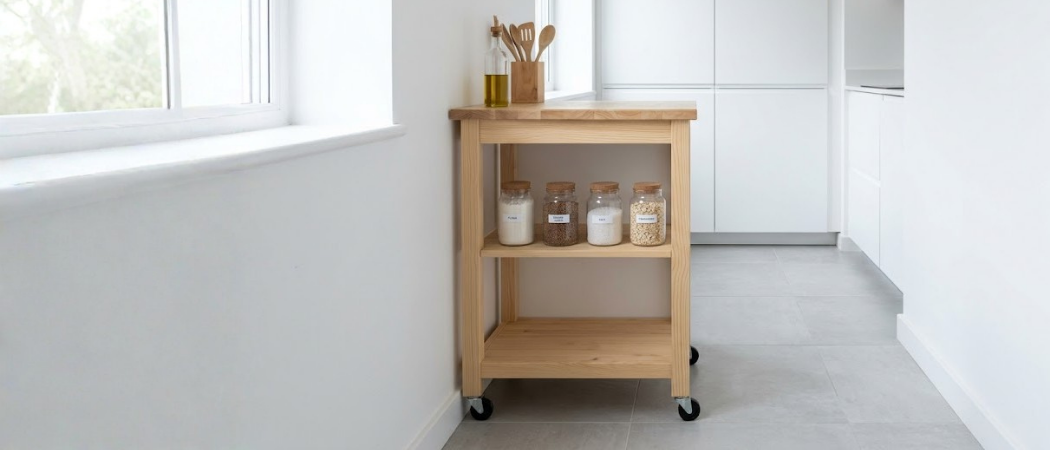
In a small flat kitchen, a trolley is the only way to add both worktop surface and storage without touching the existing kitchen structure. It requires no landlord permission, no installation, and no permanent changes to the property — which makes it one of the few genuinely flexible solutions available to renters.
The problem is choosing the right one. The range available on Amazon UK varies enormously in width, height, weight capacity, and storage configuration — and a trolley that looks suitable in a product image is often too wide for a galley kitchen corridor, too shallow to be useful as a prep surface, or too poorly constructed to hold up under daily use.
This guide covers five types of kitchen trolley suited to small UK flat kitchens, the measurements to take before buying anything, and the specific situations each type works best for.
What to Know Before You Buy
- Width is the critical measurement, and most people underestimate how quickly it becomes a problem. In a galley kitchen, a trolley wider than 40cm will reduce the corridor to less than 90cm of clear passage — which makes the kitchen uncomfortable to use and can create a safety issue in an emergency. Measure the narrowest point of your kitchen corridor before looking at any products, and treat that measurement as the hard constraint everything else works within.
- Height should match the existing worktop as closely as possible. Standard UK kitchen worktops sit at 90cm. A trolley surface at a significantly different height creates an awkward working position that becomes noticeable immediately when using it as a prep extension. Look for a surface height between 85cm and 92cm — most quality kitchen trolleys fall within this range, but it is worth confirming in the product specifications rather than assuming.
- Lockable castors are not optional if the trolley will be used as a prep surface. A trolley without locking castors moves when pressure is applied — which is every time you chop, slice, or press down on the surface. Check that the product description explicitly states lockable castors, not just castors. Many product images show a locking mechanism that is not mentioned in the written specifications, which means it may not be present on the actual unit.
- Weight capacity matters more than it appears in the product listing. A trolley holding a microwave, a kettle, and a full set of condiments is already carrying 15 to 20kg before anything is placed on the worktop surface. Look for a minimum rated capacity of 50kg across the whole unit. Products listed without a weight capacity, or with a capacity under 30kg, are not suitable for a kitchen where the trolley will hold appliances alongside stored items.
- The choice between open shelves and drawers is a habit decision, not an aesthetic one. Open shelves provide faster access with no doors or drawers to navigate, which matters in a kitchen used daily. They also collect grease and dust more quickly than closed storage in an active cooking environment. Drawers and closed cabinets keep contents clean but add a step to every access. The right format is the one that matches how the kitchen is actually used — not how it looks in a product photograph.
The 5 Best Kitchen Trolley Types for Small UK Flat Kitchens
The five types below cover the most common small kitchen situations. Each is matched to a specific space and use-case rather than ranked in order — the right trolley depends on the kitchen configuration and intended use, not on a universal ranking.
Best for Most Small UK Kitchens — The Slim Open-Shelf Trolley
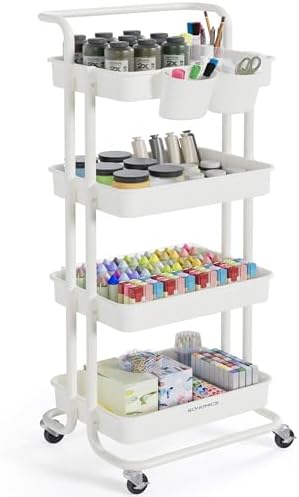
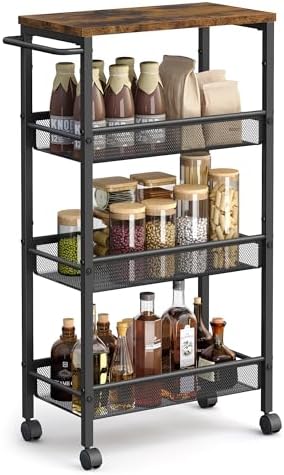
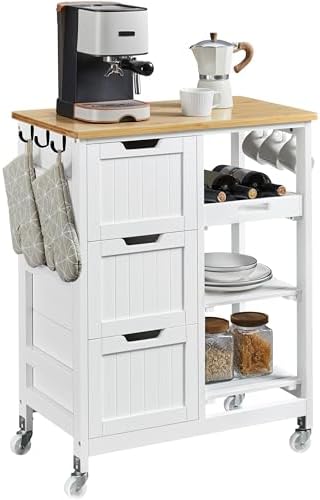
A metal or wood-frame trolley with two or three open shelves, a flat worktop surface, and lockable castors sits at 40cm wide or less, making it the most widely compatible option for UK flat galley kitchens. The open shelf design gives fast, unobstructed access to whatever is stored there, which works well when the trolley is dedicated to a specific category — dry goods, condiments, or a small appliance — rather than used as general overflow. Reliable options in this format are available from VASAGLE and SONGMICS on Amazon UK, both of which produce models in this width range with lockable castors and a worktop surface at standard height.
Pros:
- A width of 40cm or less fits the majority of UK flat galley kitchens without reducing the corridor below 90cm of clear passage, which keeps the kitchen functional alongside the trolley.
- Open shelves allow immediate, unobstructed access to stored items with no doors or drawers to navigate — particularly useful for items reached multiple times per cooking session.
- Lockable castors on quality models in this category keep the trolley stable when used as a prep surface and allow it to be moved easily when the locks are released.
Cons:
- Open shelves collect grease and airborne cooking residue in an active kitchen — items stored on a trolley positioned near the hob will need regular wiping, more frequently than items in a closed cabinet.
- The worktop depth of 40 to 45cm is narrower than a standard kitchen worktop, which limits its usefulness for larger prep tasks but does not affect its value as a supplementary surface for smaller work.
Best for: renters who need additional storage and a supplementary worktop surface in a narrow galley kitchen and want the most widely available, affordable option in the category.

Best for Adding Worktop Space — The Trolley with Wood or Butcher Block Surface
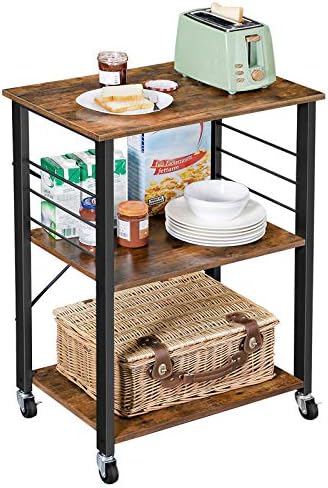
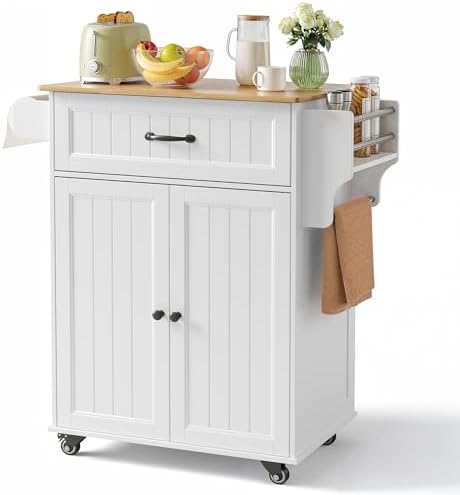
A trolley with a solid wood or butcher block top surface functions differently from a laminate or painted metal surface. Wood is more forgiving as a chopping and prep surface, more resistant to heat from pans placed directly on it, and more durable under the daily contact and moisture of active kitchen use. This type of trolley is typically heavier and priced higher than the slim open-shelf version, but it earns the difference by functioning as a genuine worktop extension rather than primarily as additional storage at worktop height. For renters whose main problem is insufficient prep space rather than insufficient storage, this is the more practical choice.
Pros:
- A solid wood surface functions as a genuine chopping and prep surface rather than just a shelf at the right height — this distinction matters when the trolley is used as a primary prep extension rather than an occasional overflow surface.
- Wood and butcher block surfaces are more resistant to heat, moisture, and daily wear than laminated or painted metal surfaces, which extends the practical lifespan of the trolley under regular kitchen use.
- The warmer visual appearance of a wood surface integrates more naturally alongside existing kitchen units than bare metal frames — relevant in kitchens where the trolley will be permanently positioned in the main sightline.
Cons:
- Solid wood top trolleys are heavier than metal-frame alternatives, which makes repositioning less straightforward even when the castors are unlocked — a consideration if the trolley will be moved regularly between cooking and storage positions.
- A wood surface requires occasional oiling — typically two to four times per year — to maintain condition and prevent cracking in dry or centrally heated environments. This is a minor maintenance requirement but one worth knowing before purchasing.
Best for: renters whose primary problem is insufficient prep surface rather than insufficient storage, and who want a trolley that functions as a genuine worktop extension.


Best for Maximum Storage — The Trolley with Drawers and Closed Cabinet
A trolley with a closed cabinet section, one or two drawers, and a worktop surface provides the highest storage capacity of any trolley type. The enclosed storage keeps contents clean and out of sight, which suits items that accumulate grease or dust on open shelves. The trade-off is width — this type typically runs 50 to 60cm wide, which puts it outside the usable range for narrow UK galley kitchens. In a kitchen with a wider corridor, an open-plan layout, or a position at the end of a run of units where width is less constrained, it functions effectively as a freestanding kitchen unit that significantly extends the available storage without permanent installation.
Pros:
- Drawers and a closed cabinet keep contents clean and protected from cooking grease and airborne dust — more appropriate than open shelves for items that would require frequent wiping if stored in the open in an active kitchen.
- The storage capacity of a drawer-and-cabinet trolley is significantly higher than an open-shelf model of similar dimensions, making it the most effective option when additional storage rather than additional surface is the priority.
- A worktop surface at standard height functions as a prep extension alongside the storage, covering both problems simultaneously in a kitchen with enough corridor width to accommodate the unit.
Cons:
- A width of 50 to 60cm reduces the corridor in a standard UK galley kitchen below the 90cm clear passage guideline — this type is not suitable for narrow galley layouts and should only be considered in wider or open-plan kitchens.
- The increased weight from the cabinet structure and drawer mechanisms makes this trolley significantly less mobile than open-shelf alternatives, even with castors — repositioning requires more effort and is less practical for daily adjustment.
Best for: renters in kitchens with a wider corridor or open-plan layout who need maximum additional storage capacity and have the floor space to accommodate a wider unit.

Best for Very Small Kitchens — The Mini Trolley Under 35cm Wide
A compact trolley of 30 to 35cm in width fits in kitchens where a standard 40cm trolley would reduce the corridor too significantly. Most models have two shelves and a small worktop surface — not large enough to function as a meaningful prep surface extension, but effective as a dedicated zone for a single category. A tea and coffee station, a condiment and oil zone, or a base for a small appliance that does not fit on the main worktop — these are the use-cases where a mini trolley earns its position in the kitchen. Available in both metal and wood-frame versions from several brands on Amazon UK, with prices typically at the lower end of the trolley category.
Pros:
- A width of 30 to 35cm fits in kitchens where the corridor measurement after subtracting 90cm of clear passage leaves less than 40cm available — extending the usable range to kitchens that cannot accommodate a standard trolley at all.
- As a dedicated single-category zone — tea station, condiment storage, small appliance base — it adds genuine function to the kitchen without the compromise of being used as general overflow storage.
- The lower weight and smaller footprint make it the easiest trolley type to reposition, clean around, and move between the kitchen and adjacent spaces when needed.
Cons:
- The worktop surface on a 30 to 35cm wide trolley is too narrow to function as a useful prep surface extension — this type solves a storage problem, not a worktop problem, and should be chosen with that distinction in mind.
- Storage capacity is limited to two shelves in most models, which means the trolley works only as a supplement to the existing kitchen storage rather than as a meaningful addition to it.
Best for: renters in very small kitchens where the corridor measurement rules out a standard 40cm trolley, and where a dedicated single-category zone would address a specific storage gap.
Best for Open-Plan Flats — The Trolley with Breakfast Bar Extension
A trolley with a fold-out or fixed extension on one side adds a seating surface for one or two people at the boundary between the kitchen and living area. In a studio flat or open-plan layout where a separate dining table is not feasible, this extension replaces the function of a dining surface without requiring a dedicated piece of furniture. The fold-out design keeps the base unit footprint manageable when the extension is not in use — it folds flat against the trolley body and does not project into the kitchen corridor. When extended, it provides a usable surface for eating, working, or additional prep.
Pros:
- Solving two problems simultaneously — additional kitchen storage and a dining or eating surface — makes this the most space-efficient trolley type for studio flats where every piece of furniture needs to justify multiple functions.
- The fold-out extension stores flat when not in use, reducing the trolley’s effective footprint to the base unit width and keeping the kitchen corridor clear during cooking.
- Positioned at the boundary of a kitchen and living area, this trolley type also functions as a visual divider between the two zones — relevant in studio flats where the kitchen and living space share a single room.
Cons:
- The base unit width of 45 to 55cm before the extension is included puts this type outside the usable range for narrow UK galley kitchens — it is suitable only for open-plan layouts where the trolley can sit at the edge of the kitchen zone rather than within the cooking corridor.
- The added complexity of a fold-out mechanism and the typically larger overall dimensions place this at the higher end of the trolley price range, which requires a clearer case for the dining surface function to justify the cost.
Best for: renters in studio flats or open-plan layouts who need both additional kitchen storage and a dining or eating surface, and have the floor space to position the trolley at the kitchen boundary.
How to Choose the Right Trolley for Your Kitchen
Start with the corridor width. Measure the narrowest point of the kitchen — in a galley kitchen, this is typically between the base units on one side and the wall or units on the other. Subtract 90cm from that measurement. The remaining figure is the maximum trolley width that keeps the corridor clear for safe movement. In most UK flat galley kitchens with a corridor of 100 to 120cm, this leaves 10 to 30cm of trolley width — which means only the slim open-shelf or mini trolley are appropriate options. In a kitchen with a wider corridor of 130cm or more, the drawer-and-cabinet version becomes viable.
Once the maximum width is established, consider the primary use. If the kitchen’s main shortage is worktop space — not enough surface for prep — the wood surface trolley addresses this most directly, provided the width constraint allows it. If the main shortage is storage — not enough cupboard capacity for the items that need a home — the open-shelf trolley or drawer-and-cabinet version is more relevant. If the kitchen is too narrow for either standard option, the mini trolley as a dedicated single-category zone is the practical solution within the width constraint.
Then consider the floor surface. Ceramic tile and vinyl — the most common kitchen floor finishes in UK flats — work with both standard and rubber castors without issue. Wooden or laminate flooring, more common in open-plan kitchen-living spaces, requires rubber castors specifically to avoid marking the surface over time. Check the castor specification in the product listing before purchasing — this detail is often listed under materials or assembly notes rather than in the headline specifications.
The placement decision is as important as the product decision. A trolley that has a fixed position and a fixed purpose functions as a genuine addition to the kitchen. A trolley that moves constantly and holds random items becomes clutter on wheels within a few weeks — the same problem that prompted the purchase, now with castors. Decide where the trolley will live and what category of items it will hold before buying. That decision determines the width, the storage type, and the surface material needed — and it prevents the purchase from solving the wrong version of the problem.
Frequently Asked Questions
What width kitchen trolley do I need for a small UK flat kitchen?
Measure the narrowest point of the kitchen corridor and subtract 90cm — this is the maximum trolley width that keeps the passage clear. In most UK flat galley kitchens with a corridor between 100 and 120cm, this leaves room for a trolley of 40cm or less. The slim open-shelf trolley and the mini trolley under 35cm are the appropriate options for most UK galley kitchens. The drawer-and-cabinet version at 50 to 60cm wide is only suitable for wider corridors or open-plan layouts.
Can a kitchen trolley replace a kitchen island in a small flat?
Functionally, yes — for most of the purposes a fixed island serves. A trolley with lockable castors and a solid surface provides additional prep space and storage in the same way a fixed island does, and it can be repositioned when needed. The practical limitations compared to a fixed island are depth — most trolleys are 40 to 45cm deep versus a standard island at 60cm or more — and stability under heavy use, where a fixed island will always outperform a unit on castors. For renters who cannot install a fixed island, a quality trolley with locking castors is the closest equivalent available.
Do kitchen trolley castors damage kitchen floors?
Rubber castors are safe on all standard kitchen floor surfaces including ceramic tile, vinyl, wood, and laminate. Hard plastic castors can mark soft flooring — particularly vinyl and laminate — when the trolley is moved repeatedly across the same paths. Check the castor material in the product specification before purchasing. If the listing does not specify rubber castors and the kitchen has vinyl or laminate flooring, it is worth contacting the seller to confirm before ordering.
Is a kitchen trolley worth it in a very small kitchen?
It depends on the corridor width and the intended use. In a kitchen where the corridor leaves 35cm or more after the 90cm clearance is subtracted, a mini trolley at 30 to 35cm wide adds a useful dedicated zone — a tea station, a condiment zone, or a small appliance base — without blocking movement. In a kitchen where the corridor leaves less than 30cm, a trolley of any size creates a movement problem that outweighs the storage benefit. In that case, vertical solutions — over-door racks, cupboard door organisers, and shelf risers — are more appropriate than a floor-standing unit.
Related Guides
A kitchen trolley works best as part of a broader kitchen system rather than as a standalone solution. For the complete zone-based approach to a small flat kitchen — including worktop management, cupboard allocation, and how each category of item gets a fixed home — how to organise a small kitchen with limited cupboard space covers the full picture before the products.
The choice between an open-shelf trolley and one with drawers and a closed cabinet follows the same logic as the broader storage format decision. Open shelving vs closed cabinets in small kitchens covers the criteria for deciding which format suits a specific kitchen and set of habits.
Conclusion
A kitchen trolley is the most practical single addition to a small UK flat kitchen — it adds both surface and storage without touching the existing kitchen structure or requiring any landlord permission. The right choice comes down to three measurements taken before looking at any products: corridor width, which determines the maximum trolley width; worktop height, which determines whether the surface will function as a genuine prep extension; and weight capacity, which determines whether the unit is structurally suited to daily kitchen use. Everything else is secondary to getting those three numbers right.