
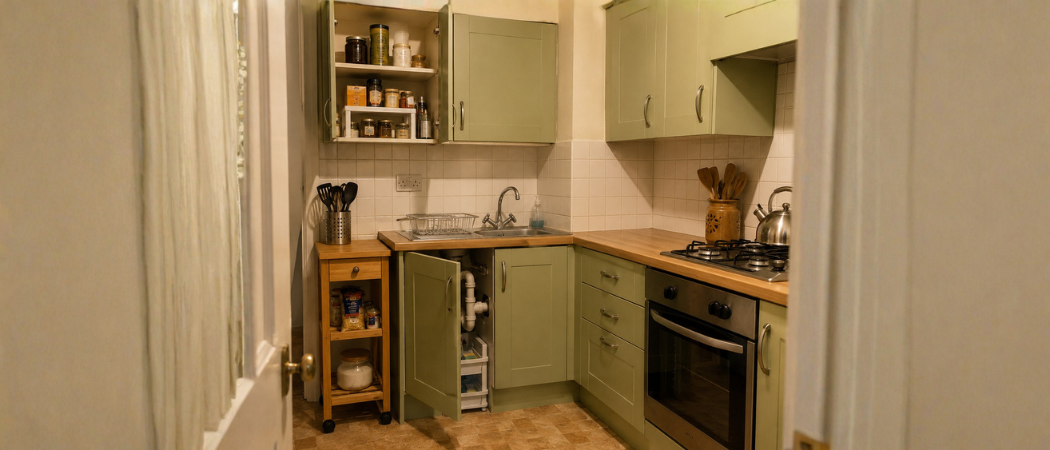
The problem in a small flat kitchen is rarely a shortage of cupboard space. It is a shortage of structure. The same physical space, organised correctly with the right products, stores significantly more than it does when items are placed wherever they fit. The difference between a kitchen that works and one that does not is almost always a question of system, not square footage.
This guide covers the five most effective product categories for small flat kitchen storage — the solutions that address the most common structural problems in UK flat kitchens, across every zone from the overhead cupboards to the under-sink area. Each category is matched to a specific problem, with clear guidance on what to look for and what to avoid.
Products are introduced where they solve an identified problem. For readers who want the full system before the products, how to organise a small kitchen with limited cupboard space covers the zone-based approach in detail.
What to Know Before You Buy
- The audit comes before the product. Buying storage products before emptying and assessing the kitchen is the most common reason reorganisations fail within weeks. The audit identifies what actually needs storing, how much space is genuinely available, and which problem each product needs to solve. Without it, products are chosen for the wrong problem.
- Every solution in this guide is renter-friendly. Nothing here requires drilling, permanent adhesive, or structural modification to the kitchen. All products are freestanding, over-door, or removable — suitable for UK renters under standard assured shorthold tenancy agreements.
- Measure before buying anything. UK flat kitchens have specific constraints that standard storage products are not designed for: overhead cupboards 30–35cm deep, base cupboards 50cm deep, under-sink cupboards with a central pipe reducing usable width. The right product for a UK flat kitchen is the one that fits the actual available space — not the standard cupboard dimensions listed in the product description.
- One zone, one product category. The most effective storage setups assign one product type to one zone — shelf risers for overhead cupboards, pull-out trays for base cupboards, adjustable caddies for under-sink. Mixing categories within the same product type creates the same disorganisation the products were bought to fix.
- Maintenance holds the system together. A well-chosen set of storage products lasts indefinitely if items are returned to their zone after use. Without a return-to-zone habit, even the best products lose their effectiveness within a few weeks.
The 5 Best Kitchen Storage Product Categories for Small Flats
The five categories below cover the most common structural problems in small UK flat kitchens. Each category is matched to a specific zone and a specific problem — not ranked in order of importance, because the right priority depends on which problem is most acute in the individual kitchen.
Best for Overhead Cupboards — Shelf Risers and Internal Shelf Structure
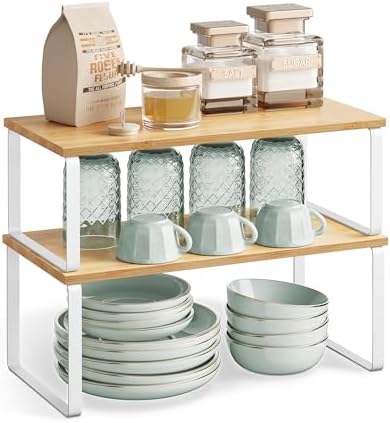
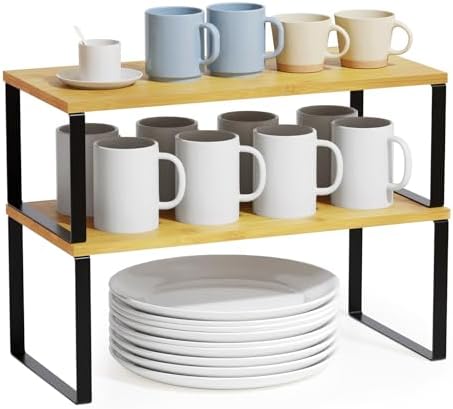
The standard overhead cupboard in a UK flat has one fixed shelf, dividing the interior into two zones. In most kitchens, the bottom zone is overcrowded and the top zone is underused — items are stacked rather than layered, and the space above the bottom stack goes to waste. A shelf riser placed inside the lower zone creates a third level within the existing cupboard, roughly doubling the usable volume without any modification. Tins on the base, smaller jars on the riser above them. Plates on the base, bowls on the riser. The same footprint, used twice.
Shelf risers are freestanding, require no tools, and leave no marks — making them the most straightforward renter-friendly addition to any overhead cupboard. For the food storage cupboard specifically, combining a shelf riser with a rotating turntable on the upper shelf covers both the vertical space problem and the depth problem simultaneously. The guide to how to organise kitchen cupboards in a small flat covers the full range of internal cupboard solutions in detail.
Pros:
- Creates a genuine additional storage level within an existing cupboard at a cost of under £20, without modifying any surface or requiring landlord permission.
- Freestanding and fully removable — can be repositioned between cupboards as the zone allocation evolves, or taken when moving out.
- Works in every overhead cupboard regardless of what is being stored — the same product applies to the food cupboard, the cookware cupboard, and the crockery cupboard.
Cons:
- Does not solve the depth problem — items at the back of the cupboard remain difficult to reach without a turntable or pull-out tray used alongside it.
- Fixed height on most models means the riser may not accommodate taller items on the lower level — check the riser height against the tallest item being stored beneath it before purchasing.
Best for: any overhead cupboard where the bottom zone is overcrowded and the vertical space above the items on the shelf is going unused.

Best for Base Cupboards — Pull-Out Trays and Turntables
Base cupboards in UK flat kitchens are 50cm deep — significantly deeper than overhead cupboards — and items pushed to the back become effectively inaccessible. The standard response is to unpack the entire cupboard to reach one item at the back, which is why base cupboards return to disorder faster than any other storage area in a small kitchen. A pull-out tray on castors brings the full depth of the cupboard forward in one movement. A turntable on the base shelf rotates the back of the cupboard to the front. Both solutions make the full depth usable without requiring any modification to the unit.
The choice between the two depends on what is being stored. Pull-out trays suit pots, pans, and larger items where the full base of the cupboard is needed. Turntables suit condiments, tins, and jars where items are smaller and the rotation motion is sufficient to bring them within reach. In cupboards where a boiler or water heater at the back reduces the usable depth, a turntable is typically more practical than a pull-out tray — the reduced depth limits how far a tray can travel, which limits its usefulness.
Pros:
- Makes the full depth of a base cupboard accessible without unpacking — the single most common and most avoidable base cupboard problem in small flat kitchens.
- Both pull-out trays and turntables are freestanding and require no installation — they sit on the cupboard floor and function immediately.
- Significantly reduces the time spent locating items in a base cupboard under daily use, which is the practical measure of whether a storage product is earning its place.
Cons:
- Pull-out trays require sufficient usable depth to function — a tray in a cupboard with less than 35cm of usable depth provides little benefit over a static organiser.
- Turntables are sized for specific shelf diameters — measure the cupboard width and the available zone before purchasing to confirm the turntable fits without overhanging the shelf edge.
Best for: base cupboards where items at the back are routinely inaccessible and the reorganisation cycle repeats every few weeks without resolving the underlying problem.
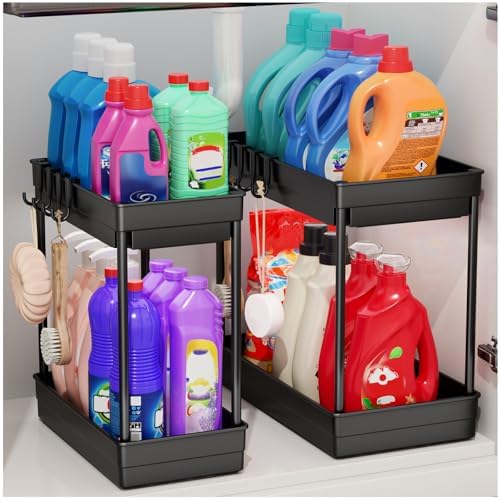
Best for Under-Sink Cupboards — Adjustable Caddies and Two-Tier Shelves
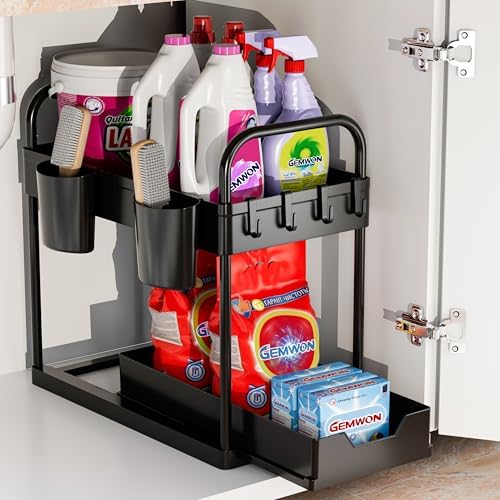
The under-sink cupboard is the most structurally constrained storage area in a small flat kitchen. The waste pipe and siphon reduce the usable width to two separate zones on either side of the pipe, the siphon sits at mid-height and limits organiser height directly beneath it, and many UK flat kitchens have a boiler or water heater at the back that reduces usable depth. Standard organisers bought without accounting for these constraints will not fit. The products that work are those designed specifically for this configuration — adjustable-width caddies that fit within one zone rather than spanning the full cupboard width, and two-tier shelves with an adjustable centre leg that clears the siphon.
For most UK flat under-sink cupboards, an adjustable caddy in the main zone and a door-mounted carrier bag holder on the inside of the cupboard door covers both the storage problem and the clutter problem for under £30. The full guide to best under-sink organisers for small kitchen flats covers the specific measurements to take before buying and the products that work within them.
Pros:
- Adjustable-width caddies fit around the pipe position rather than requiring a specific layout — the most practical starting point for a cupboard configuration that varies between kitchens.
- A two-tier shelf with an adjustable centre leg doubles the vertical storage capacity of the main under-sink zone without touching the pipe or requiring any modification.
- Both products are fully freestanding and renter-friendly — no drilling, no permanent fixings, no marks when removed.
Cons:
- Requires more precise measurement before buying than most other storage products — usable zone width, siphon clearance height, and usable depth all need to be confirmed before selecting a specific product.
- The combination of pipe constraints and boiler position means that some under-sink cupboards have very limited usable space regardless of the products chosen — the audit and measurement process establishes realistic expectations before any money is spent.
Best for: any renter whose under-sink cupboard is currently a disorganised mix of cleaning products and carrier bags with no clear system for either.

Best for the Worktop — Freestanding Shelf Units and Kitchen Trolleys
The worktop is the most valuable surface in a small flat kitchen and the one most consistently reduced by items that have nowhere else to go. A freestanding shelf unit on the worktop creates a second tier above the surface — oils, spices, and frequently used jars move to the shelf, the worktop below stays clear for prep. A kitchen trolley alongside the existing units adds both a worktop extension and additional storage below it, without touching the existing kitchen structure.
The trolley is the highest-impact single addition available to a small flat kitchen — it adds surface and storage simultaneously and requires no landlord permission. The critical measurement is corridor width: in a UK flat galley kitchen, a trolley of more than 40cm wide reduces the corridor below 90cm of clear passage. The full buying guide is covered in best kitchen trolleys for small apartments, including the five trolley types suited to different kitchen configurations and budgets.
Pros:
- A kitchen trolley adds both worktop surface and storage in a single footprint — the only product category in this guide that solves two distinct problems simultaneously.
- A freestanding worktop shelf costs under £20 and immediately increases the usable worktop area by lifting smaller items off the flat surface without taking floor space.
- Both solutions are fully removable and renter-friendly — no permanent installation and no modification to the existing kitchen.
Cons:
- A kitchen trolley requires a corridor width assessment before purchase — in a galley kitchen with a corridor under 130cm, only slim trolleys of 40cm or less are appropriate.
- A worktop shelf reduces the usable worktop width by its own footprint — position it at one end of the worktop run rather than in the centre to keep the main prep area clear.
Best for: renters whose worktop is permanently covered with items that have no other home, reducing the usable prep area below what the kitchen needs to function comfortably.
Best for Cupboard Doors — Over-Door Racks and Organisers
Every cupboard door in a small kitchen is a flat, vertical storage surface that is almost always empty. Over-door racks add storage without taking space from any existing shelf, without drilling, and at a cost of under £15 per door. The four most useful door organisers for a small flat kitchen are a spice and jar rack for the overhead food cupboard door, a pan lid holder for the base cupboard door, a cleaning caddy for the under-sink door, and a wrap organiser for foil and cling film. Together they cover every zone in the kitchen and add the equivalent of a full shelf’s worth of storage across the kitchen for under £60 total.
The critical measurement before buying any door organiser is the gap between the inside of the door and the nearest shelf edge when the door is closed. In most UK flat overhead cupboards, this is 3 to 6cm — which limits door organisers to shallow racks in that depth range. The complete guide to best cupboard door organisers for small kitchens covers what to measure and which products fit the standard UK flat kitchen door configuration.
Pros:
- Adds storage to a surface that currently holds nothing — the highest ratio of storage gained to money spent of any product category in this guide.
- No drilling and no adhesive required for over-door hook models — fully renter-friendly and removable without marks.
- Each organiser solves a specific problem for a specific cupboard rather than adding general storage — which means the impact on available shelf space is immediate and measurable.
Cons:
- The gap between the door and the shelf is the hard constraint — an organiser that exceeds this measurement will prevent the door from closing, which is the most common reason door organisers get returned.
- Weight limit is a genuine restriction — door hinges are not load-bearing in the same way as shelf brackets, and overloading a door organiser puts stress on the hinge over time.
Best for: any renter who has maximised the internal shelf space in their kitchen cupboards and is looking for additional storage without taking floor space or shelf space.
How to Choose the Right Products for Your Kitchen
Start with the problem, not the product. The five categories above each address a specific structural issue — overhead cupboard volume, base cupboard depth, under-sink configuration, worktop coverage, and door surface use. Identifying which of these problems is most acute in the specific kitchen determines which product to prioritise.
For most small UK flat kitchens, the highest-impact sequence is: shelf riser in the overhead food cupboard first, adjustable caddy under the sink second, and a door rack on the overhead food cupboard door third. These three changes cost under £50 in total and address the three most common sources of wasted space in a small kitchen — the unused vertical space in overhead cupboards, the disorganised under-sink area, and the empty door panels.
A kitchen trolley is the right next step for kitchens where the worktop is genuinely insufficient — where there is not enough surface for prep even after the overhead cupboards are properly structured and the worktop has been cleared of items that belong elsewhere. It is not the right first step, because it adds surface and storage to a kitchen that has not yet been structured around the existing space.
Measure before buying in every category. UK flat kitchens have specific dimensions — overhead cupboard depth, base cupboard depth, under-sink usable zone widths, door-to-shelf gap — that determine which products will actually fit. A product bought without these measurements is a guess. All five measurements relevant to this guide can be taken in under ten minutes with a tape measure.
Frequently Asked Questions
What is the single most effective storage product for a small flat kitchen?
A shelf riser in the overhead food cupboard. It costs under £20, requires no tools, leaves no marks, and doubles the usable volume of the cupboard’s lower zone immediately. For kitchens where the worktop is the primary constraint rather than the cupboards, a slim kitchen trolley of 40cm or less delivers the highest impact — but it requires a corridor width assessment before purchase that the shelf riser does not.
Can I significantly increase kitchen storage without drilling anything?
Yes. Every product category in this guide is freestanding or over-door — no drilling, no permanent adhesive, no modification to any surface. Shelf risers, turntables, pull-out trays, adjustable under-sink caddies, kitchen trolleys, and over-door racks are all fully renter-friendly. The total cost of addressing every zone in a small flat kitchen with these products is typically under £100.
How do I know which storage problem to fix first?
Identify which part of the kitchen causes the most friction in daily use. If finding items in the food cupboard requires moving everything on the shelf, a shelf riser is the priority. If the under-sink cupboard is inaccessible, the adjustable caddy comes first. If the worktop is always covered and prep space is consistently insufficient, the trolley is the most urgent addition. Fix the problem that slows down the kitchen most — not the one that looks worst.
Do kitchen storage products make a real difference in a very small kitchen?
The difference is proportional to how poorly the existing space is configured. A small kitchen with no internal structure in its cupboards, an unused under-sink area, and empty door panels is using a fraction of its available storage volume. Adding the right products to those three areas consistently doubles the effective storage capacity of the kitchen without changing its physical dimensions. The impact is most significant in the kitchens that need it most.
Related Guides
For the complete zone-based system before the products — audit, zone allocation, worktop management, and maintenance — how to organise a small kitchen with limited cupboard space covers the full approach.
For specific guidance on internal cupboard organisation — shelf risers, pull-out trays, vertical pan storage, and turntables — how to organise kitchen cupboards in a small flat goes into detail on each product type and how to use it within a standard UK flat kitchen cupboard.
The under-sink cupboard has its own dedicated system guide: how to maximise under-sink storage in a small flat covers the pipe and siphon configuration, the two-zone approach, and the products that work within the specific constraints of a UK flat kitchen.
For the full range of door organiser options — including what to measure before buying and which organiser suits which cupboard — best cupboard door organisers for small kitchens covers every door in the kitchen.
For kitchen trolley options across five configurations — slim open-shelf, wood surface, drawer and cabinet, mini, and breakfast bar extension — best kitchen trolleys for small apartments covers the corridor width assessment and product selection in detail.
Conclusion
A small flat kitchen works when every zone has the right structure — not when it has more products. The overhead cupboards need internal vertical structure. The base cupboards need solutions that make the full depth accessible. The under-sink area needs products designed for the pipe configuration. The worktop needs to be cleared of items that belong in cupboards. The door panels need to be used. Addressing each of these in the right sequence, with the right measurements taken first, transforms the available space without changing its dimensions.