
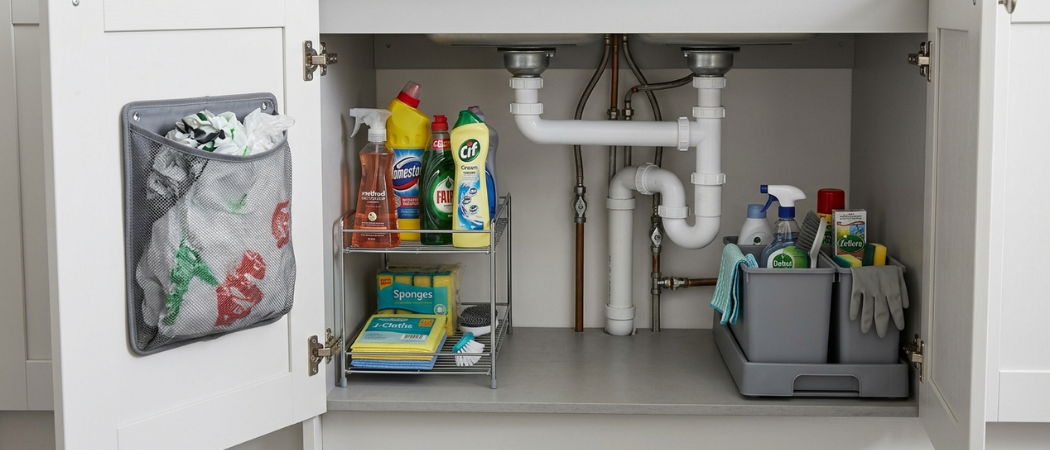
The under-sink cupboard in a small kitchen is the most consistently wasted storage area in the flat. Not because it is too small to be useful, but because it has no internal structure — so everything gets pushed in without a system, and the door gets closed before anyone has to think about it.
The pipes and siphon that make this space look awkward are actually predictable obstacles. Their position, height, and footprint are fixed — which means they can be measured, planned around, and worked with using products that cost under £30 and require no tools, no drilling, and no landlord permission.
This guide covers the full process: starting with an audit of what is currently in the cupboard, working through the measurements that determine what will actually fit, allocating zones based on how often items are used, and adding the right structure to make the space function reliably.
Start with a Full Audit
Before anything else, pull everything out of the cupboard and place it on the floor. This is not optional — reorganising around existing contents is how systems fail within a few weeks. You need to see everything that is in there before making any decisions about what should stay.
Once everything is out, group it by category. Cleaning products together, cloths and sponges together, carrier bags together, and a separate pile for anything that does not have an obvious category. That last pile is usually larger than expected and tends to contain things that have no business being under the sink at all — random cables, takeaway condiments, things that were placed there temporarily and never moved.
Go through the cleaning products specifically. Bottles accumulate under sinks faster than anywhere else in a flat. Half-empty duplicates, products that have been replaced, sprays with no labels — these should be disposed of properly rather than returned to the cupboard. An expired or near-empty bottle takes up the same space as a full one and contributes nothing.
What you are left with after the audit is the actual inventory that belongs under the sink. Everything else either goes elsewhere in the flat, gets used up and not replaced, or goes in the bin. The principle that governs this space going forward is straightforward: the under-sink cupboard is for cleaning supplies and directly associated items. It is not general overflow storage for the kitchen, and treating it as such is what fills it up in the first place.
Understand Your Space Before Buying Anything
This is the section that most people skip — and the reason most under-sink organisers end up being returned or sitting unused. Measuring the cupboard opening is not the same as measuring the usable space inside it. In a UK flat kitchen, these numbers are often significantly different.
Measure the actual usable width
The internal width of a standard UK base unit under the sink is 60cm. That is not what you have to work with. The waste pipe and siphon occupy the central section of the cupboard — typically 15 to 20cm of width — and they cannot be moved. What you actually have is two separate usable zones: one on each side of the pipe.
Measure each zone separately. Put a tape measure on the cupboard floor, start from the left internal wall, and measure to the nearest edge of the pipe. Write that number down. Then measure from the right edge of the pipe to the right internal wall. These are your two working widths. In most UK flat kitchens, one zone will be wider than the other depending on where the pipe exits the wall. Do not assume symmetry.
Any product you buy needs to fit within one of these two zone measurements — not the full 60cm cupboard width. This is the single most common reason under-sink organisers do not fit.
Account for the siphon height
The siphon — the curved section of pipe that connects the sink drain to the waste pipe — sits at mid-height in most UK under-sink cupboards. Its bottom edge is typically between 20cm and 30cm from the cupboard floor, though this varies depending on the sink height and pipe routing.
Measure the clearance from the cupboard floor to the lowest point of the siphon. This is the maximum height for any organiser placed directly underneath it. A standard two-tier shelf unit will not fit under most UK flat siphons unless it has been specifically designed with an adjustable centre leg that clears the pipe. Regular shelf units bought without checking this measurement are the second most common reason under-sink products get returned.
Check the depth
The internal depth of a UK base unit is typically around 50cm. Under the sink, this is often reduced by the position of the boiler, the water heater, or the way the waste pipe exits at the back wall. Measure from the inside face of the cupboard door — when closed — to the nearest obstacle at the back of the space. In some UK flat kitchens, particularly in older buildings, this usable depth can be as little as 35cm.
This measurement determines whether a pull-out or wheeled caddy is practical. If the usable depth is under 40cm, a pull-out system has limited benefit — there is not enough depth for items to be genuinely out of reach without it.
The two-zone approach
The most effective way to organise a UK flat under-sink cupboard is to treat it as two separate storage areas rather than one open space. The zone to the left of the pipe and the zone to the right are effectively independent — they have different widths, potentially different heights due to siphon position, and different accessibility depending on which side the cupboard opens from.
Organising each zone with its own dedicated purpose is more practical than trying to span the full width with a single large organiser. It also means that if one zone needs to change — because you add a product category, or a pipe needs access — the other zone is not disrupted.
Decide What Goes Where
Once you have the measurements and understand the two zones, the next step is to allocate what goes in each one before adding any products. This decision should be based on frequency of use, not on which items fit where.
Zone A — the larger zone, or the one nearest the door opening — is for daily-use items. Washing-up liquid, dishwasher tablets, surface spray, sponges, and cloths that are currently in rotation belong here. These are the items you reach for every day, sometimes multiple times, and they should be at the front of the cupboard without requiring you to bend fully inside to reach them.
Zone B — the smaller zone, or the one further from the door — is for items used weekly or less. Spare bottles of cleaning products, a second surface spray, replacement sponges, larger containers of washing-up liquid bought in bulk. These do not need to be at arm’s reach; they just need to be accessible when needed and stored without being in the way of daily items.
The carrier bag problem deserves specific attention. Carrier bags are the single item most likely to expand and fill any available under-sink space, because they are lightweight, compressible, and easy to push into gaps. Without a fixed container for them, they take over. They need their own dedicated holder — a bag specifically designed for this purpose that mounts on the inside of the cupboard door or sits in a defined corner of one zone. Once the holder is full, bags go to recycling rather than into the cupboard.
Add Structure Without Drilling
With zones allocated and measurements confirmed, the right products become straightforward to identify. Each one addresses a specific structural problem in the space.
Adjustable-width under-sink caddy. An extendable caddy is designed to sit within one zone of the cupboard — not span the full width. Most models extend between 34cm and 57cm, which covers the typical zone widths found in UK flat under-sink cupboards. The open design means it does not block the siphon, and the extension mechanism lets you fit it snugly to the available width without gaps. Check current options on Amazon.


Stackable two-tier shelf with adjustable centre leg. A shelf unit specifically designed for under-sink use has an adjustable leg in the centre that raises the upper tier high enough to clear the siphon. This doubles the vertical storage capacity of the zone it sits in without touching the pipe. Look for models where the leg height adjustment goes below 20cm, which ensures it will clear most UK flat siphons. See current price on Amazon.
[AFFILIATE LINK — two-tier under-sink shelf
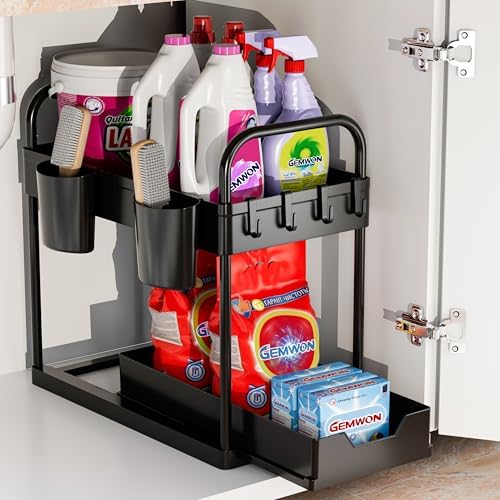
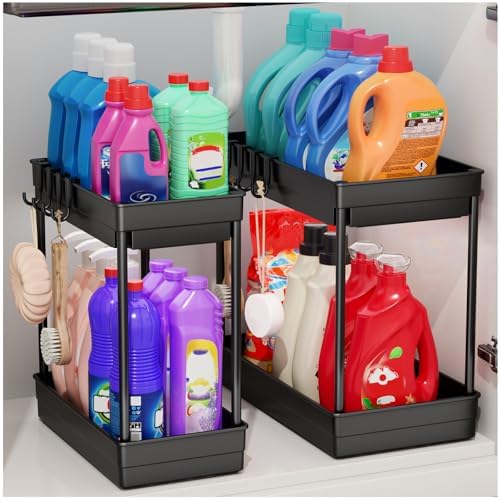

Pull-out caddy on castors. In cupboards where the usable depth is over 40cm, a small caddy on wheels lets you pull the entire contents of one zone out in a single motion. This is particularly useful if items at the back are obscured by the pipe or if the boiler reduces the accessible depth on one side. Confirm the caddy depth against your usable depth measurement before purchasing. View on Amazon.


The Maintenance System
A reorganised under-sink cupboard without a maintenance routine typically reverts to its original state within three to four weeks. The items gradually drift from their zones, empty bottles accumulate, and carrier bags reappear in corners. The solution is not a deep clean every month — it is a small number of consistent habits that keep the system functioning.
The most effective habit is the simplest: every item goes back to its zone immediately after use, not to the nearest available spot. A surface spray that gets used at the kitchen counter goes back under the sink in Zone A before anything else happens. This takes three seconds and prevents the gradual drift that undoes the system.
Once a month, a quick check of the full contents is enough to catch drift before it becomes a problem. Pull everything out, identify any empty or near-empty bottles and dispose of them, and confirm that items are still in their correct zones. This check takes about five minutes and resets the system to its baseline.
For cleaning products specifically, a one-in-one-out rule prevents the most common form of under-sink overcrowding. A new bottle of surface spray goes under the sink when the existing one is empty — not when it is running low, and not as a precaution because it was on offer. Bulk buying cleaning products and storing all of them under the sink simultaneously is one of the main ways this space becomes unmanageable.
For carrier bags, set a fixed limit that fits the holder — typically ten to fifteen bags — and treat anything beyond that as recycling. The holder creates a natural ceiling; when it is full, the next bag goes to the recycling point rather than into the cupboard.
Common Mistakes
Mistake 1: Measuring the cupboard width instead of the usable width
Most under-sink organisers that do not fit were purchased after measuring only the door opening or the total internal width of the cupboard. The actual usable width — the space on each side of the waste pipe — is significantly narrower and varies depending on where the pipe exits the wall.
The fix is to measure both zones separately before looking at any products. Write down both measurements. When comparing products, check the product dimensions against these zone measurements, not the total cupboard width. An organiser that fits in the left zone may be too wide for the right zone and vice versa.
Mistake 2: Buying a tall organiser that does not clear the siphon
A standard two-tier shelf unit bought without checking the siphon height will hit the curved pipe and either not sit flat or not fit at all. This is a straightforward measurement problem that is entirely avoidable.
Measure the clearance from the cupboard floor to the bottom of the siphon before purchasing any shelf unit. Look specifically for products described as under-sink organisers with an adjustable centre leg — these are designed to clear the siphon and are the only category of shelf unit reliably suited to this space in a UK flat.
Mistake 3: Using this space for general kitchen overflow
The under-sink cupboard becomes unmanageable when it functions as a catch-all for items that do not have another home. Batteries, takeaway bags, random packaging, spare parts for appliances — none of these belong here, but they accumulate because the door closes and hides them.
The fix is enforcing a strict category rule: this cupboard contains cleaning supplies and directly associated items only. Everything else needs a defined home elsewhere in the kitchen or flat. The audit at the start of this process should establish this clearly, and the monthly check should catch any drift.
Mistake 4: Not dealing with carrier bags as a separate category
Carrier bags are compressible and easy to push into gaps, which means they fill available space in any under-sink cupboard that does not have a fixed container for them. Without a designated holder, they take over regardless of how well the rest of the space is organised.
A door-mounted carrier bag holder removes them from the main storage zones entirely and creates a natural limit on how many bags are kept. When the holder is full, excess bags go to recycling. This is one of the cheapest and most effective changes available for under-sink organisation.
Mistake 5: Buying a pull-out organiser deeper than the usable depth
Pull-out caddies on castors are useful in deeper cupboards but create problems when the usable depth is restricted. A caddy that is 45cm deep in a cupboard with only 35cm of usable depth will not extend properly, will block the door from closing, or will collide with the back pipe.
Measure the usable depth — from the inside face of the closed door to the nearest obstacle at the back — before purchasing any pull-out system. If the usable depth is under 40cm, a standard caddy is a better choice than a pull-out model.
Mistake 6: Reorganising without doing the audit first
Adding a new organiser to a cupboard that still contains empty bottles, unused products, and items that belong elsewhere is not reorganisation — it is rearranging clutter into a more structured shape. The system will fill up immediately and the organiser will not perform as intended.
The audit is the first step for a reason. Everything comes out, everything is assessed, and only the items that belong in this specific space go back in. The products and zones that follow are sized and allocated for the actual inventory — not for a theoretical one that includes half the cupboard’s current contents.
Frequently Asked Questions
What is the best way to organise under the sink in a small kitchen?
Start with the two-zone approach — treat the space on each side of the waste pipe as a separate area with its own purpose. Daily items go in the front or larger zone; less frequent items go deeper or in the smaller zone. Add a two-tier shelf with an adjustable centre leg to use the vertical space above the pipe, and a door-mounted holder for carrier bags. Measure the siphon height and each zone width before purchasing anything — these dimensions determine which products will actually fit in a UK flat kitchen.
How do I deal with the pipes when organising under the sink?
The pipes are fixed obstacles, so the approach is to organise around them rather than fight them. Measure the width of each zone on either side of the waste pipe separately, and treat those as your two working areas. For the siphon, measure the clearance from the floor to its lowest point — this is the maximum height for anything placed directly beneath it. Organisers specifically designed for under-sink use, particularly those with adjustable legs, are built to work around this constraint. Standard shelf units from general storage ranges typically are not.
Can I add shelves under the sink in a rented flat?
Yes, as long as the shelves are freestanding and require no drilling or permanent fixing. A two-tier under-sink shelf with an adjustable centre leg sits on the cupboard floor and holds itself in position without attaching to any surface. Similarly, door-mounted holders that hang over the cupboard door edge or use removable adhesive strips are renter-friendly and leave no permanent marks. Avoid any product that requires screws, brackets fixed to the cabinet interior, or permanent adhesive — these would typically require landlord permission and could cause issues at the end of a tenancy.
How much space do I actually have under the sink in a UK flat?
The total internal width of a standard UK base unit is 60cm, but the usable width — once the waste pipe and siphon are accounted for — is split into two zones that are typically between 15cm and 25cm each. The height is usually around 40cm to 50cm, though the siphon reduces the effective height directly beneath it to somewhere between 20cm and 30cm in most UK flat kitchens. Usable depth is typically 35cm to 45cm after accounting for the pipe exit at the back wall and any adjacent water heater. Measure all three dimensions in both zones before purchasing any organiser — the actual numbers in your specific cupboard are what determine what will fit.
Related Guides
The principle of categorising by frequency of use applies to every storage area in a small flat, not just the kitchen. If you are working through storage in other parts of the home, how to store clothes under the bed without creating clutter covers the same zoning approach applied to under-bed storage.
If bulk-bought cleaning products or seasonal kitchen items are contributing to the under-sink overflow, moving them to another part of the flat is a practical alternative. How to organise seasonal clothes using under-bed storage shows how to use secondary storage areas in a small flat to free up primary kitchen space.
The mistakes that cause under-sink clutter are not unique to kitchens. Entryway storage mistakes to avoid in small apartments covers the same patterns — buying products before defining zones, ignoring the space behind doors — as they appear in the hallway, where they are equally common.
For product recommendations matched to the dimensions and constraints covered in this article, see our guide to the best under-sink organisers for small kitchen flats. For a broader overview of kitchen storage options in small flats, see our guide to the best kitchen storage solutions for small flats.
Conclusion
The under-sink cupboard is not a difficult space. It has fixed obstacles — pipes, a siphon, limited depth — but all of them are measurable and predictable. With accurate measurements, a two-zone allocation based on frequency of use, and a small number of renter-friendly products chosen to fit the actual available space, it becomes one of the more functional storage areas in a small kitchen. The system works because it is built around the real dimensions of the space — not around what a standard cupboard is assumed to hold.