

Shower products end up on the bath edge, the shower floor, or balanced on a windowsill because most shower enclosures in small UK flat bathrooms have no built-in storage. The obvious fix — a suction cup caddy — is also the product most likely to fail within weeks of being installed.
The reason suction caddies fail so often in UK bathrooms is rarely explained on product pages. UK bathroom tiles are frequently textured rather than smooth glazed, and suction cups need a completely flat, non-porous surface to form a working seal. Add bathroom humidity weakening the bond over time, and a caddy that held for the first week falls off by the third — not because the product is faulty, but because it was never going to work on that surface.
This guide covers the four shower caddy types that actually work in UK rented flat bathrooms, which fixing method suits which shower enclosure, and how to tell whether a suction cup product will hold in a specific bathroom before buying one.
What to Know Before You Buy
- Check your tile surface before buying anything that relies on suction cups. Run a finger across the tile — if it is not completely smooth, suction cups will not hold reliably regardless of how strong the manufacturer claims they are. This single check eliminates the most common reason shower caddies get returned.
- Tension rod caddies work regardless of tile surface. They press against two parallel surfaces using spring tension rather than adhesion, which makes them the most reliable option for the textured or uneven tiles common in UK bathrooms, where surface incompatibility is the primary cause of caddy failure.
- Over-showerhead caddies require no fixing at all. They hang directly from the shower arm, which makes compatibility a non-issue regardless of tile type — but they only suit showers with sufficient arm length and a layout where this position does not interfere with water flow.
- Weight limits matter more in a bathroom than they appear to. Full-size shampoo and conditioner bottles are heavier than they look once filled, particularly when stored together. Check the stated weight capacity of any caddy before loading it with a complete set of products.
- All products in this guide are renter-friendly. No drilling, no permanent fixing, fully removable without damage — suitable for any UK rental tenancy.
The 4 Best Shower Caddy Types for Small UK Flat Bathrooms
The four types below are ranked by reliability across different shower enclosures and tile surfaces, not by price or appearance alone.
Most Reliable for Any Bathroom — The Tension Rod Caddy
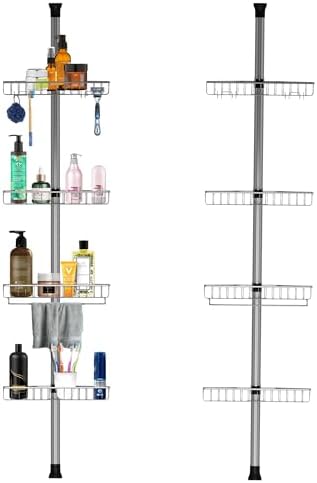
A spring-loaded rod fitted vertically between the shower tray floor and the ceiling, or horizontally between two walls in a corner, holds a caddy that clips onto the rod at one or more heights. The rod stays in position through tension alone — no suction cups, no adhesive, no drilling. This is the only fixing method in this guide that works reliably regardless of tile texture, surface smoothness, or humidity level, because it does not depend on bonding to any surface at all. It is the most consistently recommended renter-friendly shower storage solution for UK bathrooms, precisely because it removes the variable that causes most other products to fail.
Pros:
- Works on any tile surface, textured or smooth, because it does not rely on adhesion to function — the most reliable guarantee in this entire category.
- No drilling, no adhesive residue left behind, and fully removable in seconds when moving or repositioning.
- The adjustable height range on most models fits both standard shower enclosures and over-bath showers without needing a specific configuration.
Cons:
- Requires two parallel surfaces within the rod’s adjustable range — measure the relevant distance in the shower before buying.
- Some tension rods can shift slightly if knocked directly, though quality models with rubber end caps grip both surfaces firmly enough to resist normal use.
Best for: any UK flat bathroom, particularly those with textured tiles where suction-based products are likely to fail. Check current options on Amazon.

Best for Smooth Glazed Tiles — The Corner Caddy with Quality Suction Cups
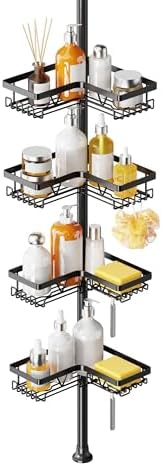
A triangular or curved caddy designed to fit into the corner of a shower enclosure, held in place by suction cups. The critical distinction from cheap, generic suction caddies is the quality of the suction mechanism — better products use larger, reinforced suction discs with a locking lever that creates a genuine vacuum seal, rather than basic press-on cups that lose hold within days regardless of the surface. Even with a quality suction mechanism, this product only works reliably on smooth, glazed, non-porous tile — a condition that needs to be checked and confirmed before purchase, not assumed because the bathroom looks modern.
Pros:
- The corner fit makes efficient use of the shower space without protruding into the area used for washing.
- Quality locking suction mechanisms hold significantly better and for longer than the basic press-on cups found on cheaper products.
- No drilling, fully removable, and repositionable without leaving marks on a suitable tile surface.
Cons:
- This is only reliable on smooth, glazed tile and will not hold on textured or embossed surfaces regardless of the suction mechanism’s quality.
- It may require periodic reapplication if the bond weakens over time, particularly in bathrooms with persistent humidity and limited ventilation.
Best for: bathrooms with confirmed smooth, glazed shower tiles only — check the surface before buying.
Zero Fixing Required — The Over-Showerhead Caddy
A caddy with a hook or bracket hangs directly from the shower arm, above the showerhead, requiring no contact with any wall or tile surface at all. Because it depends entirely on the shower arm itself rather than any adhesive or suction mechanism, compatibility is never a question of tile surface or humidity level — it works in any bathroom with a fixed shower arm of standard diameter. The main consideration is not whether it will hold, but whether the shower layout allows for this position without the caddy interfering with water flow or the movement of the shower head during use.
Pros:
- Compatibility depends only on the shower arm, not the tile surface — this works regardless of tile texture or humidity level, removing the variable that affects every other product type.
- No fixing of any kind is required — the caddy hangs and lifts off instantly, with no installation step at all.
- This is typically the lowest-cost option in the category, often under £15.
Cons:
- This is not suitable for shower enclosures without a fixed shower arm, such as handheld-only shower setups common in some over-bath configurations.
- The position above the showerhead may be less convenient to reach mid-shower than a corner or rod-mounted caddy positioned at a lower height.
Best for: any shower with a standard fixed arm, particularly where a quick, zero-effort solution is the priority. See current price on Amazon.


Best for Newer Flats — The Shower Niche Insert
For bathrooms with a built-in recessed shelf — a shower niche — already tiled into the wall, more common in newer UK flat builds and recent bathroom refits, a niche insert organiser sits inside this recess to add internal structure. Without an insert, a niche is often just a flat recessed shelf where bottles tip over or slide around during use. An insert with dividers or a tiered rack creates a defined position for each product, stopping the sliding and tipping that makes an unstructured niche frustrating to use. This product type only applies to bathrooms that already have a built-in niche — it cannot be added to a bathroom without one, since creating a niche requires structural tiling work that is not available to renters.
Pros:
- This makes a built-in niche significantly more functional by preventing bottles from tipping or sliding during use.
- No drilling is required — the insert sits inside the existing recess and holds in position through its own structure.
- It keeps the shower floor and corners completely clear, since all products are contained within the wall recess.
Cons:
- This is only relevant for bathrooms with an existing built-in niche — it is not a solution for bathrooms without one and cannot be retrofitted.
- Sizing varies significantly by niche dimensions, so measuring the recess accurately before buying is essential.
Best for: bathrooms with an existing tiled shower niche that currently has no internal structure.
How to Choose the Right Caddy for Your Shower
Start with the tile surface, since this determines which products are even viable options. Run a finger across the shower tiles. If they are completely smooth and glazed, a quality suction corner caddy is an option, alongside the more universally reliable tension rod. If the tiles are textured, embossed, or the surface is uncertain, the tension rod caddy or the over-showerhead caddy are the only reliable choices — neither depends on the tile surface at all, which removes the risk entirely.
Then consider the shower enclosure type. A separate shower cubicle with parallel walls suits a tension rod fitted horizontally in a corner, using the two walls as the pressure points. An over-bath shower with a fixed shower arm suits the over-showerhead caddy particularly well, since this configuration often lacks a natural corner for a rod or caddy to sit in. A bathroom with an existing built-in niche suits the niche insert above any other option, since the structural work of creating storage space has already been done by whoever fitted the bathroom.
Then check the weight that needs to be supported. A small number of daily products is within the capacity of most caddy types without further consideration. A full set of shampoo, conditioner, and body wash bottles for two people sharing the bathroom requires checking the stated weight capacity carefully — full bottles are heavier than they appear, and an underrated caddy will sag or detach under sustained load even if the fixing method itself is sound.
The honest fallback, when uncertain about either the tile surface or the shower layout, is the tension rod caddy. It is the safest choice across nearly every UK bathroom configuration because it is the only fixing method in this guide that does not depend on bonding to a surface at all — it succeeds or fails based on whether two parallel surfaces exist within its adjustable range, a much easier condition to confirm than tile porosity or surface texture.
Frequently Asked Questions
Why do suction cup shower caddies keep falling off in my bathroom?
Textured or embossed tiles, common in UK flat bathrooms, do not allow suction cups to form a proper vacuum seal — the cup makes contact only with the raised points of the texture, leaving gaps that prevent a reliable hold. Humidity from regular shower use accelerates the failure further, weakening whatever partial bond initially forms. Check the tile surface by running a finger across it: if there is any texture at all, suction cups will not hold reliably regardless of price or brand. A tension rod caddy is the practical alternative, since it does not depend on the tile surface at all.
What is the best shower caddy for renters in the UK?
A tension rod caddy is the most consistently reliable choice for UK renters, because it works regardless of tile surface, requires no drilling, and uses no adhesive that could damage tiles or leave residue on removal. It is the only fixing method in this category that does not depend on bonding to a surface, which makes it the safest default recommendation when the tile type is unknown or uncertain. For showers with a fixed arm and no convenient corner, an over-showerhead caddy is an equally reliable zero-fixing alternative.
How do I add shower storage without drilling or damaging tiles?
A tension rod caddy or an over-showerhead caddy are the two options that require zero contact with the tile surface itself. The tension rod relies on spring pressure against the ceiling, floor, or walls; the over-showerhead caddy hangs from the shower arm. Neither requires drilling, adhesive, or suction cups, which means neither carries any risk of damaging tiles or leaving marks when removed. Both are fully portable and can be taken to a new flat at the end of a tenancy.
How much weight can a shower caddy hold?
This varies significantly by product and fixing method, so checking the manufacturer’s stated weight capacity before loading a full set of products is essential. Full-size shampoo and conditioner bottles typically weigh more than they appear when empty packaging is compared to a filled bottle, and a caddy holding three or four full bottles can carry more weight than an underrated product is designed to support. Tension rod caddies generally have the highest stated capacity in this category because the rod itself bears the load rather than a suction or hook mechanism alone.
Related Guides
The tension rod caddy is one part of a complete no-drill bathroom storage system. For the full range of renter-friendly solutions across every area of the bathroom — freestanding units, over-door products, and removable adhesive on appropriate surfaces — how to keep a small bathroom clutter-free without drilling covers all four categories in detail.
The shower zone is one part of a complete bathroom storage system. For the full zone-based approach covering every area of a small rented bathroom — the over-toilet zone, the under-sink zone, the door zone, and the maintenance routine that keeps all of them functional — how to organise a small bathroom in a rented flat covers the complete picture.
Conclusion
Most shower caddy failures in UK bathrooms come down to one mismatch: a suction-based product applied to a textured tile surface it was never going to hold onto. Checking the tile surface first, or choosing a tension rod or over-showerhead caddy that does not depend on the surface at all, is the difference between a caddy that lasts and one that falls off within the first week.