
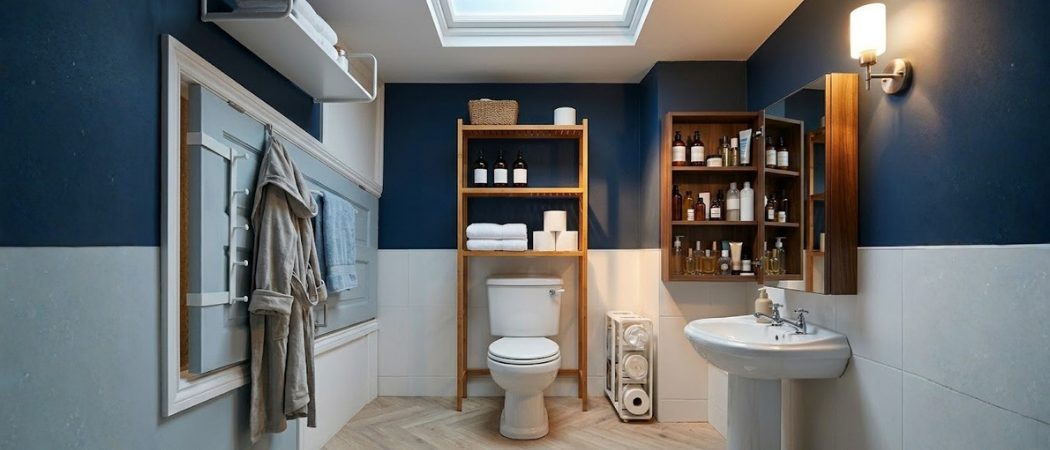
The space above the toilet is the largest unused storage area in most small UK flat bathrooms. It looks unusable because there is no shelf, no fixture, no obvious anchor point — but the floor space on either side of the toilet pan is all that is needed for a freestanding unit to use the full vertical height above it.
The right unit depends on the specific toilet configuration, the available ceiling height, and how much storage is actually needed. Choosing the wrong type means a unit that does not fit, wobbles against the cistern, or blocks access to the flush mechanism — all common results of buying based on the wall measurement rather than the toilet’s actual footprint.
This guide covers the four most useful types of over-toilet storage for UK flat bathrooms, what to measure before buying, and which type fits which bathroom layout.
What to Know Before You Buy
- Measure the toilet pan width, not the wall. A freestanding unit’s legs straddle the toilet pan — not the cistern or the wall behind it. Measure the pan at its widest point, typically 35 to 40cm for a standard UK toilet, and confirm the unit’s leg width is wider than this measurement before ordering anything.
- Check the gap between the cistern and the wall. The back legs of the unit sit in this space, typically 10 to 15cm deep in a standard UK close-coupled toilet. A unit with back legs deeper than this gap will not sit flush against the wall and may rock or become unstable under daily use.
- Measure the height from the cistern to the ceiling. Standard units range from 140cm to 175cm tall in total. Confirm the available ceiling clearance before ordering — particularly relevant in flats with lower ceiling heights, where a full-height unit may not fit even though the floor footprint is correct.
- Check whether the toilet is wall-hung. If there is no visible cistern and the flush is operated by a panel set into the wall, standard over-toilet units will not work as intended — there is no cistern gap for the back legs and no consistent pan shape to straddle. A slim unit placed beside rather than above the toilet is the alternative in this configuration.
- Prioritise rust-resistant materials. Bathroom humidity in a UK flat without an extractor fan causes untreated metal to develop surface rust within weeks. Powder-coated metal or bamboo are significantly more reliable material choices for a product that will be in near-constant humidity.
The 4 Best Types of Over-Toilet Storage for Small UK Flat Bathrooms
The four types below cover the most common bathroom layouts and storage needs in a small UK flat. Each is suited to a specific configuration rather than ranked in a single order — the right unit depends on the bathroom, not on a universal hierarchy.
Best for Most UK Bathrooms — The Freestanding Three-Tier Étagère
A metal or bamboo frame with three open shelves stands on the bathroom floor on either side of the toilet pan and spans above the cistern. Available in widths of 58 to 65cm to fit standard UK close-coupled toilets, with most models offering 160 to 175cm of total height. No wall contact is required — the unit leans gently against the wall for added stability without any fixing point. The open shelf design keeps everything visible and immediately accessible, which suits daily-use bathroom items like towels and the products currently in rotation. This is the most widely available and most affordable option in the category, with reliable models from VASAGLE and SONGMICS commonly available on Amazon UK.
Pros:
- Fits the majority of UK close-coupled toilets without any modification, provided the toilet pan width and cistern gap fall within standard measurements.
- Open shelves provide fast, visible access to towels and daily-use products without any door to open or search through.
- This is the most affordable option in the category, typically priced between £25 and £45.
Cons:
- Open shelves expose contents to bathroom humidity directly, which requires more frequent wiping down of both the shelves and the products stored on them.
- Less visually tidy than a closed unit if the contents are not consistently organised, since everything stored is visible at all times.
Best for: most UK flat bathrooms with a standard close-coupled toilet and at least 80cm of ceiling clearance above the cistern.
Best for Hiding Clutter — The Cabinet and Open Shelf Combination Unit
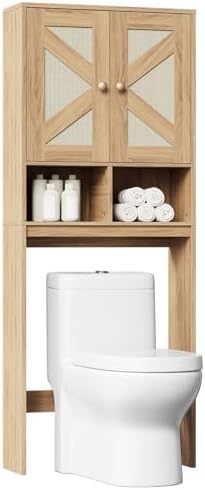
A unit combining a closed cabinet section on the upper or middle shelf with open shelves above and below it. The closed cabinet holds items that do not need to be visually presentable — spare toiletries, cleaning products, medicines — while the open shelves hold towels and items in daily use. This is the higher-ticket option in the category, typically priced between £45 and £70, but it solves a problem that pure open shelving cannot: keeping less attractive items out of sight without sacrificing all visible storage. It is particularly well suited to shared bathrooms, where the volume of products is higher and the likelihood of visible disorganisation increases with every additional user.
Pros:
- Combines visible and hidden storage in a single freestanding unit, addressing two different storage needs without requiring two separate products.
- The closed cabinet section protects its contents from bathroom humidity more effectively than fully open shelving, extending the usable life of products stored there.
- Better suited to shared bathrooms with higher product volume, where a purely open shelving system would become visually overwhelming.
Cons:
- More expensive than the open étagère, reflecting the additional materials and construction complexity of the cabinet section.
- Heavier and bulkier overall — check the toilet pan and cistern gap measurements carefully before buying, as combination units are frequently wider than basic open shelf units of the same brand.
Best for: shared bathrooms or anyone who wants to keep cleaning products and medicines out of sight while still having open storage for daily towels and products.


Best for Narrow Bathrooms — The Slim Unit Under 55cm Wide
A narrower version of the standard étagère, typically 50 to 55cm wide, designed for bathrooms where the toilet sits close to an adjacent wall, bath panel, or door — leaving insufficient clearance for a standard 60 to 65cm unit. The trade-off is shelf depth: slim units typically have shelves of 18 to 20cm rather than the standard 25 to 30cm, which limits what fits comfortably on each level. Suitable for folded towels, toilet rolls, and smaller bottles, but not for larger items like a full set of bath towels or wide product bottles that would overhang the shallower shelf edge.
Pros:
- Fits bathroom layouts where a standard-width unit would not have sufficient clearance on one or both sides of the toilet.
- Still provides three tiers of vertical storage in a constrained footprint, making it more space-efficient than abandoning the over-toilet zone entirely.
- Lightweight construction makes it easy to position precisely in a tight space without significant effort.
Cons:
- Shallower shelves limit what can be stored comfortably — bulky items, wide bottles, and stacked towel sets do not fit well on an 18 to 20cm shelf.
- The narrower base may be less stable than standard-width units if loaded unevenly, making correct bottom-heavy loading more important than with wider units.
Best for: bathrooms where the toilet has less than 10cm of clearance on one side, making a standard-width unit impractical.
Best for Limited Ceiling Height — The Over-Cistern Caddy
A low-profile caddy or small shelf unit sits directly on top of the cistern lid rather than spanning the full height above it. This is designed for bathrooms where ceiling clearance above the cistern is too limited for a full-height étagère — typically less than 80cm — or for anyone who wants a small additional storage surface without committing to a full freestanding unit. It holds a modest number of items: a small basket of toiletries, spare toilet rolls, or a plant. This is not a replacement for a full over-toilet unit, but a useful addition in bathrooms with limited vertical space or as a supplementary surface alongside another storage solution.
Pros:
- Works in bathrooms with limited ceiling clearance where a full-height unit will not physically fit between the cistern and the ceiling.
- Adds a small amount of storage without any floor footprint at all, since it sits entirely on the existing cistern lid.
- Low cost, typically under £20, making it a low-risk addition for a modest storage gap.
Cons:
- Limited storage capacity compared to a full freestanding unit — this is a supplementary solution, not a primary one.
- Sits directly on the cistern lid, which may interfere with cistern access for maintenance or repairs, and should be removed before any plumbing work.
Best for: bathrooms with low ceiling clearance above the cistern, or as a small supplementary addition alongside other bathroom storage.
How to Choose the Right Unit for Your Bathroom
Start with the toilet type. If the toilet is wall-hung with no visible cistern, none of the four products above will work as intended — there is no cistern gap for the back legs to sit in and no consistent pan shape for the unit to straddle. In this configuration, a slim freestanding unit placed beside the toilet rather than above it is the practical alternative, using available floor space adjacent to the toilet instead.
Then measure three things before looking at any specific product. Toilet pan width at its widest point determines whether a unit’s leg span will clear the pan correctly. The gap between the cistern and the wall determines whether the back legs will sit flush. Ceiling height above the cistern determines whether a full-height unit will fit at all. These three measurements together determine which of the four product types above is physically compatible with the specific bathroom — not which one looks best in a product photograph.
Once the physical constraints are established, consider the storage need. For maximum visible storage at the lowest cost, the open étagère is the right choice. For a mix of hidden and visible storage — particularly relevant in a shared bathroom where product volume is higher — the cabinet combination unit is more effective. For a narrow bathroom with limited clearance on one side, the slim unit is the only freestanding option that will fit. For limited ceiling height, or as a small supplementary addition alongside another solution, the over-cistern caddy fills the gap without requiring a full-height unit.
Regardless of which unit is chosen, the stability check applies universally: load it bottom-heavy, with heavier items on the lowest shelf and lighter items on the top shelf. Check that all joints are tightened fully at assembly, and retighten monthly — bathroom humidity cycling loosens fixings gradually over time, and a unit that was stable at installation can develop noticeable movement within a few months without this check.
Frequently Asked Questions
What size over-toilet unit fits a standard UK toilet?
Units between 58cm and 65cm wide fit the majority of UK close-coupled toilets, where the pan width is typically 35 to 40cm at its widest point and the cistern sits 10 to 15cm from the wall behind it. Confirm both measurements against the specific bathroom before ordering, as toilet dimensions vary between manufacturers and installation ages. A unit within this width range, with back legs under 12cm deep, will fit the standard UK configuration in most cases.
Do over-toilet storage units work with a wall-hung toilet?
No, not standard units. A wall-hung toilet has no visible cistern and no consistent pan base for a freestanding unit’s legs to straddle, which means the standard leg configuration cannot be positioned correctly above it. The practical alternative is a slim freestanding unit placed beside the toilet rather than above it, using the floor space adjacent to the toilet to achieve a similar vertical storage result without requiring the toilet-straddling design of a standard unit.
Are freestanding over-toilet units stable without being fixed to the wall?
Yes, when correctly assembled and loaded bottom-heavy. Stability comes from a combination of the unit’s leg span, the weight distribution across the shelves, and light contact against the wall for additional support. Heavier items belong on the lowest shelf to keep the centre of gravity low, while the top shelf should hold only lightweight items. Checking and retightening all joints monthly — since bathroom humidity gradually loosens fixings over time — maintains this stability for the life of the unit.
What material is best for over-toilet storage in a humid bathroom?
Powder-coated metal or bamboo are the most reliable material choices. Untreated metal, or metal with only a thin chrome finish, develops surface rust within weeks in a UK flat bathroom that lacks an extractor fan or adequate ventilation — the constant humidity cycling from regular shower or bath use accelerates this significantly. Powder-coated steel resists this corrosion reliably, and bamboo is naturally moisture-resistant without requiring any specific treatment, making both suitable for long-term use in a high-humidity environment.
Related Guides
For a complete guide to measuring the space correctly, deciding what to store on each shelf level, and checking stability in a humid bathroom, how to maximise storage above the toilet in a small bathroom covers the full approach before the product choice.
The over-toilet zone is one part of a complete bathroom storage system. For the full zone-based approach covering every area of a small rented bathroom — shower zone, door zone, under-sink zone, and the maintenance routine that keeps them all functional — how to organise a small bathroom in a rented flat covers the complete picture.
Conclusion
The space above the toilet is not difficult to use — it is a space that has never had the right freestanding unit placed in it. For most UK flat bathrooms with a standard close-coupled toilet, a three-tier étagère solves the problem for under £45 with no drilling and no wall contact required. The only requirement before buying is three measurements taken correctly: toilet pan width, cistern-to-wall gap, and available ceiling height.