
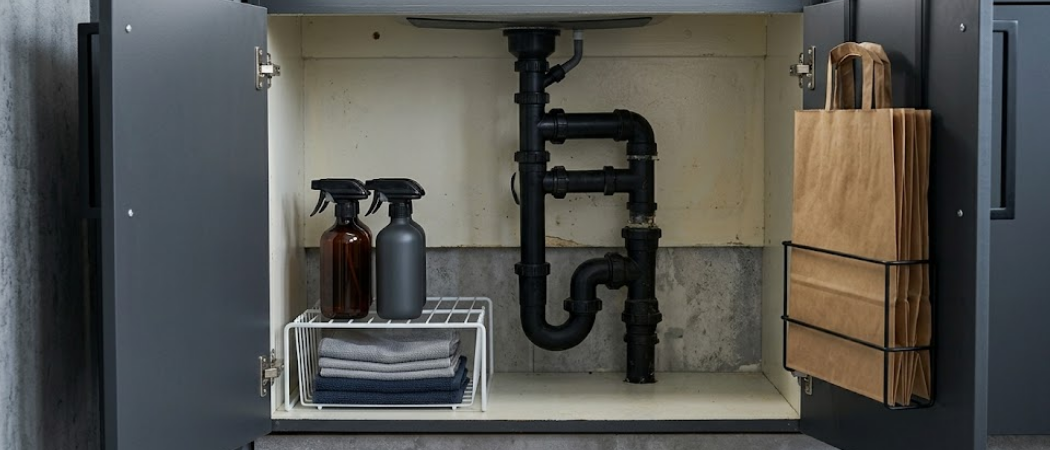
The under-sink cupboard is the most consistently wasted storage space in a small flat kitchen. The waste pipe and siphon make it look unusable — but the actual problem is that most standard organisers are not designed for this configuration. A generic shelf unit bought without accounting for the pipe position will not fit, and the cupboard goes back to being a space where cleaning products get pushed in and the door gets closed.
The right organiser works around the pipe rather than ignoring it. It fits the usable width on each side of the pipe, clears the siphon without requiring modification to the cupboard, and makes the space functional for daily use without any permanent fixings.
This guide covers the four most practical types of under-sink organiser for UK flat kitchens, the measurements to take before ordering anything, and a clear set of criteria for matching the right product to the specific configuration of your cupboard.
What to Know Before You Buy
- Measure the usable width, not the cupboard width. The internal width of a standard UK under-sink cupboard is 60cm, but the waste pipe and siphon occupy the central section — typically 15 to 20cm — leaving two separate usable zones on either side. Measure each zone individually and write both figures down before looking at any products. An organiser that fits the left zone may be too wide for the right zone, and neither measurement is the same as the full 60cm cupboard width.
- Check the siphon clearance height before buying any shelf unit. The siphon — the curved pipe connecting the sink drain to the waste pipe — sits at mid-height in most UK under-sink cupboards, typically 20 to 30cm from the cupboard floor. Measure from the floor to the lowest point of the siphon. Any organiser taller than this measurement will not fit unless it has an adjustable centre leg specifically designed to clear the pipe.
- Check the usable depth, particularly if a boiler or water heater is present. Standard UK base units are 50cm deep, but under-sink cupboards in many flats have a boiler or water heater at the back that reduces the usable depth to 35 or 40cm. Measure from the inside of the closed door to the nearest obstacle at the back before buying any pull-out organiser that relies on full depth to function correctly.
- Prioritise adjustable or extendable products over fixed-width ones. Fixed-width organisers are sized for standard cupboard widths, not for the usable zones around a UK flat pipe configuration. Extendable caddies and adjustable shelf units are significantly more likely to fit the actual available space without requiring precise pre-measurement.
- Every product in this guide is renter-friendly. Nothing here requires drilling, permanent adhesive, or any modification to the cupboard structure. All products are freestanding or hook-mounted and can be removed without leaving marks.
The 4 Best Types of Under-Sink Organiser for Small Kitchen Flats
The four types below cover the most common under-sink configurations in UK flat kitchens. Each solves a different version of the same problem.
Best for Most UK Flat Kitchens — The Adjustable-Width Caddy
An extendable caddy fits within one usable zone of the under-sink cupboard rather than attempting to span the full width. Most models extend from approximately 34cm to 57cm, which covers the typical zone width on either side of the waste pipe in a standard 60cm cupboard. The open frame design sits clear of the siphon without needing to account for its exact height, and the extension mechanism lets you fit it snugly to the available width. Because it adapts to the pipe position rather than requiring a specific layout, it works in the majority of UK flat under-sink configurations without precise pre-measurement.
Pros:
- The adjustable width accommodates different pipe positions without requiring exact measurements before purchase, which makes it the lowest-risk starting point for most under-sink configurations.
- The open frame design clears the siphon in most standard UK flat kitchens without needing to measure the exact siphon height beforehand.
- It is lightweight and fully removable with no fixings required, which suits renters who may need to move it or take it with them at the end of a tenancy.
Cons:
- The open frame provides no internal separation between items — bottles and cleaning products can tip or slide unless placed with some care, particularly on a smooth cupboard floor.
- It does not use the vertical space above the pipe, so if maximising storage capacity is the priority, a two-tier shelf is a more effective option.
Best for: renters who want a practical, adaptable solution that works across different pipe configurations without needing to measure precisely first.


Best for Maximising Vertical Space — The Two-Tier Shelf with Adjustable Centre Leg
A two-level shelf unit with a height-adjustable centre leg is specifically designed for the under-sink configuration. The lower shelf sits on the cupboard floor on either side of the pipe; the upper shelf creates a second storage level above it, using the vertical space between the pipe and the top of the cupboard that would otherwise go unused. The adjustable centre leg is the critical feature — it raises the unit to clear the siphon, accommodating the different siphon heights found across different UK flat kitchens. Without this leg, the unit would rest on the pipe rather than clearing it.
Pros:
- Creating a genuine second storage level effectively doubles the usable capacity of the under-sink cupboard, which makes a significant practical difference in a small kitchen where every storage zone matters.
- The adjustable centre leg accommodates siphon heights across a range of UK flat kitchen configurations, making this more versatile than it might appear from the product description alone.
- The unit is fully freestanding and removable — no fixings, no modification to the cupboard, no marks left when it is taken out.
Cons:
- This product requires more precise measurement than the adjustable caddy — the shelf width needs to fit within the usable zone on one side of the pipe, so measuring both zones before buying is necessary.
- If the cupboard height above the pipe is limited, the upper shelf may not provide enough clearance for tall bottles or spray cleaners — check the total unit height against the available space above the siphon.
Best for: renters who want to maximise the storage capacity of the under-sink cupboard rather than simply add basic organisation to the existing floor space.
[AFFILIATE LINK — two-tier under-sink shelf with adjustable leg]
Best for Deep Cupboards — The Pull-Out Caddy on Castors
A caddy on castors slides out when the cupboard door opens, bringing everything stored at the back of the cupboard within reach in one movement. This addresses a specific problem: under-sink cupboards where the pipe is offset to one side, leaving a clear zone on the other side that is too deep to access comfortably without pulling everything out. The pull-out caddy makes that depth usable rather than wasted. It is not the right choice for cupboards where a boiler or water heater significantly reduces the usable depth — in those cases, the caddy has nowhere to travel and provides no benefit over a static organiser.
Pros:
- Pulling the caddy out brings the full depth of the cupboard zone into reach in a single motion, eliminating the need to unpack the front items to reach what is stored behind them.
- Particularly useful when the waste pipe is offset to one side, leaving one clear, deep zone that would otherwise be difficult to access without a sliding solution.
- No installation required — the caddy sits on the cupboard floor and moves freely without any fixings to the cupboard structure.
Cons:
- The pull-out function only provides value if there is sufficient usable depth to justify it — measure the depth from the door to the nearest back obstacle before purchasing, and do not buy this for a cupboard where a boiler reduces depth to under 35cm.
- Castors may not roll smoothly on all cupboard floor surfaces, particularly older laminate or textured base unit floors — check whether the model includes a non-scratch base.
Best for: renters with a deep under-sink cupboard where the pipe is offset to one side, leaving a clear zone that is too deep to access easily without a pull-out solution.


Best for the Cupboard Door — The Over-Door Carrier Bag Holder
A holder that hooks over the inside face of the under-sink cupboard door, dedicated to carrier bags. Carrier bags are the most consistent source of under-sink clutter — they are lightweight, compressible, and easy to push into gaps, which means they accumulate in every corner of the cupboard regardless of how the main storage zone is organised. A dedicated door holder removes them from the floor and shelves entirely, freeing the main zone for cleaning products and associated items. It hooks over the door edge with no drilling, and most models hold fifteen to twenty bags — enough for any household without creating excess.
Pros:
- Removing carrier bags from the main storage zone is the single most effective change for reducing under-sink clutter, and this product accomplishes it entirely without taking up any floor or shelf space inside the cupboard.
- The over-door mounting requires no fixings — it hooks over the door edge and can be removed in seconds, making it fully compatible with standard rental agreements.
- Most models fold flat when empty, so the door closes without the holder adding any meaningful depth to the cupboard interior.
Cons:
- This product solves one specific problem — carrier bag storage — and is not a general-purpose organiser. It works best as a complement to one of the other organisers above, not as a standalone solution.
- Some cupboard door thicknesses or hinge configurations may not be compatible with standard over-door hooks — check the door edge thickness against the hook opening before purchasing.
Best for: any renter whose under-sink cupboard has a carrier bag problem, which in practice is the majority of UK flat kitchens.
How to Choose the Right Organiser for Your Under-Sink Cupboard
The decision starts with the pipe position. In most UK flat under-sink cupboards, the waste pipe runs roughly centrally, leaving two usable zones of similar width on either side. In this configuration, an adjustable caddy or a two-tier shelf fits in either zone and works alongside the pipe without conflict. If the pipe is offset significantly to one side, the deeper zone on the opposite side may be better served by a pull-out caddy, which makes the depth usable rather than leaving it inaccessible.
Once the pipe position is established, consider what is actually being stored. If the primary contents are cleaning products, cloths, and sponges, an adjustable caddy handles lighter loads and the two-tier shelf handles higher volume. If carrier bags are currently taking up a significant portion of the cupboard floor, a door holder is not optional — it is the first purchase, because without it, carrier bags will fill whatever space the organiser creates. For most UK flat under-sink cupboards, the most effective setup is one main organiser and one door holder working together.
Then measure. Usable width on each side of the pipe — both figures, separately. Siphon clearance height from the cupboard floor to the bottom of the siphon, if a two-tier shelf is being considered. Usable depth from the inside of the closed door to the nearest obstacle at the back, if a pull-out caddy is being considered. These three measurements take five minutes and eliminate the most common reason under-sink organisers get returned.
The combination that works for most UK flat kitchens is a two-tier shelf in the main zone and an over-door carrier bag holder on the door. Total cost for both is typically under £30. The two-tier shelf doubles the vertical storage capacity of the main zone; the door holder removes carrier bags from the equation entirely. Together they address both the volume problem and the clutter problem without requiring any modification to the cupboard.
Frequently Asked Questions
What is the best under-sink organiser for a UK flat kitchen?
For most configurations, an adjustable-width caddy is the most practical starting point — it adapts to different pipe positions without requiring precise measurement and works immediately in the majority of UK flat under-sink cupboards. If maximising storage capacity is the priority, a two-tier shelf with an adjustable centre leg is the more effective option, though it requires measuring the usable zone width and siphon height before purchasing. For cupboards where the pipe is offset and one side has a clear deep zone, a pull-out caddy on castors makes that depth accessible. In most cases, pairing any of these with a door-mounted carrier bag holder covers both the storage and clutter problems.
How do I organise under the sink when there are pipes in the way?
The pipes are fixed, so the approach is to measure around them rather than treat them as the obstacle. Measure the usable width on each side of the pipe separately — these are the two zones you have to work with, not the full 60cm cupboard width. Measure the siphon height from the floor to its lowest point before buying any shelf unit. Products designed specifically for under-sink use — adjustable caddies and two-tier shelves with adjustable legs — are built for this configuration. Standard shelf units from general storage ranges are not.
Can I add shelves under the sink in a rented flat?
Yes, with freestanding products that require no drilling or permanent fixings. A two-tier under-sink shelf with an adjustable centre leg sits on the cupboard floor and supports itself without attaching to any surface. An over-door carrier bag holder hooks over the door edge with no fixings. Both are fully removable and leave no marks — they are compatible with standard UK rental agreements and can be taken when moving out.
How do I stop carrier bags taking over the under-sink cupboard?
A dedicated over-door carrier bag holder is the most effective single change. It removes carrier bags from the main storage zone entirely and places them on the door, where they take up no floor or shelf space. Set a fixed limit based on the holder’s capacity — typically fifteen bags — and treat anything beyond that as recycling rather than storage. Without a dedicated container, carrier bags fill every available gap regardless of how the rest of the cupboard is organised.
Related Guides
Before choosing a product, it is worth understanding the full system for the under-sink area — how to measure around the pipes, the two-zone approach, and what belongs in this space versus what should go elsewhere. How to maximise under-sink storage in a small flat covers the system in full before the products.
The under-sink cupboard is one part of the broader kitchen storage picture. For the complete zone-based approach to a small flat kitchen — how to allocate cupboard space, manage the worktop, and build a system that holds — how to organise a small kitchen with limited cupboard space covers the full kitchen.
Conclusion
The under-sink cupboard is not a difficult space — it is a space that has not been configured for the pipe and siphon that define it. The right organiser works around these constraints rather than ignoring them. For most UK flat kitchens, an adjustable caddy or two-tier shelf in the main zone and a door-mounted carrier bag holder on the door solve the majority of the problem for under £30 — with no drilling, no modification to the cupboard, and no landlord permission required.