
The space under a bathroom sink in a small UK flat is either completely unused or permanently disorganised — and the right solution depends entirely on the type of sink. A pedestal sink and a wall-hung basin are not the same problem, even though most storage products are marketed as if they were interchangeable.
Choosing an organiser without identifying the sink type first carries a high chance of buying something that does not fit — a wall-hung basin organiser with nowhere to go around a pedestal column, or a pedestal-specific wrap that wastes the open floor space available beneath a wall-hung basin.
This guide covers the four most useful types of under-sink organiser for UK flat bathrooms, matched to specific sink configurations, with the measurements to check before buying anything.
What to Know Before You Buy
- Identify your sink type before looking at any product. A pedestal sink has a visible ceramic column running to the floor. A wall-hung basin has no column and clear floor space beneath it. The two configurations require completely different organisers, and a product designed for one will not work with the other.
- For pedestal sinks, measure the usable zones on either side of the column. These are typically narrow — 10 to 20cm on each side — and the organiser must be designed to wrap around or sit beside the column rather than span the full sink width as a standard under-sink unit would.
- For wall-hung basins, measure the full available space. Usable width is typically 45 to 55cm, depth 35 to 45cm, and height from floor to the underside of the basin 55 to 70cm. These three measurements determine which organiser will fit and how much it can hold.
- Check that the organiser has an open back or adjustable design to accommodate exposed pipes. Products with a solid back panel will not sit flush against the wall in either sink configuration, since the pipes running down the wall occupy the rear section of the available space.
- All products in this guide are renter-friendly. No drilling, no modification to pipework, fully removable and portable — suitable for any UK rental tenancy agreement.
The 4 Best Under-Sink Organisers for Small UK Flat Bathrooms
The four types below cover the two most common UK bathroom sink configurations, plus two solutions that work regardless of sink type.
Best for Pedestal Sinks — The Pedestal Sink Organiser
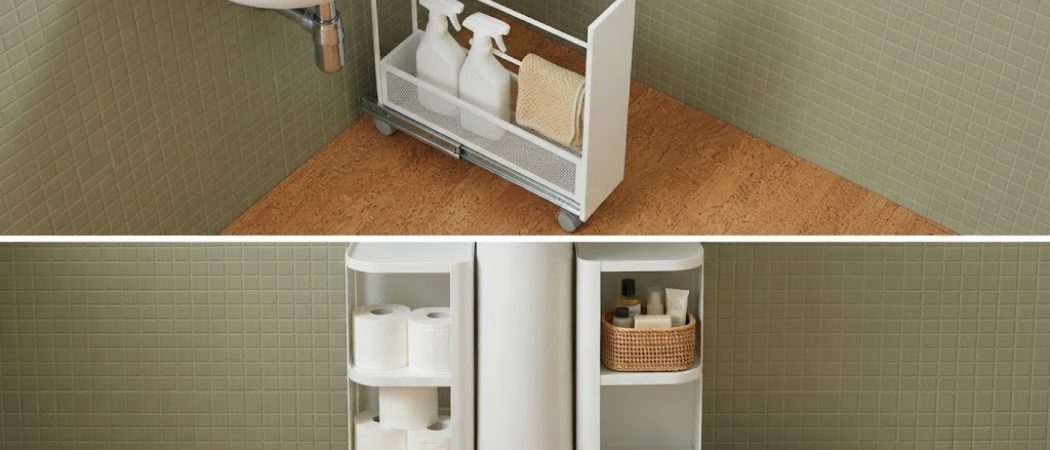
A unit specifically designed to fit around a pedestal sink column, typically consisting of two side shelves connected by a back panel that sits against the wall, with a cut-out or adjustable gap in the centre to accommodate the column. This creates two usable shelf zones on either side of the pedestal — enough for daily cleaning products, spare toilet rolls, and small toiletry items in rotation. This is the only product type designed specifically for the most common storage gap in UK flat bathrooms, where standard under-sink organisers simply cannot be placed around the column at all.
Pros:
- This is the only organiser type designed specifically to work around a pedestal column, addressing a configuration that standard under-sink products ignore entirely.
- It creates two structured storage zones where previously there was only exposed floor space on either side of an unused column.
- No drilling is required — the unit sits on the floor and leans against the wall and the pedestal itself for added stability.
Cons:
- Usable shelf depth is limited by the narrow zones available on either side of the column, which restricts what fits comfortably on each shelf.
- This product is not suitable for wall-hung basins — the cut-out design serves no purpose without a column to fit around, and would leave most of the unit’s structure unused.
Best for: any UK flat bathroom with a freestanding pedestal sink and no existing under-sink storage. Check current options on Amazon.


Best for Wall-Hung Basins — The Slim Pull-Out Caddy
A small caddy or tray mounted on castors slides out from beneath a wall-hung basin, designed specifically for the clear floor space this configuration provides. It brings items stored at the back within reach in a single motion, avoiding the need to crouch and search through a static arrangement. The open-frame design accommodates exposed pipes running down the wall without obstruction, sitting around them rather than against them. This caddy is most effective when the basin is installed at a sufficient height — 65cm or more from floor to underside — to allow the caddy to extend and retract freely without catching on the basin above it.
Pros:
- Makes full use of the clear floor space available beneath a wall-hung basin, which would otherwise remain empty or become a loose collection of items.
- The pull-out design avoids reaching or crouching to access items stored at the back, reducing the friction that causes under-sink storage to fall out of use.
- The open frame accommodates exposed pipes without obstruction, sitting flush against the wall regardless of pipe position.
Cons:
- This requires sufficient basin height to slide freely — measure before buying if the basin is installed at a lower height, as the caddy may catch on the underside.
- Castors may not roll smoothly on all bathroom floor surfaces, particularly textured tile or uneven vinyl — check the floor type before relying on the pull-out function.
Best for: wall-hung basins with at least 65cm of clearance from floor to underside, in bathrooms with a smooth, even floor surface. See current price on Amazon.

Best for Larger Under-Sink Spaces — The Stackable Basket System
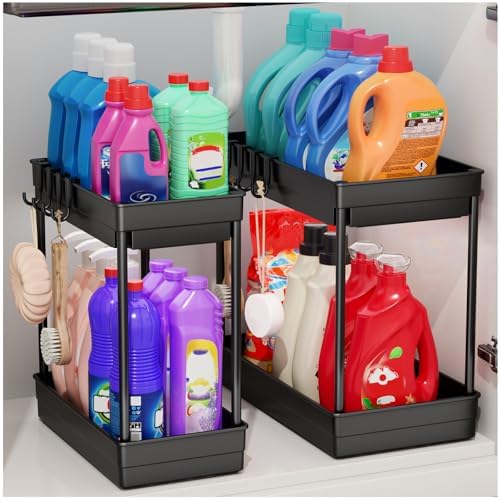
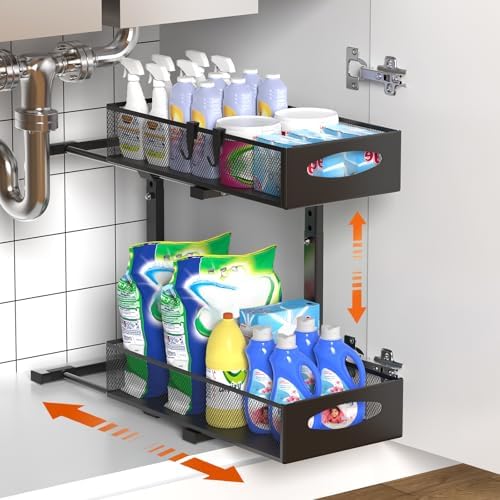
A set of two or three open-frame baskets designed to stack vertically, used in under-sink spaces with sufficient clearance — typically wall-hung basins with 65cm or more of height available. Each basket holds one category of items, creating tiered storage without a fixed frame connecting them. This is particularly useful for bathrooms with a higher volume of products to store, such as shared bathrooms where two people’s routines and products need to be accommodated. The modular design means baskets can be added or removed individually as storage needs change, which a fixed-frame organiser does not allow.
Pros:
- The modular design allows baskets to be added or removed as storage needs change, rather than being locked into a fixed capacity.
- This works well for shared bathrooms with higher product volume, where flexibility matters more than a single fixed configuration.
- The baskets are lightweight and easy to reposition individually without disturbing the rest of the stack.
Cons:
- This requires sufficient vertical clearance and is not suitable for low-mounted basins or pedestal sinks, where there is no equivalent open vertical space.
- Stacked baskets can become unstable if the top basket is overloaded relative to the ones below it — distribute weight with heavier items lower in the stack.
Best for: wall-hung basins with generous clearance, particularly in shared bathrooms needing flexible, higher-capacity storage.
Best for the Bathroom Cabinet Door — The Over-Door Caddy
For bathrooms with a vanity unit or a separate bathroom cabinet, the inside of the cabinet door is flat, unused vertical space. An over-door caddy hooks over the door edge and holds smaller items — spare toiletries, cleaning cloths, travel-size products — without taking up any shelf space inside the cabinet itself. This is the one product in this guide that does not depend on sink type, since it applies to any cabinet with a door regardless of what sits beneath the basin, and it frees the under-sink shelf space inside the cabinet for larger items that cannot go on the door.
Pros:
- This adds storage without depending on sink type or under-sink configuration, making it relevant to any bathroom with a cabinet door.
- No drilling is required — the caddy hooks over the door edge and is removed without leaving any marks.
- It frees shelf space inside the cabinet for larger items, since smaller products move to the door instead.
Cons:
- This is only relevant for bathrooms with an existing cabinet or vanity unit door — it has no application in a bathroom with a pedestal or wall-hung basin and no cabinet.
- It is limited to lightweight items — heavier products are unsuitable for door-mounted storage and put unnecessary strain on the cabinet hinge over time.
Best for: any bathroom with a vanity unit or cabinet, regardless of the under-sink configuration beneath the basin.
How to Choose the Right Organiser for Your Bathroom Sink
Start by identifying the sink type, since this determines which products are even physically compatible with the space. A visible ceramic column running from the basin to the floor means a pedestal sink — the pedestal organiser is the only product specifically designed for this configuration, and nothing else in this guide will fit correctly around the column. No column and clear floor space beneath the basin means a wall-hung basin — both the pull-out caddy and the stackable basket system work here, with the choice between them depending on the available height.
Once the sink type is confirmed, measure the available space precisely. For pedestal sinks, measure the usable zone on each side of the column — this determines whether a standard pedestal organiser fits or whether a narrower model is needed. For wall-hung basins, measure width, depth, and height from the floor to the underside of the basin — all three figures determine which of the wall-hung solutions will fit and function correctly.
Then consider what is actually being stored and in what volume. A small number of daily cleaning products is sufficient justification for the pedestal organiser alone, or the pull-out caddy alone for a wall-hung basin. A higher volume of products, particularly in a shared bathroom, calls for the stackable basket system under a wall-hung basin, or the pedestal organiser combined with an over-door caddy for a pedestal sink where the under-sink capacity alone is more limited.
For bathrooms with a vanity unit, the over-door caddy adds capacity regardless of what is chosen for the under-sink area itself — it works alongside any configuration. The total cost of a complete under-sink system, combining the main organiser with an over-door caddy where applicable, is typically under £40 for a UK flat bathroom.
Frequently Asked Questions
What is the best under-sink organiser for a pedestal sink?
A pedestal-specific organiser designed to wrap around or sit beside the column is the only reliable option. It creates two usable storage zones on either side of the pedestal, where a standard under-sink organiser would have nowhere to sit because the column occupies the central floor space. Measure the usable zone width on each side of the column before buying, as this varies between bathroom installations and determines whether a standard or narrower pedestal organiser is needed.
How do I store items under a wall-hung bathroom basin?
A pull-out caddy on castors or a stackable basket system are the two most effective options, with the choice depending on the available height from floor to the underside of the basin. A pull-out caddy works well when the basin is installed at 65cm or higher, allowing the caddy to extend freely. A stackable basket system also requires similar clearance but offers more flexibility for higher product volumes. Measure the height before choosing between the two — a lower-mounted basin may not have sufficient clearance for either.
Can I use a kitchen under-sink organiser in a bathroom?
Sometimes, but bathroom sinks have different width and depth constraints than kitchen units, particularly pedestal sinks, which kitchen under-sink organisers are not designed for at all — kitchen products assume a 60cm cupboard with a waste pipe, not an open column configuration. For wall-hung basins, a kitchen organiser may fit if the dimensions happen to align, but checking the specific width, depth, and height against the bathroom measurements is necessary before assuming compatibility. Products designed specifically for bathroom under-sink use are a more reliable starting point for either sink configuration.
What can I store under a bathroom sink in a small flat?
Cleaning products used regularly, spare toilet rolls, and the current spare product in rotation all belong under the bathroom sink. Daily toiletries do not belong here — they should be at basin height or in the over-toilet unit for easy access without bending down. Medicines and bulk spare products also belong elsewhere in the flat, following the same principle covered in the broader guide to organising under the bathroom sink: this space holds weekly-use items and current spares only, not a general overflow for anything bathroom-related.
Related Guides
For a complete guide to identifying your sink type, measuring the available space, and deciding what should and should not be stored under the bathroom sink, how to organise under the bathroom sink in a small flat covers the full system before the product choice.
The under-sink zone is one part of a complete bathroom storage system. For the full zone-based approach covering every area of a small rented bathroom — the shower zone, the door zone, the over-toilet zone, and the maintenance routine that keeps them all functional — how to organise a small bathroom in a rented flat covers the complete picture.
Conclusion
The under-sink area in a small UK bathroom is not difficult to organise — it requires identifying which of the two common sink configurations applies and choosing the product designed for it. A pedestal sink and a wall-hung basin are different problems with different solutions, and the right organiser for under £30 makes the difference between wasted space and genuinely usable storage.