
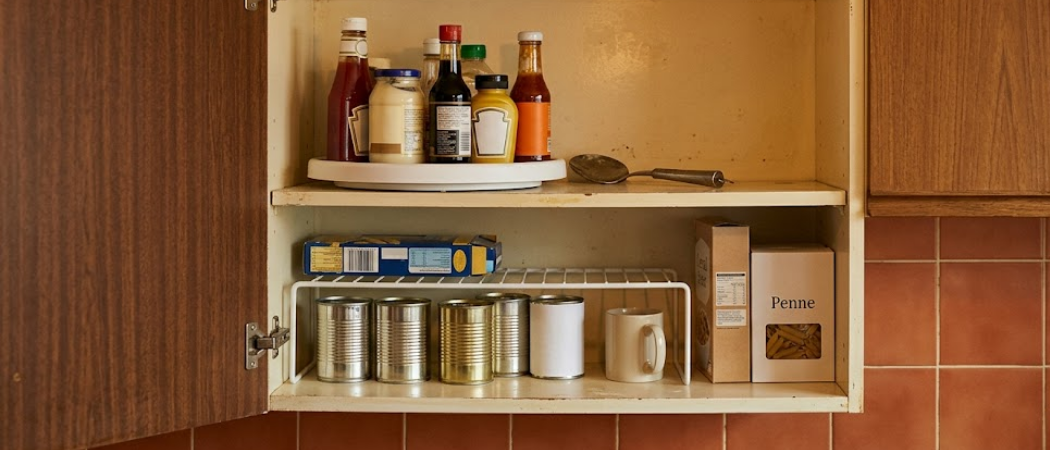
Most UK flats have no pantry. Food storage gets squeezed into whatever cupboard space remains after cookware and cleaning products are allocated — which is usually one overhead cupboard, a shelf or two, and a corner of the worktop that gradually fills up between shops.
The result is predictable. Tins stack up without rotation so the oldest ones stay at the back for months. Dry goods sit in half-open packets that go stale before they are finished. The worktop collects overflow that has nowhere else to go, reducing the usable prep area week by week. A weekly shop arrives and there is no clear system for where anything goes.
The absence of a pantry is a constraint, but it is not the root cause. The problem is treating the available storage as one undifferentiated space rather than a system of distinct zones for different food categories. This article covers that system — across the food cupboard, the worktop, and overflow storage elsewhere in the flat — without any permanent modifications to the kitchen.
Step 1 — Audit What You Actually Store
Before building any system, establish what actually needs to be stored. This step cannot be skipped — a system designed around an inaccurate picture of the inventory will not hold.
Pull everything out of the food cupboard and place it on the kitchen table or floor, grouped by category. Tins and cans together, dry goods together — pasta, rice, grains, pulses — condiments and sauces, snacks, breakfast items, baking supplies, and oils as separate groups. Seeing the full inventory by category rather than as a single pile is the only way to understand what the cupboard is actually holding.
Check every item for expiry dates. Cleaning products are not the only thing that accumulates unnoticed — food does too, particularly tinned goods and baking supplies bought for a specific recipe and never fully used. Remove anything out of date. Remove anything that has been in the cupboard for more than three months and is unlikely to be used. These items are not part of the food storage problem — they are clutter with expiry dates.
Look specifically at which categories are over-represented. Most households have significantly more tinned goods than they realise, accumulated across multiple shops without a rotation system in place. Three tins of the same item, bought across three different weeks because the existing ones were at the back and forgotten, is a common result of an unstructured food cupboard.
The audit typically removes 20 to 30 percent of what the food cupboard currently holds. That reduction is not a side effect — it is the point. A food storage system only works for the food that is actually eaten. Items that will never be used take space from items that will, and no amount of reorganisation compensates for a cupboard that contains the wrong inventory.
Step 2 — Divide Food into Storage Zones
Not all food has the same storage requirements or the same access frequency. A tin of chopped tomatoes used twice a week and a bag of ground almonds used twice a year should not occupy the same zone in the cupboard — but in an unstructured system, they usually do.
Daily access zone — front of the food cupboard. Items used every day or every other day belong at the front of the shelf, within easy reach, never stored behind anything else. Breakfast cereals, coffee, tea, cooking oils in current use, condiments that are open and being used. These are the items reached for without thinking, often while doing something else in the kitchen simultaneously. If they require moving other items to access, they will not be put back correctly after use.
Weekly rotation zone — mid and rear of the food cupboard. Tins, pasta, rice, grains, and jarred sauces belong here — items bought in a weekly shop and used throughout the week. This zone requires an active rotation system: new items go at the back, older items come to the front. Without this habit, the same tins sit at the back for months while duplicates accumulate in front of them. The rotation takes ten seconds per item when unpacking a shop and eliminates the expired-tin problem entirely.
Bulk and backup zone — overflow storage outside the kitchen. Items bought in bulk or kept as backup do not need to be in the kitchen cupboard. A spare bag of pasta, extra tins, a large bag of rice bought because it was on offer — these belong in overflow storage elsewhere in the flat. A shelf in a bedroom cupboard or a under-bed storage container is a legitimate location for backup food supplies when the kitchen cupboard is at capacity. The kitchen cupboard holds the current inventory. Overflow storage holds the backup.
Infrequent use zone — top shelf only. Baking supplies, specialist ingredients, items used a few times a year. These go on the top shelf, clearly grouped, and stay out of the daily workflow entirely. The top shelf of an overhead cupboard is the hardest to reach — it should hold only what is accessed rarely enough that the inconvenience does not matter.
Step 3 — Add Structure to the Food Cupboard
The standard food cupboard in a UK flat has one fixed shelf, creating two usable zones. Without internal structure, items stack on top of each other, things fall behind other things, and the back of each zone becomes inaccessible within days of being reorganised.
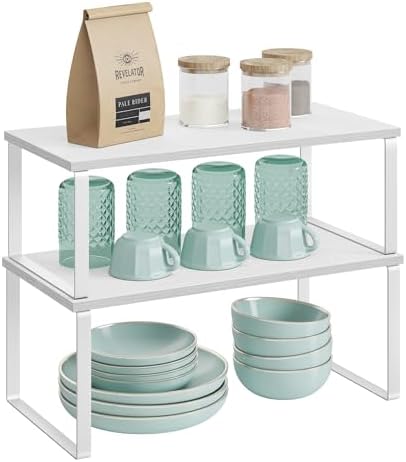
Use a shelf riser to create a third level
A shelf riser placed inside the lower zone of the cupboard creates an additional level within the existing space. Tins sit on the cupboard shelf at the base, smaller jars and packets sit on the riser above them — everything visible, nothing stacked. The same physical footprint stores significantly more once the vertical space within the lower zone is used. Shelf risers are freestanding, require no tools, and leave no marks when removed, which makes them one of the most practical additions for renters working within a standard UK flat kitchen cupboard.


Use a rotating turntable for condiments and jars
A turntable placed on the shelf keeps condiments, sauces, and jars accessible without requiring items at the front to be moved to reach items at the back. Rotate the turntable to bring whatever is needed to the front. This works particularly well in the daily access zone, where the same jars and bottles are reached multiple times per day and the friction of moving items to access others adds up quickly. A standard 25cm turntable fits within the 30cm depth of most UK flat overhead cupboards without touching the back wall.


Step 4 — Use the Worktop Strategically for Food Storage
The worktop is a prep surface first. In a kitchen without a pantry, a portion of it can be allocated to food storage without reducing the usable prep area — but only if the allocation is deliberate and limited.
Items that belong on the worktop are those used in every cooking session without exception: oils used daily, condiments added to most meals, a fruit bowl if fruit is eaten every day. A small container holding tea, coffee, and sugar belongs on the worktop if a kettle station is in use. These items justify their worktop footprint because accessing them from a cupboard multiple times per day would create more friction than keeping them on the surface.
Items that do not belong on the worktop are those that have ended up there because the food cupboard is full. Tins, packets of cereal, spare bottles of sauce — if these are on the worktop, the problem is not a lack of worktop space, it is a lack of organisation in the food cupboard. Moving them back into the cupboard correctly, using the zone system from Step 2, is the fix. Adding more worktop storage is not.
Where a small worktop shelf adds genuine value is in lifting frequently used jars and spices off the flat surface rather than adding more items to it. A narrow freestanding shelf unit — no deeper than 20 to 25cm — creates a second tier above the worktop for spices, oil bottles, and small jars, keeping the surface below clear for prep. This only works if the shelf is positioned so that the worktop width it occupies is not part of the active prep area.
Step 5 — Handle Overflow Without Adding Clutter
In a small kitchen, the food cupboard will not accommodate everything — particularly in the days immediately after a large weekly shop. The solution is not to add more kitchen storage. It is to distribute overflow to appropriate locations elsewhere in the flat, with clear rules for what goes where.
Under-bed storage is a practical location for bulk non-perishable items: large bags of rice, extra tins bought in a multi-buy offer, backup supplies of pasta or grains. The key rule is straightforward — only sealed, non-perishable items go here. Nothing that requires temperature control, air circulation, or that could attract pests if a seal is compromised. A flat under-bed container with a lid keeps these items clean, accessible, and completely out of the kitchen.
A spare shelf in a bedroom wardrobe or hallway cupboard works equally well for backup food storage. If the flat has a wardrobe with a top shelf that is partially empty, or a hallway cupboard with available space, allocating one shelf specifically to kitchen overflow turns it into a functional extension of the food system rather than a random dumping area. The shelf should hold only non-perishable, sealed items and should be treated with the same rotation discipline as the kitchen cupboard — new items at the back, older items at the front.
The most effective long-term approach to overflow is to buy only what fits in the available storage. A weekly shop calibrated to the actual capacity of the food cupboard eliminates overflow before it becomes a problem. This requires knowing the capacity of the cupboard — which the zone system from Step 2 establishes clearly.
Common Mistakes
Mistake 1: Storing everything in one cupboard regardless of access frequency
When items used daily and items used twice a year occupy the same zone in the same cupboard, the daily-use items are constantly being moved to reach something behind them and returned to the wrong place. Over time, the zone structure collapses entirely and the cupboard returns to a single undifferentiated pile.
The fix is zone allocation by frequency of use before anything goes back into the cupboard. Daily items at the front, weekly rotation items in the middle and rear, infrequent items on the top shelf. The allocation is made once and maintained by habit — items return to their zone after use, not to the nearest available space.
Mistake 2: No rotation system for tins and dry goods
Without a rotation system, the items bought most recently sit at the front because they were the last ones placed in the cupboard. The older items at the back get forgotten, expire, or are only discovered during a clear-out. The household keeps buying duplicates of items already in the cupboard because the existing ones are not visible.
The fix is a consistent rule applied every time shopping is unpacked: new items go behind existing items of the same category, always. This takes seconds per item and eliminates the accumulation of expired stock over time.
Mistake 3: Using the worktop as overflow food storage
Overflow food ends up on the worktop because it is the path of least resistance — it is easier to put something down on a clear surface than to find a place for it in a full cupboard. Once items are on the worktop, they tend to stay there, and the worktop gradually loses usable prep area.
The worktop is for daily-use items only. Anything that migrates to the worktop from the food cupboard is a signal that the cupboard organisation needs attention — either the zone system needs adjusting or items that do not belong in the kitchen need to be removed.
Mistake 4: Buying in bulk without overflow storage allocated
Bulk buying makes financial sense for non-perishable items that are used regularly. It creates a clutter problem when the bulk quantity arrives without anywhere specific to put it. The extra tins or packets end up on the worktop, on the floor, or pushed into an already-full cupboard.
The fix is to allocate overflow storage before buying in bulk. Identify the shelf or under-bed container that will hold the backup stock, confirm it has capacity, and then make the purchase. Bulk buying up to available overflow storage capacity is practical. Bulk buying beyond it creates a problem that compounds with every subsequent shop.
Mistake 5: Keeping food items that are never actually eaten
Specialist ingredients bought for one recipe, items purchased with good intentions that turned out not to suit the household’s actual diet, gifts that went into the cupboard and were never opened — these accumulate over time and take space from items that are genuinely used.
A monthly audit of the food cupboard, even a brief one, catches these items before they become a significant portion of the available storage. Any item that has been in the cupboard for more than three months without being used should be assessed honestly. If it will not be eaten in the next month, it should leave.
Frequently Asked Questions
How do I store food in a kitchen with only one cupboard?
Apply the zone system within the single cupboard: daily-use items at the front of the lower shelf, weekly rotation items in the mid and rear sections, infrequent-use items on the top shelf. Add a shelf riser to create a third level in the lower zone. Move bulk and backup items to overflow storage elsewhere in the flat — a bedroom shelf or under-bed container — so the kitchen cupboard holds only the current working inventory. The cupboard does not need to hold everything, only what is in active use.
Where can I store food in a small flat if the kitchen is full?
Non-perishable, sealed items can go in under-bed storage containers, on a spare shelf in a bedroom wardrobe, or in a hallway cupboard if one is available. These locations work for backup tins, large bags of dry goods, and bulk purchases. The rule for all of these locations is the same: sealed, non-perishable items only, stored in a container or on a dedicated shelf rather than loose. Apply the same rotation discipline as the kitchen cupboard — new items at the back, older items at the front.
Is it safe to store food under the bed?
Yes, for sealed, non-perishable items stored in a clean, lidded container. Tins, vacuum-sealed dry goods, and factory-sealed packets are suitable. Items that should not go under the bed include anything that requires temperature control, anything in packaging that has been opened and resealed, and anything that could attract pests if the seal fails. A flat under-bed storage box with a secure lid keeps the items clean and prevents any issues with dust or moisture from the floor.
How do I stop my food cupboard from becoming disorganised?
Two habits maintain the system: the rotation rule and the monthly audit. The rotation rule — new items always go behind existing items of the same category — prevents the back-of-cupboard accumulation that creates most food storage problems. The monthly audit, which takes five minutes, removes expired items, catches zone drift before it becomes significant, and identifies categories that are expanding beyond their allocated space. Neither habit requires much time individually; together they prevent the need for a full reorganisation.
Related Guides
For the complete kitchen system — zones, worktop management, and cupboard allocation across the whole kitchen — how to organise a small kitchen with limited cupboard space covers the full approach before going into category-specific detail.
For specific solutions to add internal structure to existing cupboards — shelf risers, pull-out trays, and door racks — how to organise kitchen cupboards in a small flat covers the options that work within standard UK flat kitchen cupboards without drilling or permanent modification.
The under-bed overflow storage mentioned in Step 5 follows the same principles as under-bed clothing storage — categories, containers, and a clear system for what goes where. How to store clothes under the bed without creating clutter covers the approach in detail, and most of it applies directly to food storage in the same space.
Conclusion
The absence of a pantry is a constraint, not a barrier. A zone-based system across the food cupboard, the worktop, and overflow storage elsewhere in the flat replaces the function of a pantry without requiring any structural changes to the kitchen. The food cupboard holds the current working inventory, organised by frequency of use. Overflow goes to allocated storage outside the kitchen. The system holds as long as the rotation habit is applied consistently and the monthly audit catches drift before it compounds.