
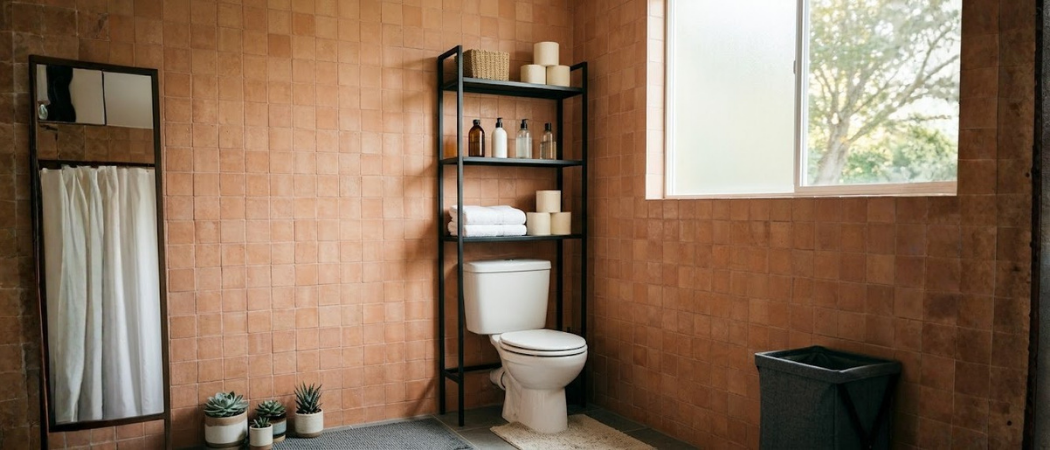
The wall above the toilet in a small flat bathroom is almost always empty. It is the largest unused vertical surface in the room — and in a bathroom with no built-in storage, it is also the most valuable. Most renters leave it empty not because there is nothing to put there, but because every obvious solution appears to require drilling into tiles or walls, which is not available to most tenants without landlord permission.
Freestanding over-toilet shelving units require no wall contact at all. They stand on the bathroom floor on either side of the toilet pan, span above the cistern, and hold three full shelves of storage in a footprint that takes up none of the usable floor space in the room. No drilling, no landlord permission, and no tools beyond an Allen key for assembly.
This article covers how to measure the space correctly before buying anything, which type of unit works for which bathroom configuration, what to store at each shelf level to make the space genuinely functional, and when a standard over-toilet unit is not the right answer.
Measure Before You Buy
Most over-toilet units bought online do not fit because the buyer measured the wrong thing. Wall width, available height, and overall room dimensions are not the relevant measurements. The measurements that determine whether a unit will fit are specific to the toilet itself — and they take five minutes to take correctly.
Measure the toilet footprint, not the wall
A freestanding over-toilet unit does not hang from the wall or rest on the cistern. Its legs stand on the bathroom floor on either side of the toilet pan — which means the legs must be far enough apart to straddle the pan without touching it. The relevant measurement is the width of the toilet pan at its widest point, typically 35 to 40cm for a standard UK close-coupled toilet. The unit legs must be set wider than this measurement to clear the pan on both sides.
Most standard over-toilet units are 60 to 65cm wide between the outer edges of the legs — which provides 20 to 25cm of clearance on each side of a standard UK toilet pan. This is sufficient for the vast majority of UK flat bathrooms. Measure the toilet pan width at its broadest point — usually at the front of the pan rather than at the cistern — and confirm it is narrower than the unit’s leg span before ordering.
Measure the depth from cistern to wall
The cistern on a standard UK close-coupled toilet sits 10 to 15cm from the wall behind it. The back legs of a freestanding over-toilet unit must fit within this gap — between the back of the cistern and the wall. Most units have back legs approximately 10 to 12cm deep. If the gap between the cistern and the wall is less than the unit’s back leg depth, the unit will be pushed forward, sit at an angle, and become unstable.
Measure the gap from the back of the cistern to the wall before buying. If the gap is under 10cm — which occurs in some older UK flat bathrooms where the cistern is positioned very close to the wall — check the specific back leg dimension in the product specification rather than assuming a standard unit will fit.
Measure the height available
From the top of the cistern to the ceiling is typically 80 to 120cm in a standard UK flat bathroom. A three-tier over-toilet unit is typically 160 to 175cm tall in total, with the lowest shelf positioned above the cistern at approximately 70 to 80cm from the floor. The upper shelves then occupy the vertical space above that point.
Measure from the floor to the ceiling at the position where the unit will stand — not from the top of the cistern, which is the common mistake. The unit height in the product specification is the total height from floor to the top of the frame, and that total must be less than the floor-to-ceiling measurement at that position. In bathrooms with a sloped ceiling or a ceiling that drops near the toilet wall, measure at the exact point where the top of the unit will sit.
Check for wall-hung toilets
If the toilet has no visible cistern and the flush is activated by a panel built into the wall above the toilet, this is a wall-hung toilet. Standard freestanding over-toilet units are not designed for this configuration — the legs have nothing to straddle, because there is no pan base to clear and no cistern creating the gap the back legs need. A standard unit placed over a wall-hung toilet will be unstable and incorrectly positioned.
The alternative for a wall-hung toilet is a tall slim freestanding shelving unit placed beside the toilet rather than above it. This achieves the same vertical storage without requiring the unit to straddle the toilet configuration. Measure the available floor space beside the toilet — typically between the toilet and the adjacent wall or bath panel — and choose a unit narrow enough to fit without blocking movement.
The Three Types of Over-Toilet Storage That Work Without Drilling
The freestanding three-tier étagère
The most versatile and widely available option. A metal or bamboo frame with three open shelves spanning the width above the cistern, with legs standing on the floor on either side of the toilet pan. Available in widths of 58 to 65cm to fit standard UK close-coupled toilets. The open shelf design means everything stored on it is visible and immediately accessible without opening a door or lid. The trade-off is that open shelves in a bathroom accumulate moisture — products stored here should be in moisture-resistant containers, or be products that are unaffected by bathroom humidity. This is also the most affordable option in the category, with reliable models available under £35. Check current options on Amazon.


The over-toilet cabinet unit
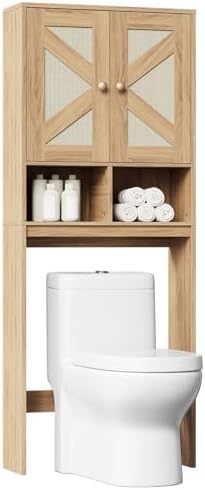
A unit with a closed cabinet section on the upper portion and open shelves on the lower portion. The closed cabinet conceals products that are less visually uniform — spare toiletries in different packaging, medicines, cleaning supplies — while the open lower shelves hold towels and items in current use. The enclosed upper section also protects contents from the direct humidity that affects open shelves. More expensive than the open étagère, but significantly better suited to bathrooms where visual tidiness is a priority or where the contents are not uniformly presented. Assembly is typically more involved than the open frame unit. See current price on Amazon.
[AFFILIATE LINK — over-toilet cabinet unit with closed storage]


The slim over-toilet unit for narrow bathrooms
For bathrooms where the standard 60 to 65cm unit width would leave insufficient clearance between the toilet and an adjacent wall, bath panel, or radiator, slim units of 50 to 55cm width are available. These fit a narrower footprint but have shallower shelves — typically around 20cm deep rather than the 25 to 30cm of standard units. This depth reduction limits what can be stored: folded towels, toilet rolls, and small product bottles fit comfortably; larger bottles, heavy containers, and bulkier items do not. A slim unit used at full capacity for appropriate items is more functional than a standard unit that does not fit the space.
What to Store on Each Shelf Level
The placement of items across the three shelf levels determines whether the unit is genuinely functional or simply present. In a bathroom, two factors govern placement: frequency of access and weight distribution.
Bottom shelf — heaviest items and most frequent access. The bottom shelf of a standard over-toilet unit sits at approximately 70 to 80cm from the floor — below eye level and within easy reach without stretching. This is where daily-use items belong: hand towels folded and stacked, toilet rolls in current rotation, the product used every day. Heavy items also belong here — the lower the centre of gravity on a freestanding unit, the more stable it is under daily use and in the presence of bathroom humidity, which causes materials to expand and contract over time.
Middle shelf — weekly use items. The middle shelf sits at approximately 100 to 110cm from the floor — at or just above eye level for most adults. Spare products, folded face cloths, and items used several times a week but not every day are appropriate here. Avoid heavy items on the middle shelf — a unit loaded heavily in the middle with a lighter base becomes progressively less stable, particularly as joints loosen slightly over months of humidity cycling.
Top shelf — rarely used items and lightweight storage. The top shelf of a standard three-tier unit is typically 140 to 155cm from the floor — above eye level for most adults and requiring a reach or a step to access comfortably. Store only lightweight items here: spare toilet rolls stacked loosely, an empty basket for miscellaneous items, seasonal products used a few times a year. Never store heavy glass bottles, full product containers, or anything breakable on the top shelf of a freestanding unit. A heavy item falling from 150cm in a small bathroom is a safety risk.
Stability and Safety in a Humid Environment
A freestanding over-toilet unit that is incorrectly assembled or improperly loaded is a safety risk in a confined bathroom space. Several specific checks apply.
Assembly requires all joints to be tightened fully at installation and rechecked monthly. A loose joint in a freestanding bathroom unit becomes progressively looser with humidity cycling — warm shower steam expands the joints, cooling and drying contracts them. Over weeks, a joint that was finger-tight at assembly may develop noticeable movement. Check all fixings monthly and retighten any that show movement. This takes two minutes and prevents a unit from becoming unstable gradually without any obvious warning.
Material selection determines how long a unit lasts in a bathroom environment. Metal units must be powder-coated or stainless steel — untreated metal will develop surface rust within weeks in a UK flat bathroom, particularly in bathrooms without an extractor fan or adequate natural ventilation. Bamboo is naturally moisture-resistant and does not rust, making it a reliable alternative for bathrooms with high humidity and limited ventilation. Avoid chrome-finish units described only as “chrome” without a rust-resistance specification — the finish may not protect the underlying metal adequately.
Weight distribution across the three shelves must follow the heavy-at-bottom principle consistently — not just at installation, but as items are added and removed during daily use. A unit that is correctly loaded on day one can become top-heavy over time if heavy items gradually migrate upward. The monthly check is the right moment to reassess the loading and return any heavy items to the lower shelf.
Wall contact provides additional stability without any fixing. Most freestanding over-toilet units lean slightly against the wall when positioned correctly — the angle of the frame naturally causes the upper portion to rest against the wall surface. This contact requires no fixing and leaves no permanent mark. If the contact point is against a tiled surface, place a small felt pad between the unit frame and the tile to prevent scratching the tile glaze under the slight pressure.
When a Freestanding Unit Is Not the Right Answer
A standard freestanding over-toilet unit works for the majority of UK flat bathrooms — but not for all configurations.
Wall-hung toilets have no cistern to work around and no pan base configuration that a standard unit can straddle. The space above a wall-hung toilet is clear and usable, but a standard over-toilet unit cannot be positioned correctly without the toilet pan and cistern that its leg placement is designed around. The practical alternative is a tall slim freestanding shelving unit placed beside the toilet rather than above it. This requires floor space adjacent to the toilet — typically between the toilet and the nearest wall or bath panel — but achieves the same vertical storage result without requiring a specific toilet configuration.
Very narrow bathrooms present a different constraint. If the toilet is immediately adjacent to a wall or bath panel with less than 10cm of clearance on one side, the legs of a standard unit cannot clear the toilet and reach the floor simultaneously on that side. A slim unit designed for narrower configurations — 50 to 55cm wide — is the only freestanding over-toilet option in this case. If even a slim unit does not fit due to the bathroom layout, an over-door rack on the bathroom door provides an alternative vertical storage solution that uses no floor space at all.
Bathrooms with very low ceilings are a less common but real constraint in some older UK flat conversions, particularly those in period buildings where upper floors were subdivided. If the ceiling height is less than 200cm at the toilet position, a standard three-tier unit at 160 to 175cm tall may not fit — or may fit with very limited clearance that makes the top shelf impractical to use. Measure the floor-to-ceiling height at the toilet position before ordering any unit taller than 160cm.
Common Mistakes
Mistake 1: Measuring the wall width instead of the toilet footprint
The wall above the toilet is typically 60 to 90cm wide — wide enough for any standard over-toilet unit. This measurement is irrelevant to whether the unit will actually fit. What determines fit is whether the unit’s leg span is wide enough to straddle the toilet pan without the legs resting on or touching the pan itself.
Measure the toilet pan width at its widest point before looking at any units. This measurement is typically 35 to 40cm for a standard UK close-coupled toilet. Any unit with a leg span of 58cm or more will clear this with adequate room. The wall width measurement can be ignored entirely.
Mistake 2: Not checking the depth between cistern and wall
A unit bought without checking the cistern-to-wall gap will typically sit 5 to 10cm further forward than intended — the back legs cannot reach the floor in the gap behind the cistern, so the unit tilts forward and becomes unstable. This is the most common reason over-toilet units are returned.
The fix is to measure the gap between the back of the cistern and the wall before purchasing. Then check the back leg depth specification in the product listing — this is often listed under dimensions or assembly notes. If the cistern-to-wall gap is smaller than the unit’s back leg depth, the unit will not sit correctly.
Mistake 3: Loading the top shelf with heavy items
The intuitive behaviour when filling a new storage unit is to put the largest or heaviest items where there is most space — which is often the top shelf. On a freestanding unit in a bathroom, this creates a top-heavy configuration that is unstable under daily use and becomes progressively more so as humidity affects the joints.
Heavy items belong on the bottom shelf. Towels, toilet rolls, and heavy product bottles go at the base. The top shelf holds only lightweight items — spare rolls, empty baskets, seasonal products. Redistribution takes two minutes and significantly improves the unit’s stability for the life of the product.
Mistake 4: Buying an untreated metal unit for a humid bathroom
Units described as “chrome” or “metal” without a specific rust-resistance rating are frequently made from untreated or lightly coated steel. In a UK flat bathroom — particularly one with a shower over bath, limited ventilation, and no extractor fan — surface rust can appear within weeks on an untreated unit.
Check the material specification before purchasing. Powder-coated steel and stainless steel are both reliably rust-resistant in bathroom conditions. Bamboo is a suitable alternative. If the listing does not specify the coating or material clearly, assume the rust resistance is insufficient for a high-humidity environment.
Mistake 5: Assuming a wall-hung toilet means no over-toilet storage is possible
The assumption that a wall-hung toilet rules out vertical storage above it leads to leaving the entire vertical zone unused. In practice, the space above and beside a wall-hung toilet is often more accessible than the space above a standard cistern — there is no cistern to work around and the wall space is unobstructed.
A tall slim freestanding shelving unit placed beside the toilet achieves the same vertical storage without requiring the toilet-straddling configuration of a standard over-toilet unit. Measure the floor space beside the toilet and choose a unit narrow enough to fit without blocking movement to and from the toilet.
Frequently Asked Questions
Do over-toilet storage units need to be fixed to the wall?
No — freestanding over-toilet units are self-supporting and require no wall fixing. The legs stand on the bathroom floor on either side of the toilet pan, and the upper frame rests lightly against the wall for added stability without any fixing point. The contact with the wall is purely gravitational — the unit leans slightly rather than being attached. A felt pad at the contact point prevents any scratching of tiled surfaces.
What size over-toilet unit do I need for a UK flat bathroom?
Take three measurements before buying: the toilet pan width at its widest point, the gap between the back of the cistern and the wall, and the floor-to-ceiling height at the toilet position. For the majority of UK flat bathrooms with a standard close-coupled toilet, a unit 60 to 65cm wide, with back legs under 12cm deep, and a total height under 175cm will fit correctly. Confirm all three measurements against the product specification before ordering.
Are over-toilet storage units safe in a bathroom with children?
Safety depends primarily on weight distribution and assembly quality. Keep heavy items on the bottom shelf to maintain a low centre of gravity. Check all joints are fully tightened at assembly and recheck monthly. Avoid loading the top shelf with heavy or breakable items. In a bathroom used regularly by young children, a unit with a closed cabinet section — which encloses the upper shelves — is more stable than an open étagère because the cabinet structure adds rigidity to the frame.
Can I use an over-toilet unit with a wall-hung toilet?
No — standard freestanding over-toilet units are designed to straddle a close-coupled toilet pan and cistern. A wall-hung toilet has no pan base or cistern for the unit to work around, so the standard leg configuration cannot be positioned correctly. The practical alternative is a tall slim freestanding shelving unit placed beside the toilet rather than above it, which achieves the same vertical storage without requiring the straddling configuration.
Related Guides
The over-toilet zone is one part of a complete bathroom organisation system. For the full zone-based approach — shower zone, door zone, under-sink zone, and the maintenance routine that keeps all of them functional — how to organise a small bathroom in a rented flat covers the complete picture before the individual product decisions.
The principle of measuring around fixed obstacles before buying any storage product applies in every room of a small flat. In the kitchen, it is the pipe and siphon under the sink — how to maximise under-sink storage in a small flat covers that measurement process in detail, with an approach that transfers directly to measuring around a toilet cistern.
Assigning each shelf level a specific purpose — rather than filling shelves based on available space — is the same principle covered in how to organise kitchen cupboards in a small flat, where the same logic of frequency of use and weight distribution determines what goes where in each cupboard.
Conclusion
The space above the toilet is the most consistently wasted storage area in a small UK flat bathroom — and the easiest to address without any permanent modification to the room. A freestanding three-tier unit costs under £40, requires no drilling, and creates three full shelves of usable storage in a footprint that occupies no floor space beyond the toilet itself. Three measurements taken before buying — toilet pan width, cistern-to-wall depth, and available ceiling height — are the only requirement for choosing a unit that fits correctly and functions reliably.