
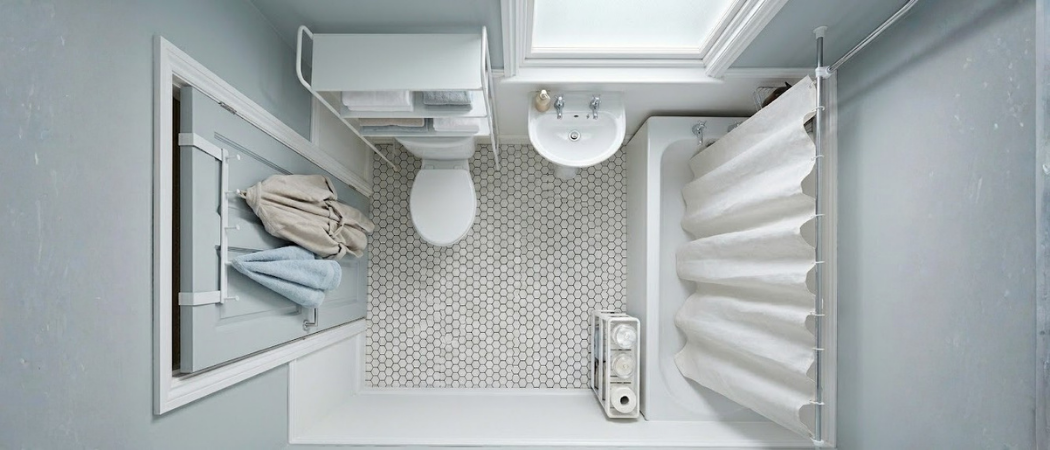
In a rented flat, drilling bathroom walls is rarely permitted. Tiles crack if drilled incorrectly, landlords deduct costs from deposits, and most tenancy agreements explicitly prohibit making holes in walls. This rules out the most common bathroom storage solutions shown in home improvement content — wall-mounted shelves, fixed towel rails, and built-in niches — which are also the solutions most bathroom storage products are designed around.
Most renters assume that no drilling means no storage options beyond what the landlord provided. This is not correct. Four categories of no-drill solution — freestanding units, over-door products, tension rods, and removable adhesive on appropriate surfaces — together cover every storage need in a standard UK flat bathroom without touching the walls permanently.
This article covers a complete no-drill bathroom storage system built from these four categories, what each category works for, and the honest limitations of each — including the specific limitations of adhesive products on the tile surfaces common in UK flat bathrooms.
Category 1 — Freestanding Units
Freestanding units require no wall contact and work in any bathroom regardless of wall surface, tile type, or tenancy restrictions. They are the most reliable no-drill option because they depend entirely on gravity rather than adhesion or tension — which means they cannot fail due to surface incompatibility or humidity.
Over-toilet shelving unit. A freestanding étagère that stands on the bathroom floor on either side of the toilet pan and spans above the cistern creates three full shelves of storage in a footprint that uses no usable floor space. No wall contact is required — the unit leans slightly against the wall for stability without any fixing point. In a small bathroom with no built-in storage, this is the single most effective addition available to a renter. It uses the largest consistently empty vertical zone in the room and costs under £40 for a functional model.
Slim bathroom trolley. A narrow trolley on castors that slides into a gap of 15 to 25cm — between the toilet and the bath, between the basin and the wall, or wherever a slim unused gap exists in the bathroom layout. Most UK flat bathrooms have at least one gap of this width that is currently serving no purpose. A slim trolley in this position adds three to four tiers of accessible storage without occupying any dedicated floor space and without any wall contact. The castors allow it to be pulled out for access and pushed back flush when not in use.
Freestanding towel rail. A freestanding towel rail stands on the bathroom floor and holds towels without any wall fixing. In bathrooms where the landlord-provided towel rail is undersized, poorly positioned, or missing entirely, a freestanding rail adds towel capacity without making any modification to the room. Slim models occupy under 30cm of floor space and can be positioned wherever the floor space permits.
Category 2 — Over-Door Solutions
The back of the bathroom door is flat, vertical space that is almost always empty. Over-door products hook over the door edge and hold items on the inside face — no drilling, no adhesive, no contact with any wall or tile surface, and no marks left on the door when removed.
Over-door hook set. A set of hooks that hang over the top of the bathroom door hold towels, dressing gowns, and bags on the inside face without any fixing to the door surface. The hooks sit over the door edge and are held in place by their own weight and the weight of whatever hangs from them. Fully removable in seconds. This is the lowest-cost and fastest no-drill bathroom storage addition available — it addresses the towel and dressing gown storage problem immediately and requires no measurement beyond confirming the door thickness is within the hook opening range. Check current options on Amazon.
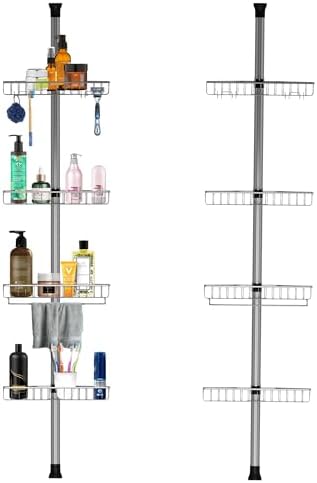
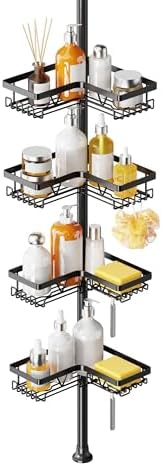

Over-door storage rack. A larger rack that hooks over the bathroom door and provides multiple tiers of storage on the inside face — enough for toiletries, small cleaning products, and items that would otherwise clutter the basin surround or window ledge. The rack hooks over the door top edge in the same way as a hook set but extends further down the door panel. Before buying, check the door thickness against the product specification — most over-door racks are designed for doors of 35 to 45mm thickness, which covers the majority of UK flat internal bathroom doors, but older or non-standard doors may fall outside this range.
Category 3 — Tension Rod Solutions
A tension rod is a spring-loaded rod that presses against two parallel surfaces and holds itself in position through tension alone. No drilling, no adhesive, no marks on any surface. The rod works between any two surfaces that are parallel and within its adjustable length range — which makes it one of the few no-drill solutions that works reliably on textured tiles, where adhesive fails.
Tension rod shower caddy. A tension rod fitted vertically in the corner of a shower enclosure or bath surround — pressing between the ceiling and the shower tray floor, or between two walls in a corner — holds a multi-shelf caddy that clips onto the rod. The caddy holds shampoo, conditioner, body wash, and shower accessories without any suction cups, drilling, or adhesive. It works on any tile surface regardless of texture, which makes it the most reliable no-drill shower storage solution for UK renters, where textured tiles are common and suction cups consistently fail. See current price on Amazon.


Tension rod under the basin. A horizontal tension rod fitted between two surfaces in the under-basin area — between the sides of a pedestal, or between the wall and a pipe boxing — creates a hanging rail for small baskets or S-hooks. Products in the baskets hang below the basin without touching the floor and without any wall contact. This works best in wall-hung basin configurations where there is clear space beneath the basin and two parallel surfaces within the rod’s adjustable range.
Tension rod across a window alcove. If the bathroom has a window recess or an alcove beside the bath, a horizontal tension rod fitted across the opening creates an instant shelf — baskets hung from it hold products, or a rod-mounted shelf attachment holds bottles directly. This uses otherwise completely dead space without any modification to the recess or the surrounding surfaces. The rod adjusts to fit the width of the opening and holds in position through spring tension.
Category 4 — Removable Adhesive on Appropriate Surfaces
Removable adhesive products are the most widely marketed no-drill bathroom storage solution and the most frequently misused. The failure cases are predictable and avoidable — but only if the surface is assessed correctly before buying.
Where removable adhesive works reliably. Smooth, painted plaster walls — the walls above the tile dado in most UK flat bathrooms — are the most reliable surface for removable adhesive hooks and strips. The adhesive bonds to the paint layer and, if removed correctly according to the manufacturer’s instructions, releases without damaging the surface. Smooth, glazed tiles also hold removable adhesive and suction cup products reliably, provided the tile surface is completely clean, fully dry, and non-porous. On these surfaces, removable adhesive is strong enough for lightweight items — a towel hook, a small shelf with light contents, a soap dish — and holds consistently under normal bathroom conditions.
Where removable adhesive does not work. Textured tiles are the most common failure case in UK flat bathrooms. The adhesive cannot make full contact with a textured surface — it contacts the raised points of the texture only, leaving gaps that prevent a reliable bond. The product holds initially and then fails within days, typically when the bathroom is humid after a shower. Check the tile surface by running a finger firmly across it before buying any adhesive product. If the surface has any texture at all, do not use adhesive — use a tension rod solution instead. Humid surfaces are the second failure case: adhesive applied to a wall that has not dried completely after a shower will not bond correctly regardless of the surface type. Always wait a minimum of two hours after the bathroom has been used before applying any adhesive product, and ideally longer.
The weight limit rule. Removable adhesive products have manufacturer-stated weight limits. In a bathroom, treat these limits conservatively — bathroom humidity cycling weakens the adhesive bond gradually over time, even on suitable surfaces. A hook rated to 3kg in a dry environment should not be loaded to 2.5kg in a bathroom. Use removable adhesive for lightweight items only: a hand towel hook, a small soap shelf, a mirror. For anything heavier, use a freestanding unit or an over-door solution instead.
A Complete No-Drill Bathroom Storage System
The four categories above are more effective in combination than any single solution in isolation. For a standard small UK flat bathroom, a complete no-drill system looks like this.
The freestanding over-toilet shelving unit provides the main storage zone — towels on the lower shelf, spare products in the middle, toilet rolls and rarely used items at the top. This single unit addresses the largest unused storage zone in the bathroom without touching any wall.
The tension rod caddy in the shower or bath enclosure holds all shower products — shampoo, conditioner, body wash — without any wall contact and without relying on suction cups that fail on textured tiles. Every shower product has a fixed location and the bath edge stays clear.
The over-door hook set on the bathroom door holds towels and the dressing gown on the inside face, freeing the towel rail for its intended purpose and adding hanging capacity where there was previously none.
A slim trolley in the gap beside the toilet or bath holds cleaning products and daily-use items at an accessible height, replacing the cluttered basin surround as a default storage surface.
Removable adhesive hooks on the smooth painted wall beside the basin — not on tiles — hold a hand towel and small items at mirror height, using the one surface in the bathroom where adhesive holds reliably without being a risk.
The result is a complete bathroom storage system with no holes in any wall, no damage to any surface, and every component removable and portable when the tenancy ends.
Common Mistakes
Mistake 1: Using suction cups on textured tiles
Suction cups are marketed as renter-friendly and no-drill — which they are, on the right surface. On textured tiles, the cup cannot form a seal across the full contact area and the hold fails within days, usually when the bathroom is humid after a shower. The failure is often blamed on the product rather than the surface mismatch.
The fix is to check the tile surface before buying any suction-mounted product. Run a finger firmly across the tile — if it has any texture, suction cups will not hold reliably. A tension rod caddy is the correct alternative for the shower zone: it works on any surface regardless of texture and holds in position through tension rather than adhesion.
Mistake 2: Applying adhesive to a recently used bathroom surface
Adhesive products applied to a surface that is still warm or humid from a recent shower do not bond correctly. The moisture prevents the adhesive from making full contact with the surface, and the bond that forms is significantly weaker than the rated strength. The product appears to hold initially and then fails when the bathroom is used again.
Wait a minimum of two hours after the bathroom has been used before applying any adhesive product — longer if the bathroom has poor ventilation and takes more time to return to ambient humidity. Wipe the surface with a dry cloth immediately before applying the adhesive, even if it appears dry, to remove any remaining moisture film.
Mistake 3: Overloading removable adhesive products
The weight limits stated by removable adhesive manufacturers are measured under laboratory conditions on ideal surfaces at constant temperature and humidity. A bathroom is none of those things — humidity cycles with every shower, temperature varies significantly, and the adhesive bond degrades gradually over weeks and months even on suitable surfaces.
Treat manufacturer weight limits conservatively in a bathroom context. A hook rated to 4kg should not carry more than 2kg of wet towels in a bathroom with daily shower use. Use removable adhesive for genuinely lightweight items — a hand towel hook, a soap shelf, a small mirror. For anything that needs to carry real weight, use a freestanding unit or an over-door solution.
Mistake 4: Ignoring the back of the bathroom door
The back of the bathroom door does not register as storage space because it is not a surface that is visible when the room is in normal use. The door is open when the bathroom is being used, which means the inside face is against the wall and out of sight. Most renters never consider it as a storage location.
An over-door hook set addresses this in the most straightforward way possible — it hooks over the door top edge, holds towels and a dressing gown on the inside face, and can be installed in under thirty seconds. It is the fastest and cheapest no-drill bathroom storage addition available and consistently delivers more immediate impact than any other single product in this category.
Mistake 5: Buying a freestanding unit without measuring the available floor space
The space available for a freestanding unit in a small bathroom is constrained by the toilet position, the cistern, the adjacent wall or bath panel, and the bathroom door arc. A unit bought based on its total dimensions rather than the available space in the specific bathroom configuration will either not fit or will obstruct movement.
Measure the gap on each side of the toilet, the depth from the cistern to the wall behind it, and the floor-to-ceiling height at the toilet position before buying any over-toilet unit. For a slim trolley, measure the gap it will occupy — width, depth, and height clearance. The measurements take five minutes and eliminate the most common reason bathroom storage units are returned.
Mistake 6: Assuming no-drill means limited storage
The assumption that no drilling means minimal storage options leads to leaving bathrooms significantly underorganised. Renters accept cluttered basin surrounds, overloaded towel rails, and empty walls above the toilet because they assume nothing can be done without permission.
The four-category system — freestanding, over-door, tension rod, and removable adhesive — covers every storage zone in a standard UK flat bathroom without a single hole in any wall. A bathroom fully equipped with solutions from all four categories has more organised storage than most bathrooms with drilled shelving, because the system is designed around the specific zones and constraints of the room rather than placed wherever a drill can reach.
Frequently Asked Questions
What is the best no-drill storage solution for a small bathroom?
The answer depends on the primary storage gap. For maximum overall storage volume, a freestanding over-toilet shelving unit is the most impactful single addition — it creates three full shelves in a space that is otherwise unused. For the shower zone specifically, a tension rod caddy is the most reliable solution for UK flat bathrooms where textured tiles make suction cups unreliable. For towels and hanging storage, an over-door hook set on the bathroom door addresses the need immediately at minimal cost. The combination of all three covers the main storage needs of a small bathroom more effectively than any single solution.
Do Command strips work in bathrooms?
On smooth painted walls, yes — Command strips and equivalent removable adhesive products bond reliably to painted plaster and release cleanly if removed according to the instructions. On tiles, it depends entirely on the tile surface. Smooth, glazed tiles hold removable adhesive reliably for lightweight items. Textured tiles do not — the adhesive cannot make full contact and the bond fails under bathroom humidity. Check the tile surface before buying: if it has any texture, use a tension rod or freestanding solution instead of adhesive.
Can I use a tension rod in any shower or bath enclosure?
Yes, for vertical tension rods — a rod pressing between the ceiling and the shower tray or bath floor, or between two walls in a corner, works in any enclosure regardless of tile surface. The only check required is that the rod’s adjustable length range covers the distance between the two surfaces. Most tension rod caddies adjust between 130cm and 300cm for floor-to-ceiling installation, which covers standard UK flat bathroom ceiling heights. Measure the relevant distance before buying to confirm the rod extends to the required length.
Will no-drill storage solutions damage the bathroom when I move out?
Freestanding units and over-door solutions leave no marks on any surface — they make no contact with walls and leave nothing behind when removed. Removable adhesive products leave no marks if removed correctly: pull the adhesive tab slowly at a low angle along the wall surface rather than pulling it away from the wall. Pulling at the wrong angle tears the adhesive rather than releasing it, which can damage the paint. Suction cups leave no marks on smooth surfaces when released correctly — press the release tab rather than pulling the cup directly off the tile.
Related Guides
For a complete zone-based system covering every area of a small rented bathroom — what to store where, how to allocate each zone, and the maintenance routine that keeps the system functional — how to organise a small bathroom in a rented flat covers the full approach before the individual product decisions.
The freestanding over-toilet unit is the single most effective no-drill storage addition to a small bathroom. For detailed guidance on measuring the toilet footprint, choosing between the three unit types, and loading each shelf level correctly, how to maximise storage above the toilet in a small bathroom covers every configuration and common mistake.
The space under the bathroom sink — whether a pedestal or wall-hung basin — has its own no-drill solutions specific to each configuration. How to organise under the bathroom sink in a small flat covers the pedestal organiser, the slim freestanding unit, and the measurement process for each sink type.
Conclusion
A rented bathroom does not need drilled walls to be organised. Freestanding units cover the main storage zones without touching any wall. Over-door solutions use the back of the bathroom door — a surface that is otherwise always empty. Tension rods work in the shower enclosure regardless of tile texture. Removable adhesive works on smooth painted walls and smooth glazed tiles for lightweight items. Together, these four categories create a complete storage system that covers every area of a standard small UK flat bathroom — and every component of it can be removed, packed, and taken to the next flat without leaving a single mark behind.