
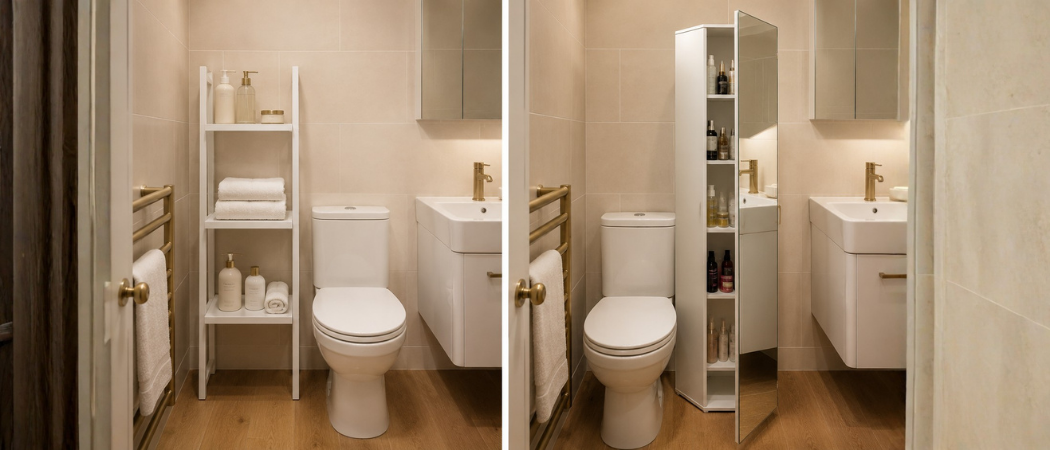
Quick verdict: For most renters in small UK flat bathrooms, a mirrored bathroom cabinet is the better choice. It provides enclosed storage, eliminates the need for a separate mirror, and keeps products protected from bathroom humidity in a way that open shelves cannot. Open shelves work only when the bathroom is used with consistent tidiness habits and when the products stored are genuinely presentable at all times. In a high-humidity UK flat bathroom with limited ventilation, that condition is rarely met consistently — and the exception to this is covered below.
Adding storage to a small bathroom comes down to one choice in most cases: open shelves that display what is stored on them, or a closed cabinet that conceals it. Both options are widely available for small bathrooms without drilling. Both have specific advantages and specific failure modes that product descriptions do not mention.
This article covers an honest comparison of both options for a small rented UK flat bathroom — including the humidity problem that affects open shelves, the bulk problem that affects cabinets, and the specific situations where each option is genuinely the better choice.
The Case for a Bathroom Cabinet
Cabinets keep products away from humidity. Every product stored on an open bathroom shelf is exposed to steam, condensation, and humidity cycling every time the shower or bath is used. Labels peel, cardboard packaging softens, and products accumulate a film of moisture and dust that requires regular cleaning to manage. A cabinet door eliminates this exposure entirely — products inside are protected from the bathroom environment even in a poorly ventilated UK flat bathroom where steam lingers for an hour after every shower. This is not a minor advantage. In a bathroom used daily, the difference in product condition and shelf cleanliness between open and closed storage is visible within weeks.
Cabinets hide disorganisation without requiring it. An open shelf requires its contents to be consistently tidy and visually coherent — mismatched bottles, a sideways tube, an open packet of cotton wool all register immediately on a visible shelf. A cabinet does not require any of this. Whatever is inside is invisible when the door is closed, regardless of how it is arranged. This is not a permission to be disorganised — it is an honest acknowledgement that closed storage is more forgiving of how people actually use bathrooms under time pressure, and that the visual tidiness of an open shelf is a maintenance commitment that has to be sustained every day to remain effective.
The mirrored cabinet — the most efficient use of small bathroom space. A mirrored bathroom cabinet solves two problems with one product: it provides enclosed storage and replaces the need for a dedicated bathroom mirror. In a small flat bathroom where every surface and every wall position matters, this combination is the most efficient storage addition available. For renters who can obtain landlord permission to mount a cabinet, it frees wall space that a separate mirror would otherwise occupy. For renters who cannot, a freestanding mirrored cabinet unit — available as an over-toilet freestanding unit or as a slim floor-standing unit beside the basin — achieves the same result without drilling. Check current options on Amazon.


The Case for Bathroom Shelves
Shelves keep products immediately accessible. An open shelf requires no door to open, no searching inside a closed space, and no closing again after use. In a bathroom where the morning routine is fast — reaching for products while getting ready, grabbing something mid-shower — this immediate access matters more than it appears in the abstract. A well-curated shelf with a deliberately limited number of frequently used products is faster to use than a cabinet. The key word is curated: this advantage only holds when the number of products on the shelf is kept small enough that every item is visible and reachable without moving anything else.
Shelves take less visual space. A cabinet adds physical bulk to a bathroom wall — a box that projects from the surface and, in a small bathroom where walls are already close, can make the room feel more enclosed. An open shelf does not add this bulk in the same way. In a bathroom where the priority is keeping the space feeling open rather than maximising concealed storage, a slim open shelf is a genuine advantage. This is a real consideration — but it only holds if the shelf contents are consistently maintained. A cluttered open shelf adds more visual noise to a small bathroom than a closed cabinet ever would.
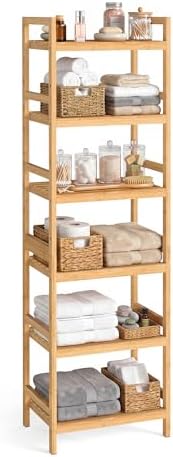
Freestanding shelf units are available without drilling. For renters, freestanding bathroom shelf units — slim three-tier or four-tier units in metal, bamboo, or wood-effect finishes — provide open storage without wall contact. Most are narrow enough to fit beside the toilet, beside the basin, or in a corner without obstructing movement. The limitation compared to a wall-mounted shelf is floor space: a freestanding unit occupies floor area that a wall-mounted option would not. See current price on Amazon.


The Humidity Problem — Why This Matters More in UK Bathrooms
UK flat bathrooms have high humidity and frequently limited ventilation. Many older flat conversions have no extractor fan and rely on a single openable window — which is often kept closed from October to March. Steam from a shower or bath in a poorly ventilated bathroom condenses on every surface in the room within minutes, including every product on open shelves. This is not a problem that better organisation resolves. It is a physical property of the environment.
The practical consequences for open shelves are consistent and cumulative. Products stored on open shelves in a high-humidity UK bathroom need cleaning weekly — not just the shelf surface but the products themselves. Pump dispensers accumulate a visible film within days of a shower. Cardboard packaging softens and eventually degrades. Labels peel at the edges. A set of open shelves that looked clean and considered on the day of installation looks progressively more neglected without active and regular maintenance. This is not a criticism of open shelving as a concept — it is a description of what happens in a specific environment.
The practical consequences for a cabinet are significantly lower. The inside of a bathroom cabinet in a humid environment also accumulates moisture over time, but at a much slower rate than an open shelf because the door prevents direct exposure to steam after every shower. The inside of a closed bathroom cabinet in a UK flat typically needs cleaning monthly rather than weekly. Over a year of daily bathroom use, the difference in maintenance load between the two options is substantial — and it is the factor that most product comparisons between shelves and cabinets consistently fail to address.
The Habit Question
Open shelves in a bathroom only work consistently if the products on them are always returned to the same position after use, are visually coherent with each other, and are wiped down regularly enough to prevent humidity residue from accumulating. Before choosing open shelves, ask honestly: are the products currently in the bathroom all visually presentable? Are they consistently returned to the same spot after every use? Is the bathroom cleaned thoroughly — surfaces wiped, products moved and replaced — after every shower or bath?
For most people using a bathroom at pace on weekday mornings, the honest answer to at least one of these questions is no. This is not a personal failing — it is a realistic assessment of how bathrooms are used. If the answer to any of these questions is no, a cabinet is the better choice. Not because open shelves are wrong, but because the maintenance requirement of open bathroom shelves in a humid UK flat is higher than it appears in the product photographs that make them look appealing.
The exception is narrow and specific: a single small open shelf with a deliberately limited number of products — three to five items maximum — that are used every day and always returned to the same position. A shelf holding a soap dispenser, a face wash, and a moisturiser can be maintained with minimal effort because the number of decisions involved is small. A full set of open shelves holding the complete bathroom inventory of two people is a different proposition entirely, and the maintenance requirement is proportional to the number of products involved.
Use Case Scenarios
You have no mirror in the bathroom and need to add storage
A mirrored cabinet, without question. It solves both problems — storage and mirror — in a single product without requiring two separate solutions and twice the wall space or floor space. Any other choice in this situation means buying a mirror and a storage solution separately, spending more money and occupying more space than a single mirrored cabinet would require.
You want to add storage but the bathroom already feels small and enclosed
A slim open shelf unit placed beside the toilet or on a windowsill — not a cabinet. The visual lightness of open shelving is a genuine advantage in a bathroom that already feels tight, provided the shelf contents are kept to a small number of items and are consistently maintained. A cabinet in a very small bathroom can feel oppressive in a way that an open shelf does not.
You share the bathroom with another person
A cabinet. Two people using the same bathroom means twice the products, twice the maintenance load for open shelves, and twice the likelihood of products being left in incorrect positions. A cabinet makes none of this visible — whatever state the inside is in, the door closes on it. The maintenance requirement of open shelves in a shared bathroom is not realistically sustainable for most households.
You move frequently and want storage you can take with you
Freestanding options for both. A freestanding mirrored cabinet unit or a freestanding open shelf unit both require no drilling and can be disassembled and moved at the end of a tenancy. The choice between them in this scenario follows the same habit-based logic as in a permanent bathroom — the portability consideration is equal for both.
The Renter Constraint — What Is Actually Available Without Drilling
Wall-mounted cabinets and wall-mounted shelves both require drilling into the wall behind them. For most UK renters, this means both options in their standard form are not available without explicit landlord permission — which most tenancy agreements do not grant for bathroom walls, where tiled surfaces create a higher risk of damage.
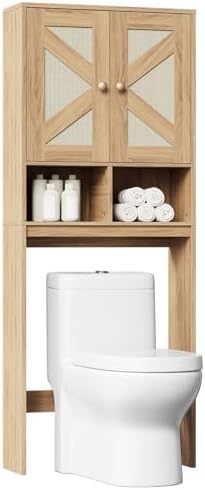
The relevant comparison for renters is therefore between freestanding alternatives. Freestanding mirrored cabinet units are available as over-toilet freestanding structures with a mirrored door panel, or as slim floor-standing units designed to sit beside the basin at a height appropriate for use as a bathroom mirror. Both require no drilling and no wall contact. Freestanding open shelf units are available as slim three-tier or four-tier floor-standing units in metal, bamboo, and wood-effect finishes — narrow enough for most UK flat bathrooms and available without drilling in the same way.
Both categories are available on Amazon UK from brands including VASAGLE, SONGMICS, and Homfa at price points from approximately £25 to £70. The freestanding constraint does not meaningfully limit the choice between cabinets and shelves — it simply shifts both options from wall-mounted to floor-standing formats, with the cabinet retaining its advantage on every criterion that matters in a humid UK flat bathroom.
Frequently Asked Questions
Is a bathroom cabinet or shelves better for a small bathroom?
For most UK renters in small flat bathrooms, a mirrored cabinet is the more practical choice — it manages humidity, hides disorganisation, and solves the mirror and storage problems simultaneously. Open shelves are the better choice in one specific situation: a bathroom that already feels enclosed where a cabinet would add unwanted bulk, with a deliberately small number of products that are consistently maintained. Outside that situation, the cabinet’s lower maintenance requirement in a humid UK bathroom makes it the default recommendation.
Can I add a bathroom cabinet without drilling in a rented flat?
Yes — freestanding mirrored cabinet units are available as over-toilet structures or as slim floor-standing units that sit beside the basin. These require no drilling and no wall contact. The trade-off compared to a wall-mounted cabinet is that they occupy floor space — typically a footprint of 30 to 45cm — rather than wall space. For most small UK flat bathrooms, this trade-off is manageable, particularly in the over-toilet configuration where the floor space behind the cistern is not usable for anything else.
Do open bathroom shelves get dirty quickly?
In a UK flat bathroom with limited ventilation, yes — faster than most people expect. Steam from a daily shower condenses on every surface, including open shelves and the products on them. Pump dispensers accumulate a film within days, cardboard packaging softens, and labels begin to peel at the edges. A set of open bathroom shelves requires weekly wiping — both the shelf surface and the products themselves — to remain presentable. In a bathroom with a functioning extractor fan and good ventilation, the maintenance frequency reduces but does not disappear.
What is the best bathroom storage for a shared flat?
A cabinet, for shared bathrooms. Two people using the same bathroom means twice the products and twice the maintenance requirement for open shelves to remain tidy. A cabinet contains the disorganisation that inevitably results from two people’s routines and product choices without requiring either person to maintain a consistent standard of shelf presentation. The closed door is the most practical feature a shared bathroom storage solution can have.
Related Guides
For the complete zone-based approach to a small rented bathroom — covering every area from the shower zone to the door zone, with a maintenance routine that holds the system together — how to organise a small bathroom in a rented flat covers the system before the individual product decisions.
Both shelves and cabinets are available in no-drill freestanding versions — but they are two of four categories of no-drill bathroom storage solution available to renters. For the complete guide to renter-friendly bathroom storage across all four categories, how to keep a small bathroom clutter-free without drilling covers the full range including tension rods, over-door solutions, and the honest limitations of removable adhesive on UK bathroom tiles.
The same habit-based framework for deciding between open and closed storage applies in the kitchen as in the bathroom. Open shelving vs closed cabinets in small kitchens covers the same open versus closed decision in a different room, with the same structure of habit assessment and use-case scenarios.
Conclusion
For most renters in small UK flat bathrooms, a mirrored cabinet is the more practical choice — it manages humidity, hides disorganisation, and eliminates the need for a separate mirror in one product. Open shelves work when the number of products is deliberately limited and the weekly maintenance commitment is realistic and sustainable. The honest question is not which option looks better in a product photograph — it is which one will still look the same in three months with no additional effort applied to maintaining it.