
The area under a bathroom sink in a small UK flat is either completely unused or permanently chaotic. In most cases it holds a loose collection of cleaning products, spare toiletries, and items that have no other home — with no system, no structure, and no clear sense of what belongs there and what does not.
Unlike kitchen under-sink storage, bathroom under-sink organisation depends entirely on the type of sink. A pedestal sink and a wall-hung basin require completely different solutions — and most bathroom storage content treats them as the same problem, which is why most of the products bought for this space end up not fitting or not working.
This article covers how to identify which sink type you have, what the specific constraints of each configuration are, and which renter-friendly products work for each — without drilling, without modifying the pipework, and without spending more than £45.
Identify Your Sink Type First
Before looking at any products, identify which of the three configurations below describes the bathroom sink in the flat. The wrong product for the wrong sink type will not fit regardless of how carefully it is chosen.
The pedestal sink. A pedestal sink has a visible ceramic column running from the basin down to the floor. The column conceals the water supply pipes and waste pipe but occupies the central floor space beneath the basin entirely. There is no cupboard, no door, and no enclosed storage — just the column in the centre and exposed floor on either side of it. The storage potential is limited and specific to the space available around the column. This is the most common sink type in older UK flat conversions, Victorian terrace conversions, and pre-2000 rental bathrooms generally.
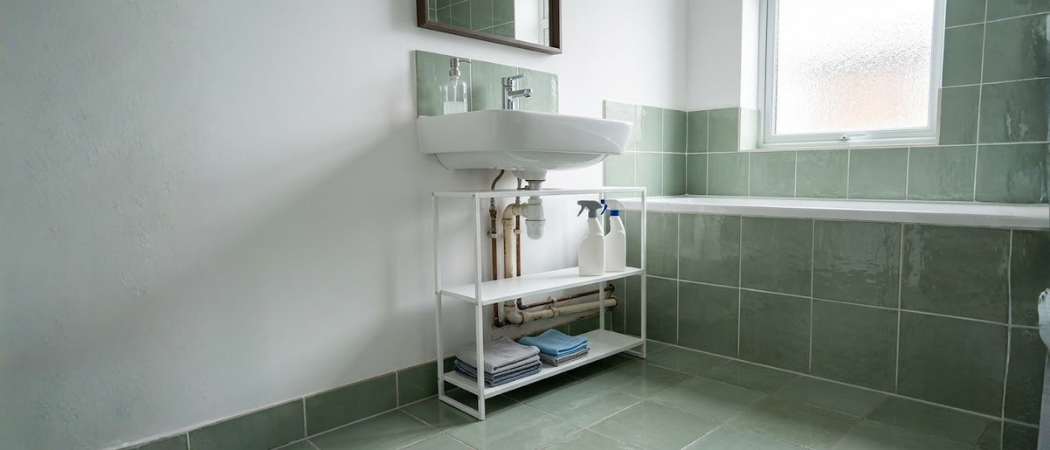
The wall-hung basin. A wall-hung basin has no column. The basin is fixed directly to the wall and the pipes run down the wall surface or are partially boxed in. The floor beneath is completely clear — but completely unstructured. There is more usable space than with a pedestal sink, but without a freestanding organiser placed in it, that space remains empty or becomes a general dumping area. This configuration is common in newer UK flat builds and post-2000 bathroom refits.
The vanity unit. A vanity unit has the basin fitted into a cabinet with a door. If this is the configuration in the flat, under-sink storage is partially solved — the cabinet provides enclosed space and a door. The remaining challenge is organising the interior of that cabinet, which is unstructured by default. This is covered briefly later in this article.
Organising Under a Pedestal Sink
The pedestal sink is the most challenging configuration for under-sink storage because the column occupies the most useful central floor position. Solutions that work for other sink types will not work here — the column is physically in the way of any organiser that requires clear floor space.
The pedestal sink organiser
A dedicated pedestal sink organiser is a unit designed specifically to fit around the pedestal column. It typically consists of two side shelf sections connected by a back panel that sits against the wall, with a central opening or adjustable section that accommodates the column in the middle. The result is two usable shelf zones on either side of the pedestal — enough for daily cleaning products, spare toilet rolls, and small toiletry items in rotation. No drilling is required — the unit sits on the floor and uses the wall and the column itself for stability. Before buying, measure the width of the pedestal column at its base and the floor space on each side, as these dimensions vary between bathroom fittings. Check current options on Amazon.


The curtain approach
A tension rod mounted between the wall and the side of the pedestal — or between two walls if the sink is in a corner — with a fabric curtain attached, conceals the pedestal area entirely and creates the visual impression of an enclosed vanity unit. Behind the curtain, a small basket or shallow tray on the floor holds products. This is a low-cost solution that prioritises visual tidiness over structured storage — suitable when the storage need is modest, the primary goal is concealing the exposed pipes and column, and the number of items to store is small enough to fit in one or two baskets. The tension rod requires no drilling and leaves no marks on the wall.
What does not work with a pedestal sink
Freestanding under-sink organisers designed for wall-hung basins or kitchen under-sink cupboards do not work with pedestal sinks. The column sits exactly where a standard freestanding organiser needs to be placed — in the centre of the available floor space. Drawer units, pull-out caddies, and open-frame shelf units all require clear floor space that the pedestal occupies. The only solutions that work are those specifically designed for the pedestal configuration, simple baskets placed in the available floor space on either side of the column, or the curtain approach. Anything else will either not fit or will need to be returned.
Organising Under a Wall-Hung Basin
The wall-hung basin offers significantly more storage potential than a pedestal sink, but the open floor space beneath it requires a freestanding organiser to become functional. Without structure, the space accumulates items randomly and becomes harder to use than a properly configured pedestal sink area.
Measure the available space first
The usable width under a wall-hung basin is typically 45 to 55cm — narrower than the basin itself because the pipes running down the wall reduce the accessible width at the back. The usable depth from the wall to the front edge of the basin is typically 35 to 45cm, again reduced by the pipe position at the back. The height from the floor to the underside of the basin varies significantly depending on the installation — typically 55 to 70cm in UK flat bathrooms, but this varies enough that it must be measured rather than assumed.
Measure all three dimensions before buying any organiser. The height measurement is particularly important — a unit taller than the available height under the basin will not fit, and this dimension varies more between installations than width or depth. Note the pipe position at the back of the space and check that the organiser being considered has an open back or a back panel with sufficient clearance for the pipes.
Slim freestanding under-sink unit
A slim freestanding organiser with two or three open shelves and an open frame fits under a wall-hung basin and uses the full available height without obstructing the pipes at the back. The open frame design is the critical feature — a solid back panel will either not fit behind the pipes or will force the unit away from the wall, reducing the available depth significantly. Most open-frame under-sink organisers for bathrooms are 40 to 50cm wide and 25 to 35cm deep, which fits the majority of wall-hung basin configurations in UK flat bathrooms. Confirm all three measurements against the product dimensions before ordering. See current price on Amazon.


Pull-out caddy for deeper access
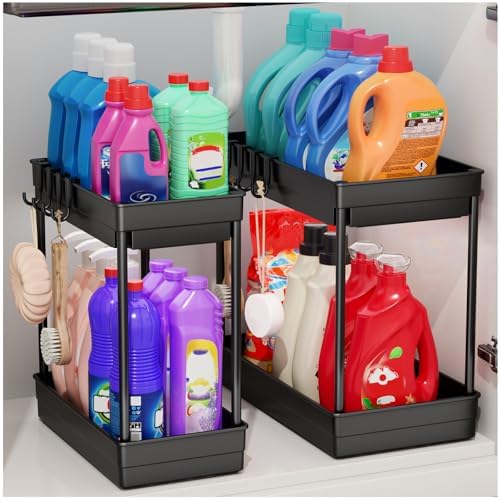
If the basin is installed at a height of 65cm or more from the floor to its underside — which is at the higher end of the typical UK range — a small pull-out caddy on castors fits underneath and slides out for access. This is useful for storing cleaning products that are used frequently and need to be fully accessible without bending into the back of the space. In bathrooms where the basin height is under 60cm, the clearance is insufficient for a pull-out caddy and a static open-frame organiser is the more practical option.
Organising the Interior of a Vanity Unit
For flats with a bathroom vanity unit, the under-sink challenge is different — the space is enclosed but unstructured. Items accumulate at the back, nothing is accessible without unpacking the front of the unit, and the single shelf divides the interior into two zones that are both underused.
The interior of a bathroom vanity unit responds to the same approach as a kitchen base cupboard: a small turntable on the shelf for bottles and products that need rotation, a shelf riser to create a second level in the lower zone, and a door-mounted caddy on the inside of the vanity door for small items that would otherwise clutter the shelf. The full approach to internal cupboard structure — including which products work and how to apply the zone system within a single cupboard — is covered in how to organise kitchen cupboards in a small flat.
What to Store Under the Bathroom Sink
Regardless of sink type, what goes in the under-sink space determines whether it is genuinely useful or simply occupied.
Cleaning products for the bathroom belong here — toilet cleaner, surface spray, cloths and sponges. These are used at least weekly and should live in the room where they are used. Spare toilet rolls, if there is sufficient space, are a practical addition. The current spare hand soap and the product in rotation — the backup that comes into the bathroom when the current product runs out — also belong here.
Daily toiletries do not belong under the sink. Reaching down to a floor-level organiser for a product used twice a day is a friction point that causes the system to break down within days — products stop being put away because returning them is more effort than leaving them on the basin surround. Daily items belong at basin height or on the over-toilet unit where they are accessible without bending. The under-sink zone is for weekly-use items and current spares, not the products used at every visit to the bathroom.
Medicines, bulk spare toiletries, and cleaning product backups do not belong here either. Medicines degrade faster in a high-humidity bathroom than in a bedroom or kitchen cupboard. Bulk backups take up space needed by active products and create overcrowding that makes the space feel unusable. The one-in-one-out rule applies directly: a new cleaning product only comes under the sink when the existing one is finished. Storing multiples of the same product in this space is how it becomes the most cluttered area in the bathroom.
Common Mistakes
Mistake 1: Buying a wall-hung basin organiser for a pedestal sink
Standard freestanding under-sink organisers are designed for the clear floor space beneath a wall-hung basin. They have no accommodation for a central column — which means placing one in front of a pedestal sink results in a unit that either cannot sit flat on the floor or sits in front of the column rather than around it, occupying the floor space on one side while leaving the other side unaddressed.
The fix is to identify the sink type before looking at any products. A pedestal sink requires a pedestal-specific organiser with a central opening, or simple baskets in the floor space on each side. A wall-hung basin accepts standard freestanding organisers. Buying for the wrong configuration is the most common and most avoidable under-sink storage mistake in bathroom organisation.
Mistake 2: Not measuring before buying
Bathroom basins in UK flats are installed at varying heights depending on the building age, the bathroom layout, and the specific fittings chosen by the landlord or developer. A basin installed at 55cm from floor to underside and one installed at 70cm are both within the normal range — but an organiser suited to one may not fit under the other.
Measure width, depth, and height before ordering any under-sink organiser for a bathroom. The height measurement is the most variable and the most likely to cause a mismatch. Note the pipe position at the back of the space and confirm the organiser has an open back or sufficient pipe clearance before purchasing.
Mistake 3: Storing daily toiletries under the sink
Daily toiletries end up under the sink because the under-sink space is the first available storage area in a bathroom with no shelving. Once products are placed there at the initial reorganisation, they tend to stay — even when the friction of bending down twice a day to access them means they are more often left on the basin surround than returned to their allocated spot.
Daily toiletries belong at basin height or on the over-toilet unit’s lowest shelf, where they are accessible without bending. The under-sink zone works for items accessed weekly — cleaning products, spare toilet rolls, product backups in rotation. Placing daily items there guarantees the system breaks down within a week.
Mistake 4: Ignoring the pipe position when choosing a freestanding organiser
Pipes running down the back wall of a wall-hung basin occupy the rear section of the available under-sink depth. An organiser with a solid back panel either cannot fit against the wall at all, or pushes the unit 10 to 15cm forward — significantly reducing the usable depth and creating a gap between the unit and the wall that collects dust and fallen items.
Open-frame organisers accommodate pipes at the back without obstruction and sit flush against the wall. When looking at product listings, check whether the back of the organiser is open or closed. If the listing does not specify clearly, look for images showing the rear of the unit before purchasing.
Mistake 5: Treating under the bathroom sink as general overflow storage
The under-sink area in a bathroom becomes the most cluttered space in the room when it serves as the default location for anything bathroom-related that does not have another home. Medicines, spare toiletries in bulk, cleaning product backups, and items with no clear purpose accumulate there because the space is out of sight and easy to close off.
Assigning this space exclusively to cleaning products and bathroom-specific current spares prevents the accumulation. Everything else — bulk spares, medicines, cleaning backups — belongs elsewhere in the flat. The under-sink zone in the bathroom is a functional storage area for a specific category, not a general overflow cupboard.
Frequently Asked Questions
How do I add storage under a pedestal sink without drilling?
A pedestal sink organiser designed to wrap around or sit either side of the column is the most structured option — it creates two shelf zones on either side of the pedestal without touching the wall. Measure the pedestal column width at its base and the floor space on each side before buying. A tension rod with a fabric curtain is a lower-cost alternative that conceals the area and allows a basket or tray to be placed on the floor behind it. Both options require no drilling.
What can I store under a bathroom sink in a rented flat?
Bathroom cleaning products — toilet cleaner, surface spray, cloths, sponges — belong here along with spare toilet rolls and the current product in rotation. Daily toiletries, medicines, and bulk spare products do not belong under the sink. Daily items need to be at basin height for easy access; medicines degrade in bathroom humidity; and bulk backups should live in overflow storage elsewhere in the flat rather than filling the under-sink space.
My bathroom sink is wall-hung with exposed pipes — what storage works?
An open-frame freestanding organiser is the most practical solution. The open back accommodates the pipes without obstruction and allows the unit to sit against the wall. Measure the width, depth, and height of the available space before buying — the height from floor to the underside of the basin varies significantly between UK flat bathrooms and determines which units will fit. Confirm the organiser has an open back rather than a solid back panel before ordering.
Can I use kitchen under-sink organisers in a bathroom?
Sometimes, with specific checks. Kitchen under-sink organisers are typically designed for a 60cm wide base unit — wider than most bathroom under-sink spaces, particularly under wall-hung basins. The height may also differ — kitchen base units are deeper and taller than the space under most bathroom basins. Check the product dimensions against the bathroom measurements rather than assuming a kitchen organiser will transfer directly. Products specifically designed for bathroom under-sink use are sized for the configurations found in UK flat bathrooms and are a more reliable starting point.
Related Guides
The under-sink zone is one part of a complete bathroom organisation system. For the full zone-based approach — over-toilet zone, shower zone, door zone, and the maintenance routine that keeps all of them functional — how to organise a small bathroom in a rented flat covers the complete picture before the individual zone decisions.
The kitchen under-sink area follows similar principles to the bathroom — measuring around fixed obstacles, choosing the right organiser for the specific configuration, and assigning the space to one category of items only. How to maximise under-sink storage in a small flat covers the kitchen version of this problem in detail, with a measurement approach that transfers directly to the bathroom context.
For flats with a bathroom vanity unit, the internal organisation of the cupboard follows the same logic as kitchen cupboard organisation — shelf risers, turntables, and door-mounted caddies applied to an enclosed under-sink space. How to organise kitchen cupboards in a small flat covers the full approach to internal cupboard structure.
Conclusion
The space under a bathroom sink in a small UK flat is not a difficult storage problem — it is a problem that requires identifying the right solution for the specific sink configuration before buying anything. A pedestal sink and a wall-hung basin have completely different constraints and completely different products that work for each. Identifying the sink type, taking three measurements, and matching the organiser to the actual configuration is the entire difference between a solution that fits and functions and one that gets returned.