
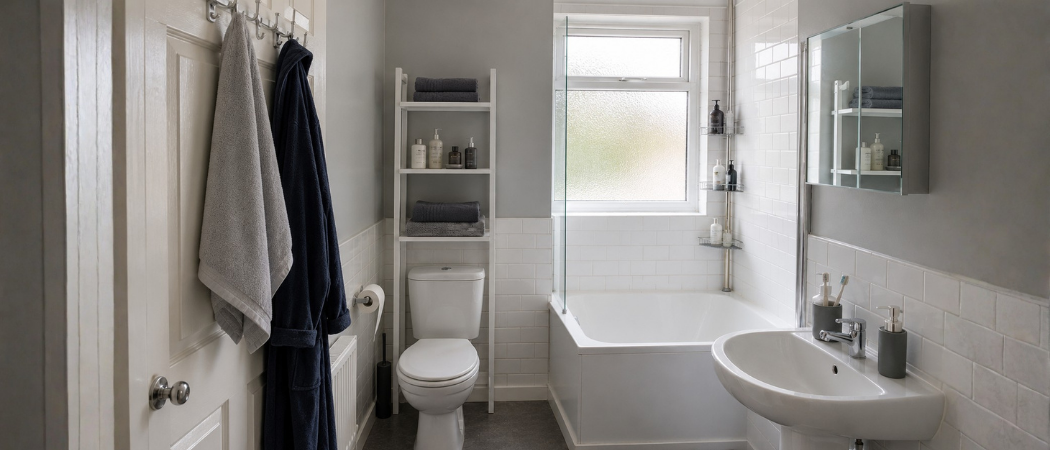
A small bathroom in a rented flat accumulates clutter faster than any other room. There is rarely a dedicated home for anything — products end up on the edge of the bath, on top of the toilet cistern, and across every flat surface available. The bathroom feels chaotic not because it is too small, but because nothing has a fixed place and everything migrates to wherever there is momentarily space.
Most bathroom organisation content assumes you can drill walls, install shelving, or fit a vanity unit. In a rented flat, none of those options are available without landlord permission — which most landlords will not grant for a bathroom. Every solution in this guide works without touching the walls permanently, without specialist tools, and without any modification to the existing fittings.
What follows is a zone-based system for a small rented bathroom — starting with an audit of what the bathroom actually contains, moving through a zone allocation that gives every item a fixed home, and ending with a maintenance routine that prevents the system from degrading under daily use.
Step 1 — Start with a Full Audit
Before adding any storage or buying any product, remove everything from the bathroom completely. This step is not optional — reorganising around existing contents produces a tidier version of the same underlying problem, because the items that do not belong in the bathroom remain in it and continue to take up space that functional items need.
Take every product, every towel, and every item out of the bathroom and group everything by category on the floor outside: skincare, haircare, shower products, cleaning products, medicines and first aid, towels, and spare toiletries. Once everything is grouped, assess each category honestly — what is used every day, what is used once a week, and what has not been touched in months.
Remove everything expired, empty, or unlikely to be used before it expires. Most bathrooms contain between 20 and 30 percent of products that serve no current purpose — duplicates accumulated from multi-buy purchases, products bought and abandoned, samples that were never going to be used. These leave the bathroom at this point, not later.
Identify what does not belong in the bathroom at all. Spare toilet rolls, cleaning product backups, medicines, and first aid supplies can all live elsewhere in the flat if bathroom space is limited. The bathroom is a high-humidity, low-space environment. Only items used at least weekly should have a permanent home here. Everything used less frequently than that belongs in a bedroom cupboard, a kitchen shelf, or a dedicated box elsewhere in the flat — not in the bathroom taking up space that daily-use items need.
The audit reduces the volume of what needs to be stored before any system is designed around it. Designing a zone system around the full, unaudited bathroom contents means designing for clutter. Designing it around what actually needs to be there means the system has a realistic chance of holding.
Step 2 — Define Your Bathroom Zones
A zone is a fixed area for one category of items. Without zones, products end up wherever there is space when they are put down — and the bathroom returns to its original state within days of being tidied. The zone system eliminates the decision of where to put something by making the answer fixed in advance.
Zone 1 — Daily toiletries zone. The products used every single day: toothbrush, toothpaste, face wash, moisturiser, deodorant. These need to be immediately accessible — on the basin surround, in a small caddy on the cistern top, or in the most reachable shelf position in the room. This zone should contain as few items as possible. Daily use does not mean every product owned — it means only what is reached for every morning and evening without exception. Anything used less often than daily does not belong in this zone.
Zone 2 — Shower and bath zone. Shampoo, conditioner, body wash, razor, and shower gel currently in use. These live in or immediately adjacent to the shower or bath — in a caddy, on a tension rod shelf, or on the bath edge if no alternative exists. The key rule for this zone is strict: only the products currently in use live here. Backups and spare bottles go elsewhere — under the sink or in a bedroom cupboard — and rotate into the shower zone when the current product runs out.
Zone 3 — Under-sink zone. In a rented UK flat bathroom, this is typically the space beneath a pedestal sink or wall-hung basin — an awkward area with no internal structure, often used as a catch-all for cleaning products and spare toiletries. This zone holds cleaning products, spare soap, spare toilet rolls, and items used weekly rather than daily. It requires specific organisers designed for the irregular footprint around a pedestal base. A dedicated guide to this zone will be available when published.
Zone 4 — Vertical zone above the toilet. The space above the toilet cistern is the largest consistently unused storage area in most small UK bathrooms. A freestanding shelving unit standing on the floor behind the cistern uses this vertical space for towels, spare products, and items that do not need to be within immediate reach. No drilling required — the unit is entirely freestanding and makes contact only with the floor.
Zone 5 — Door zone. The back of the bathroom door is flat, vertical space that most renters never use. Over-door hooks hold towels, dressing gowns, and bags. An over-door rack can hold products that would otherwise clutter the basin surround. No drilling required — hooks hang over the door edge and are removed without leaving marks.
Once zones are defined, items go back to their zone after every use. If an item does not have a zone, it does not have a place in this bathroom — which means the audit did not go far enough, or the item belongs elsewhere in the flat.
Step 3 — Add Structure Without Drilling
With zones allocated, the next step is to add physical structure to each one. Products here are tools that support the zone system — not the starting point.
Over-door hooks for the door zone. A set of over-door hooks handles towels, dressing gowns, and bags on the back of the bathroom door without any drilling or adhesive. The hooks hang over the door edge and hold up to the rated weight of the set. This is the most immediate and lowest-cost structural addition to any rented bathroom — it takes thirty seconds to install, leaves no marks, and immediately clears items from the floor and basin area.


Freestanding over-toilet unit for the vertical zone. A three-tier étagère or over-toilet shelving unit stands on the floor behind the cistern and uses the full height available above the toilet — typically 80 to 100cm of unused vertical space. No wall contact is required and no fixings are needed. This is the single most effective storage addition to a small UK bathroom because it creates three full shelves of usable storage in a zone that is otherwise completely empty. Towels on the lower shelf, spare toiletries in the middle, and items used rarely on the top shelf.


Step 4 — Manage the Shower Zone Without Permanent Fixtures
The shower zone is the hardest to organise in a rented flat because the most effective solutions — wall-mounted caddies, built-in niches, and adhesive-mounted shelves — require drilling or permanent adhesive on tiles. Neither is available to most renters without landlord permission.
A tension rod caddy is the most reliable renter-friendly solution for this zone. A tension rod fitted between two walls of the shower enclosure or bath surround holds a caddy shelf using spring pressure against the walls — no wall contact, no adhesive, no marks. It can be removed in seconds and repositioned without any damage to the tiles. This works in both enclosed shower cubicles and over-bath shower setups, provided there are two parallel surfaces close enough for the rod to span.
Suction cup caddies are an alternative, but with a significant limitation: they work only on smooth, glazed tiles. Textured tiles — which are common in UK flat bathrooms, particularly older builds — do not provide the flat contact surface suction cups require, and the caddy will fall repeatedly regardless of how carefully it is applied. Check the tile surface by running a finger across it before buying a suction cup product. If there is any texture, a tension rod caddy is the only reliable non-permanent option.
The rule for the shower zone applies regardless of which product is used: only products currently in use stay here. A shower caddy holding eight products is a clutter problem and a hygiene problem — bottles accumulate product residue, become difficult to clean around, and make the shower feel smaller than it is. Three to four products is the practical limit for a small shower caddy. Everything else lives in the under-sink zone and rotates in as needed.
Step 5 — Deal with the Items That Do Not Fit
In a genuinely small bathroom, not everything can have a home inside the bathroom itself. The solution is to distribute overflow to appropriate locations elsewhere in the flat — not to add more storage inside the bathroom until it is full again.
Spare toiletries and product backups belong in a small basket or box in a bedroom cupboard or on a wardrobe shelf. Only the product currently in use lives in the bathroom — the backup comes in when the current one runs out. This single habit reduces bathroom clutter meaningfully for most people, because the bathroom is no longer functioning as storage for products that will not be used for weeks or months.
Medicines and first aid supplies belong in a dedicated box outside the bathroom entirely. High humidity degrades many medicines over time, which makes the bathroom a poor environment for them regardless of available space. Moving medicine storage to a bedroom or kitchen cupboard also frees a zone in the bathroom for items that genuinely need to be there — and a medicine box in a fixed, accessible location outside the bathroom is easier to find in an emergency than one buried under bathroom clutter.
Cleaning products follow the same principle. One set of bathroom cleaning products lives under the sink in the bathroom — the products used to clean the bathroom itself. Backup bottles and spare cleaning supplies live in the kitchen cupboard alongside other household cleaning items. The bathroom is not a storage room for cleaning supplies. It is a room that gets cleaned, and the products used to clean it should be the only cleaning products permanently based there.
The Maintenance Routine
A reorganised bathroom lasts approximately two weeks without a maintenance routine. Products drift from their zones, the shower caddy acquires an extra bottle, and the basin surround gradually accumulates items again. The zone system does not maintain itself — it requires two habits applied consistently.
The two-minute daily reset is the most important habit. Every item used goes back to its zone immediately after use — not to the nearest flat surface, not to the edge of the bath, not to the basin surround. This takes exactly the same time as leaving something down carelessly, and it prevents the entire system from degrading gradually. The zone system makes this effortless because there is only one place each item can go — the decision is already made.
Once a week, check the shower zone for empty or near-empty bottles and remove them. Check the under-sink zone for items that have drifted from their category. This check takes two minutes and prevents the weekly accumulation that eventually forces a full reorganisation.
Once a month, check expiry dates across all bathroom products, remove anything empty or expired, and assess whether any zone has accumulated items that do not belong there. The monthly audit takes five minutes and eliminates the need for a full reorganisation by catching drift before it compounds. A bathroom maintained with these three habits — the daily reset, the weekly zone check, and the monthly audit — does not require reorganising. It requires only maintaining.
Common Mistakes
Mistake 1: Keeping every product that enters the bathroom
Products accumulate in bathrooms because they arrive regularly — from shopping, from travel, from gifts — and leave only when they are consciously removed. Most people remove products when they are empty, which means anything that gets abandoned half-used stays indefinitely. Over time, the bathroom fills with products that are nominally in use but practically never touched.
The audit removes the baseline clutter before any zone system is applied. Without the audit, the zone system is designed to accommodate items that should not be in the bathroom at all. With it, the system is sized correctly for the actual inventory — and has room to function.
Mistake 2: Using the bath edge as permanent storage
The bath edge becomes a storage surface because it is horizontal, accessible, and at the right height. Shampoo bottles go there temporarily and never move. Products accumulate until the edge is full, at which point new items go on the floor. The bath edge is also difficult to clean around when covered in products, and bottles left in contact with the bath surface leave marks over time.
The fix is to move all shower zone products into a caddy — tension rod or otherwise — and treat the bath edge as a surface, not a shelf. If a product is in current use, it lives in the caddy. If it is not in the caddy, it is not in the shower zone.
Mistake 3: Ignoring the space above the toilet
The vertical space above the toilet cistern does not register as storage space because it is empty — and empty space in a bathroom is so unusual that it does not prompt the question of what could go there. Most people in small bathrooms are focused on the surfaces that are already full, not the vertical space that is not being used.
A freestanding over-toilet shelving unit uses this space without any wall contact, any drilling, or any landlord involvement. In most small UK flat bathrooms, this addition creates more storage than any other single change to the room — three full shelves in a zone that was previously contributing nothing.
Mistake 4: Buying adhesive products without checking the tile surface
Suction cups and adhesive-mounted products are marketed as renter-friendly solutions, which they are — on the right surface. On textured tiles, which are common in UK flat bathrooms, they do not hold reliably regardless of how carefully they are applied or how long they are left to set. The product falls, usually taking something with it.
Check the tile surface by running a finger across it before buying any adhesive or suction-mounted product. Smooth, glazed tiles hold adhesive and suction reliably. Any texture at all makes a tension rod solution the only reliable non-permanent option for the shower zone.
Mistake 5: Storing everything bathroom-related in the bathroom
The bathroom is treated as the natural home for everything related to personal care, cleaning, and hygiene — which means everything from spare toilet rolls to three-year-old medicines ends up there. In a small bathroom, this volume of items overwhelms any storage system regardless of how well it is designed.
The fix is to move all non-daily-use items out of the bathroom. Spare toiletries in a bedroom cupboard, medicines in a dedicated box elsewhere, cleaning product backups in the kitchen cupboard. The bathroom holds only the items in current, regular use — not the inventory of everything that might be needed at some point.
Mistake 6: Reorganising without defining zones first
Tidying a bathroom without zones means moving items to cleaner-looking positions. Within a few days, everything has migrated back to wherever there is space, because no fixed locations were established. The bathroom looks better for approximately two weeks and then returns to its original state — which prompts another tidying session, and the cycle repeats.
Zones before products, every time. The zone system defines where each item belongs before anything is put back. Products bought to support the zone system then have a specific structural problem to solve. Products bought before zones are defined have nowhere particular to go.
Frequently Asked Questions
How do I add storage to a bathroom in a rented flat without drilling?
Four options require no drilling and no permanent wall contact: over-door hooks on the back of the bathroom door, a freestanding over-toilet shelving unit standing on the floor behind the cistern, a tension rod caddy in the shower or bath enclosure, and freestanding organisers in the under-sink zone. Combined, these four additions cover every storage zone in a small bathroom without touching a wall permanently. Total cost for all four is typically under £60.
What should I keep in a small bathroom?
Apply the zone system as the filter. Daily toiletries in the daily zone, current shower products in the shower zone, weekly-use items under the sink, towels on the door or over-toilet unit. Everything used less frequently than weekly belongs outside the bathroom. Medicines, spare toiletries, and cleaning product backups have better homes in other rooms — and moving them out of the bathroom frees the space for items that genuinely need to be there.
How do I organise a bathroom with no shelves and no storage?
A bathroom with no built-in storage has three immediate additions available without drilling: a freestanding over-toilet shelving unit, over-door hooks on the bathroom door, and a tension rod caddy in the shower or bath. These three products together provide a towel zone, a shower products zone, and a general storage zone — covering the basic functional requirements of a small bathroom without any wall contact. All three can be installed in under an hour.
Why does my bathroom always get messy again after I tidy it?
Because tidying moves items and zones keep them. Tidying without a zone system puts items in positions that seem reasonable in the moment — but those positions are not fixed, so items migrate freely during daily use. The bathroom returns to disorder because nothing was ever given a permanent location. A zone system assigns a fixed home to every item. The daily two-minute reset then maintains those positions rather than re-establishing them from scratch each time.
Related Guides
The zone-based approach and the return-to-zone maintenance habit work across every room in a small flat. The same principles that prevent bathroom clutter apply directly in other rooms — entryway storage mistakes to avoid in small apartments covers how the same patterns of missing zones and absent maintenance routines create identical problems in the hallway.
The under-sink zone in the bathroom shares structural characteristics with the kitchen under-sink cupboard — obstacles reducing the usable space, no internal structure, and a tendency to become a catch-all. How to maximise under-sink storage in a small flat covers the measurement and two-zone approach for kitchen under-sink configurations, with principles that apply directly to a bathroom pedestal or wall-hung basin.
For the same zone-based system applied to the most-used room in the flat, how to organise a small kitchen with limited cupboard Space covers the complete kitchen organisation approach — audit, zone allocation, and maintenance — in the same sequence used in this guide.
Conclusion
A small rented bathroom is not too small to be organised. It is missing a zone system, a return-to-zone habit, and the right freestanding products to give each zone physical structure. The audit establishes what actually needs to be stored. The zones give every item a fixed home. The over-door hooks, the freestanding over-toilet unit, and the tension rod caddy provide the structure for the three zones that matter most. None of these solutions require drilling, landlord permission, or spending more than £40 in total — and the maintenance routine that holds the system together takes two minutes a day.