
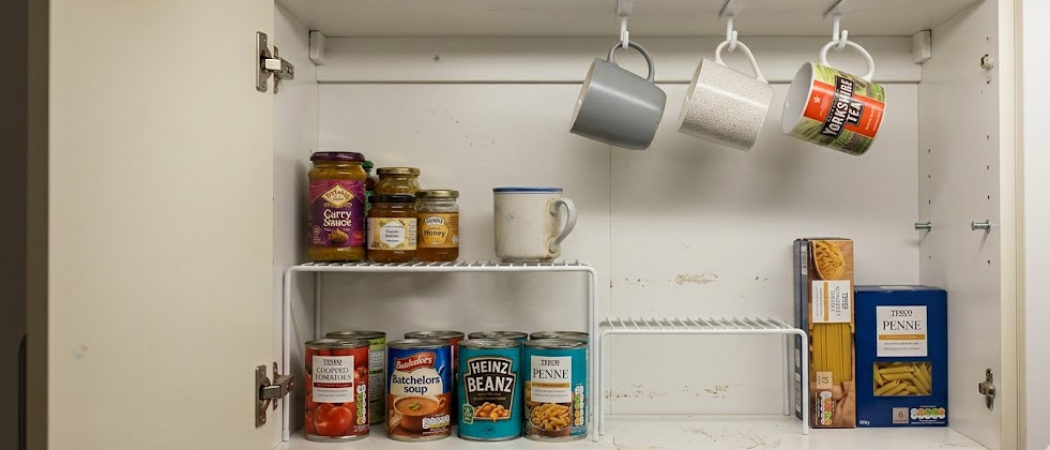
Kitchen cupboards in small flats are rarely too small — they are too disorganised. A cupboard that feels full usually has 40% of its vertical space unused, items stacked in ways that make the bottom layer inaccessible, and categories mixed together so that nothing is where it should be. The problem is not capacity. It is configuration.
Most people reorganise by putting things back more neatly. Within a few weeks, the same problem returns because the underlying structure has not changed. Neat is not the same as organised — neatness is a visual state, organisation is a functional one.
This article covers a cupboard-by-cupboard approach: overhead cupboards, base cupboards, and the space behind doors. Every solution is freestanding, over-door, or removable. No drilling, no permanent modifications, no landlord permission required.
Start by Emptying Everything
Before adding any structure, every cupboard needs to be emptied completely. Reorganising around existing contents is how systems fail within weeks — you tidy what is there rather than questioning whether it should be there at all.
Take everything out of every cupboard and place it on the kitchen table or floor, grouped by category. Cookware together, food items together, cleaning products together, utensils together. This reveals three things that reorganising in-place never does: what is actually in the cupboard, how much physical space exists without the clutter filling it, and what does not belong there at all.
At this stage, items that are expired, duplicated, or no longer used leave the kitchen. A tin of something bought two years ago and never opened, a duplicate peeler, a pan with a broken handle — these are not storage problems, they are clutter problems, and no amount of reorganisation fixes them. Items that belong in the wrong zone — cleaning products sitting in a food cupboard, random tools mixed in with cookware — are separated out before anything goes back in.
The goal of the empty-out is not to put everything back. It is to put the right things back, in the right cupboard, with the right internal structure supporting them.
One principle to establish before anything goes back in: a cupboard that is not completely full works better than one that is. Leave approximately 20% of space in every cupboard after reorganising. When a cupboard reaches capacity, something needs to leave the kitchen — not be compressed further or moved to another already-full cupboard. Overflow is a sign that the kitchen contains more than it needs to, not that more storage is required.
Overhead Cupboards — Using the Full Height
Overhead cupboards are where the most space is wasted in a small UK flat kitchen. The standard single shelf divides the cupboard into two zones, but most people only use the bottom zone effectively. The top half becomes a space for items stacked too high to retrieve safely, or for things that were put there once and never touched again.
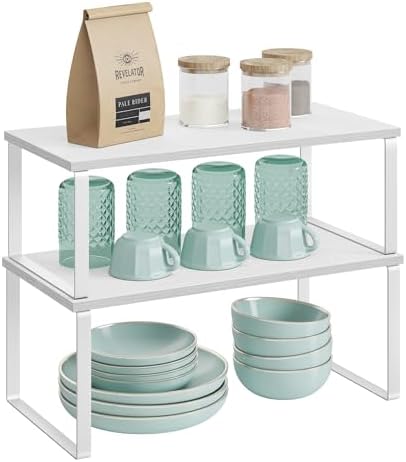
Add a shelf riser to create a third level
A shelf riser sits inside the existing cupboard on the lower shelf and creates an additional level within the bottom zone. Plates on the cupboard shelf, bowls on the riser above them. Tins on the lower level, shorter jars on the tier above. The same physical space stores significantly more without any modification to the cupboard itself. Most shelf risers are freestanding, require no tools, and can be removed without leaving any marks — which makes them one of the most practical additions available to renters.


Use stackable tin and can organisers
Tins stacked directly on top of each other are impossible to rotate and easy to lose at the back of the shelf. A stackable tin organiser arranges them on a slight incline so each tin is visible from the front and the oldest one is always at the front. This is particularly useful in the food storage cupboard where rotation matters — a tin hidden at the back of a stack gets forgotten and expires. These organisers are freestanding and fit within the standard 30cm depth of a UK flat overhead cupboard.
Store mugs on hooks under the shelf
The underside of an overhead shelf is usable space that most renters never consider. Removable under-shelf hooks hold mugs by their handles, freeing the shelf surface entirely for plates, bowls, or food items. The hooks clip or slide onto the shelf edge without any drilling. This works particularly well in the cupboard nearest the kettle, where mugs tend to accumulate on the shelf and crowd out everything else.
Keep the top shelf for rarely used items only
The top shelf of an overhead cupboard is the hardest to reach safely. It should hold only items used rarely — a spare serving dish, seasonal bakeware, a blender used once a month. If daily-use items are currently on the top shelf, the zone allocation needs to be reconsidered. Daily items belong at eye level or below, where they can be reached without effort and returned without hesitation.
Base Cupboards — Solving the Depth Problem
Base cupboards are deeper than overhead cupboards — typically 50cm — and almost always have a fixed shelf mid-height. The problem is consistent: items at the back are unreachable, the mid-height shelf does not align with what actually needs to be stored, and the result is a cupboard where half the contents are effectively invisible.
Use a pull-out organiser for the full depth
A pull-out tray or small rolling organiser sits on the base of the cupboard and slides forward when the door opens, bringing everything at the back within reach in one movement. This is particularly effective in base cupboards used for pots, pans, or tins, where the item at the back is reliably the one that is needed most urgently. No installation is required — the organiser sits on the cupboard floor and moves freely.


Add a turntable for deep or corner cupboards
A rotating turntable works in any deep cupboard where the back half is currently unreachable but a pull-out organiser is not practical. Place it on the lower shelf, load it with tins, condiments, or cleaning products, and rotate it to bring whatever is at the back to the front. It requires no installation and fits on any flat shelf surface. In a corner base cupboard, where depth is extreme and access is awkward, a turntable is often the only solution that makes the full space usable.
Store pans vertically with dividers
Pans stacked horizontally require unpacking the entire stack to reach the pan at the bottom — which is almost always the one that is needed. Adjustable pan dividers stand each pan upright so every piece of cookware is individually accessible. They fit inside a standard base cupboard without modification and adjust to different pan diameters. Lids can be stored separately in the same cupboard using a vertical lid rack, or laid flat on the mid-height shelf where they are easy to match to their pan.
Use the mid-height shelf correctly
The fixed mid-height shelf in a base cupboard sits approximately 25 to 30cm above the cupboard floor in most UK flat kitchens — enough clearance for most pans standing upright below it, but not for tall appliances. Use the lower space for tall items: pans, a blender, large containers. Use the shelf itself for flatter items that do not stack well on the floor: lids stored vertically, chopping boards, bakeware. The shelf is not wasted space — it is often being used for the wrong category.
Behind the Doors — The Space Everyone Ignores
The inside of every kitchen cupboard door is flat, vertical space. In most small flat kitchens, every door panel is unused. This is one of the more straightforward capacity increases available in a small kitchen — no floor space, no shelf space, no modification required.
A slim over-door rack hooks over the top of the cupboard door and hangs on the inside face. It holds spice jars, foil and cling film boxes, small cleaning items, or anything that currently clutters a shelf but does not require much depth. The important constraint is clearance: the rack must not be so deep that it presses against the shelf inside when the door closes. Before buying any over-door rack, measure the gap between the inside of the door and the nearest shelf edge when the door is closed. Most standard racks are 8 to 12cm deep — check this against your clearance before purchasing.
Removable adhesive hooks or mounted rails on the inside of a door work well for flat items: a chopping board, a grater, a roll of cling film stored horizontally. Use removable adhesive only — not permanent — to stay within standard rental agreement terms. Check the stated weight limit before loading, and stay well within it. Adhesive rated for 2kg should not be loaded to 1.8kg.
There are limits to what door-mounted storage can hold. The door hinge is not designed to carry significant weight, and overloading a door organiser puts stress on the hinge over time. Door-mounted storage is for lightweight items: jars, packets, foil rolls, light cleaning products. A useful test: if you would be uncomfortable carrying the loaded organiser with one hand, it is too heavy for the door.
The Under-Sink Cupboard — A Separate System
The under-sink cupboard does not follow the same rules as the rest of the kitchen. It has a waste pipe and siphon running through the centre, often a boiler or water heater at the back, and a usable width that is significantly narrower than the door opening suggests. Standard cupboard organisers bought without accounting for the pipe position will not fit. The approach — measuring each zone separately, accounting for siphon height, choosing organisers designed for this configuration — is covered in full in the dedicated guide to how to maximise under-sink storage in a small flat.
The Maintenance System
A reorganised cupboard without a maintenance routine lasts approximately three weeks. Items drift from their zones, categories mix again, and the back of every cupboard fills up with things that were put there temporarily.
The most important habit is the return-to-zone rule: every item goes back to its designated cupboard after use — not to the nearest available space, not to the counter to deal with later. This takes the same amount of time as putting something away carelessly, and it is the only thing that prevents the system from degrading gradually. When this habit holds, the cupboards stay organised without any further intervention.
Once a month, open every cupboard and check for three things: items that have drifted from their zone, expired food or products that need to be disposed of, and anything that has accumulated without a clear home. A monthly check takes five minutes and prevents the need for a full reorganisation. When items keep reappearing without a home, that is a signal that the zone allocation needs adjustment — not that the system needs more willpower to maintain.
The 20% rule applies throughout. Every cupboard should have roughly 20% free space at all times. A cupboard that is completely full is at the edge of its functional capacity — one new item tips it into disorder. When a cupboard reaches capacity, the answer is to remove something, not to compress the contents further. If there is nowhere for the removed item to go, it belongs elsewhere in the flat or should leave the household.
Common Mistakes
Mistake 1: Reorganising without emptying first
Most kitchen reorganisations fail within weeks because they are done around the existing contents. Items get repositioned rather than questioned, categories stay mixed, and expired or unused items stay in the cupboard taking up space. The reorganisation looks better immediately but the same structural problems remain underneath.
Emptying completely before reorganising is the only way to see both the actual inventory and the actual space at the same time. It is also the only opportunity to remove items that do not belong — once everything is back in the cupboard, the motivation to take it all out again quickly disappears.
Mistake 2: Storing daily-use items on the top shelf
The top shelf of an overhead cupboard is the most inconvenient location in the kitchen. Reaching it safely requires a step or a stretch, which means items stored there will either not be put back after use or will be avoided in favour of something more accessible. When daily-use items end up on the top shelf, they either migrate to the worktop permanently or stop being used.
The top shelf is for items used rarely — seasonal bakeware, a spare serving dish, a blender used monthly. Daily-use items belong at eye level or below, where they can be reached and returned without effort.
Mistake 3: Stacking pans horizontally in base cupboards
Horizontal pan stacks require unpacking everything above the target pan every time one is needed. In practice, this means the pan at the bottom is rarely used and the same two pans on top are used for everything — not because they are the best choice, but because they are accessible.
Vertical pan storage with adjustable dividers solves this completely. Each pan stands upright and is individually accessible. The change requires no modification to the cupboard and costs under £20 for most standard divider sets.
Mistake 4: Ignoring the inside of cupboard doors
Renters tend to overlook door-mounted storage because it is not immediately visible when looking at the kitchen. The result is that every door panel — often four to six panels in a small kitchen — goes unused while shelves are overcrowded.
An over-door rack on the inside of a single cupboard door adds meaningful capacity for lightweight items: spice jars, foil rolls, small packets. Multiply that across several doors and the available storage increases significantly without touching a single shelf or occupying any floor space.
Mistake 5: Filling every centimetre of cupboard space
A completely full cupboard is harder to use and harder to maintain than one with room to move. When every centimetre is occupied, retrieving one item disturbs several others, things get pushed to the back, and the system degrades quickly under daily use.
The 20% rule is not about wasting space — it is about keeping the cupboard functional. A cupboard at 80% capacity is usable. A cupboard at 100% capacity is a problem waiting to happen. When a cupboard is full, something needs to leave the kitchen, not be redistributed to another already-full cupboard.
Mistake 6: Mixing categories across cupboards
In a small kitchen with limited cupboards, the temptation is to put things wherever they fit rather than where they belong. The result is that finding anything requires checking multiple cupboards, and returning items after use involves a decision that usually gets deferred — which means things end up on the worktop instead.
One zone per cupboard, even when the allocation feels inefficient at first. A cupboard that holds only cookware is faster to use and easier to maintain than one that holds cookware, some food items, and a few cleaning products that did not fit under the sink.
Frequently Asked Questions
How do I add more storage inside a kitchen cupboard without drilling?
Shelf risers create an additional level inside an existing overhead cupboard without any modification. Under-shelf hooks mount on the shelf edge and hold mugs or lightweight items below the shelf surface. Pull-out trays on the base of a cupboard bring the full depth within reach. Turntables work in deep or corner cupboards where the back half is currently inaccessible. All of these are freestanding or clip-on, require no tools, and leave no marks when removed.
What is the best way to organise pots and pans in a small kitchen?
Vertical pan storage with adjustable dividers in a base cupboard is the most practical solution. Each pan stands upright and is individually accessible without disturbing the others. Lids should be stored separately — either vertically in a lid rack in the same cupboard, or flat on the mid-height shelf. Avoid stacking pans horizontally in a base cupboard: the pan at the bottom becomes effectively inaccessible and the stack is unstable.
How do I stop things falling out of kitchen cupboards?
Things fall out when a cupboard is overcrowded and items have no fixed position. The fix is to address both: remove enough items to bring the cupboard to 80% capacity, and add internal structure — a shelf riser, a pull-out tray, dividers — so that what remains has a defined location. A cupboard where every item has a fixed home and there is room to retrieve it without disturbing everything else does not spill its contents.
How do I organise a kitchen cupboard that is too deep?
A pull-out organiser is the most effective solution for a deep base cupboard — it brings the full depth forward in one movement and makes everything visible at once. For overhead cupboards or shelves where a pull-out is not practical, a turntable achieves the same result by rotating the back of the shelf to the front. In both cases, the goal is to eliminate the dead zone at the back of the cupboard where items disappear and expire unseen.
Related Guides
The under-sink cupboard is a distinct problem from the rest of the kitchen and requires its own approach. The pipe and siphon configuration means standard cupboard organisers do not fit without measurement and planning — the full process is covered in the guide to how to maximise under-sink storage in a small flat.
For the broader kitchen system — zones, worktop management, and where each category of item belongs across the whole kitchen — how to organise a small kitchen with limited cupboard space covers the full picture before going into cupboard-level detail.
The same principle of categorising first and adding structure second applies to every storage area in a small flat. How to store clothes under the bed without creating clutter applies the same approach to bedroom storage, where the same patterns of mixed categories and unused vertical space tend to appear.
For specific product recommendations, a guide to door-mounted organisers for small kitchen cupboards will be available when published. For a complete overview of kitchen storage solutions, see the guide to best kitchen storage solutions for small flats when published.
Conclusion
The cupboards are not too small. They are missing internal structure and a clear zone allocation. A shelf riser in an overhead cupboard and a pull-out tray in a base cupboard together cost under £40 and create the functional equivalent of an additional cupboard’s worth of usable space — without modifying anything. The system holds as long as the return-to-zone rule is followed consistently and the 20% free-space rule prevents the cupboards from filling back up.