
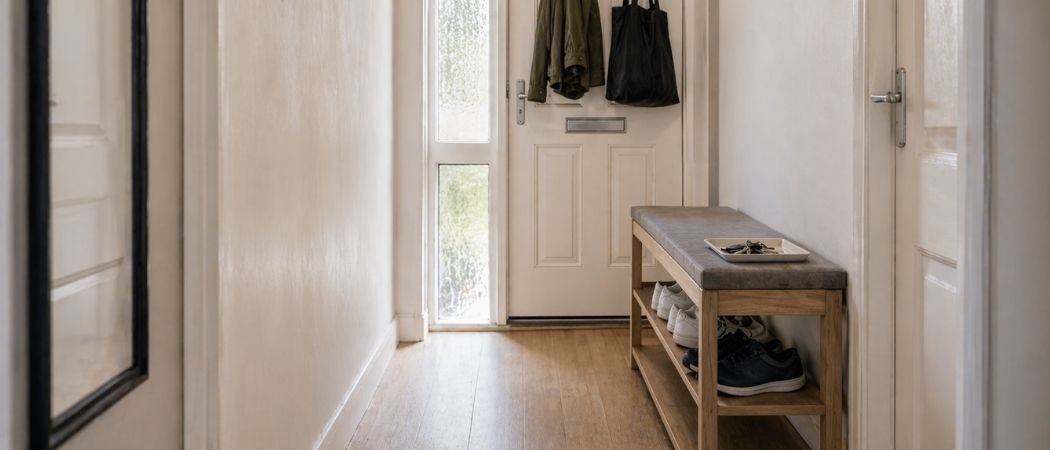
How to Keep Your Entryway Clutter-Free in a Small Apartment
A small hallway accumulates disorder faster than any other part of a flat. It is the first place you pass through when you arrive and the last before you leave — which means it absorbs the chaos of both transitions. Shoes come off at the door, bags get dropped, coats get hung on whatever is closest.
Most people respond by tidying when it gets bad enough. That works for a day or two, then the same items end up in the same places again. The cycle repeats because the tidy was a fix for the symptom, not the cause.
The cause is almost always the same: no defined system. This guide covers how to build one that holds without requiring constant effort to maintain.
The Real Problem Isn’t the Space
UK hallways are narrow by design — most run between one and one and a half metres wide, with no buffer zone between the front door and the rest of the flat. There is no mudroom, no transition area, no dedicated drop zone. Items arrive and immediately need somewhere to go.
When that somewhere is not clearly defined, the floor becomes the default. Not because the people using the space are disorganised, but because the path of least resistance is to put things down rather than put them away.
This is a design problem, not a behaviour problem. Every item that regularly ends up in the hallway needs a fixed location — not a general area, but a specific spot. Shoes have one place. Coats have one place. Keys have one place. When every item has an assigned home, the decision of where to put it is already made. When nothing has a fixed place, every item requires a small decision that usually gets deferred.
The space does not need to be larger. It needs to be structured.
Define Your Entry Zones
The most practical way to structure a small entryway is to divide it into three functional zones. These do not need physical dividers — they just need to be clearly defined in how the space is set up.
Zone 1: Shoes. This is the primary zone and the one that causes the most problems when it is not managed. Shoes need a fixed spot immediately inside the door — a rack, a cabinet, or a bench with open shelving underneath. The format matters less than the location: it should be the first thing you encounter when you walk in, so using it requires no detour. If you are deciding between formats, the article on best entryway storage benches for small apartments covers options that combine shoe storage with seating in a compact footprint.
Zone 2: Daily-carry items. Keys, wallet, transit card, sunglasses — whatever leaves with you every day. This zone needs to be at roughly hand height, immediately accessible, and physically separate from the shoe zone. A shallow tray or small bowl on top of a bench works well. A hook at shoulder height works equally well. The format is secondary; what matters is that there is a specific, fixed spot that is always used for these items and nothing else. Many entryway beches include a flat top surface that serves this function alongside the shoe storage below.
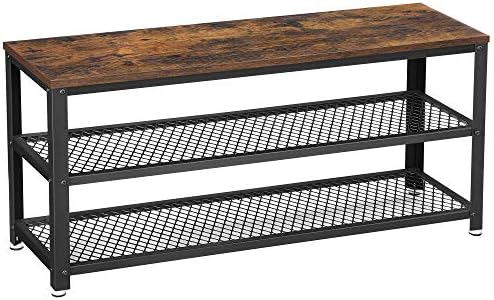
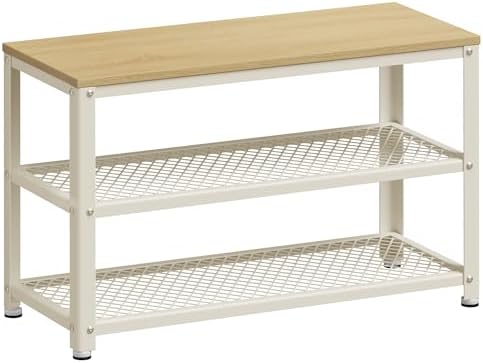
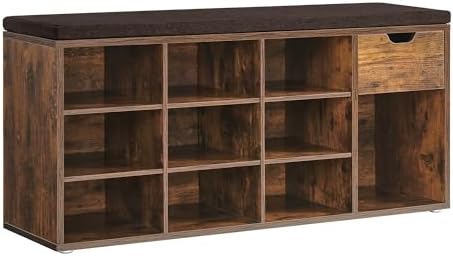
Zone 3: Coats and bags. These need to be off the floor and off door handles. A hook rail on the wall or an over-door hook system handles this without requiring any drilling — relevant for renters who cannot make permanent changes to the property. Capacity here should be limited deliberately: if the hooks hold four items, they should hold four items, not six with extras draped over the top. When storage is full, something needs to leave — not expand.
Each zone works only if it has a defined capacity limit. When a zone overflows, the overflow does not belong in the hallway — it belongs elsewhere in the flat or removed entirely.
The One-In-One-Out Rule for Shoes
Shoe volume is the most common reason entryway storage systems stop working. The system is set up for six pairs, eight pairs accumulate, and suddenly nothing fits correctly and shoes are back on the floor.
The practical fix is a strict rotation rule: when a new pair comes in, an older pair goes into secondary storage or leaves altogether. This is not about minimalism — it is about keeping the volume of shoes in the entryway matched to the capacity of the storage you have.
The number of pairs that should be actively accessible in the hallway is lower than most people expect. Two pairs per person covers the majority of daily use: one for work or regular wear, one for other activities. Seasonal footwear, occasion shoes, and anything worn less than weekly belongs in secondary storage — under the bed, in the wardrobe, in a box on a high shelf. The guide to how to store shoes without a wardrobe in a small apartment covers the secondary storage options that work in small flats.
The rotation only works if secondary storage actually exists and is accessible. If shoes go into a bag under the bed and never come back out, the system does not hold.
Make It Easy to Put Things Away
Storage systems fail when putting something away correctly is harder than leaving it on the floor. In an entryway, that friction point is usually a lid, a door, or a full shelf that requires rearranging to add one more item.
Open storage has a practical advantage in high-traffic spaces: there is nothing to open. You walk in, you drop shoes on the shelf, you leave. The action requires no decision and no additional step. That is why open-format storage tends to hold up better in entryways than closed storage, even for people who are generally tidy.
Closed storage — cabinets with doors, lift-top benches — works if you have the consistent habit of opening and closing it every time. If that habit is not already established, it is unlikely to form under the pressure of daily use. The guide to best shoe racks for small spaces covers open-format options across different hallway widths, including narrow-profile models suited to UK corridors.
The principle applies beyond shoe storage: any element of the system that adds friction will eventually be bypassed. Design for the actual behaviour, not the ideal one.
The 2-Minute Reset
A system needs maintenance to hold. In an entryway, that maintenance does not need to be significant — but it needs to happen regularly.
A two-minute reset at the end of the day is sufficient. This is not cleaning: it is returning every item to its designated zone. Shoes back on the shelf, keys back in the tray, bags back on the hooks. Two minutes is enough if the system is well-designed, because every item already has a fixed home and the only task is moving things back to it.
If the reset consistently takes longer than two minutes, the system has a structural problem — either there are too many items for the available storage, or some items do not have a clearly defined home. The solution is to fix the system, not to spend more time on the reset.
Common Mistakes
- Buying storage before defining zones. Purchasing a shoe rack or bench before deciding where shoes, coats, and daily-carry items will each live means the product may not match the actual need — and a second purchase usually follows within a few months.
- Keeping too many items in the hallway. The entryway is a transit zone, not a storage room. When the volume of items consistently exceeds what the space can hold neatly, the system will always fail regardless of the products involved.
- Choosing closed storage when the habit calls for open. If you do not consistently open and close doors or lids when using a space at pace, closed storage will become unused storage. Match the format to the real behaviour.
- Ignoring the daily-carry zone. Keys, cards, and wallets left without a fixed spot will migrate throughout the flat and create a low-level daily friction that compounds over time. A dedicated tray or hook at the entry point costs almost nothing and removes the problem entirely.
Frequently Asked Questions
How do I stop shoes from piling up in my hallway?
Set a firm limit on how many pairs belong in the entryway — two per person is a practical starting point — and move everything else into secondary storage. When a new pair arrives, an old pair rotates out. The issue is almost always volume exceeding capacity, not the wrong type of storage.
What’s the easiest way to organise a small UK hallway?
Define three zones before buying anything: one for shoes, one for daily-carry items, and one for coats and bags. Then choose the smallest, most accessible storage format for each zone. The guide to best shoe storage solutions for small apartments covers options across different budgets and hallway sizes if you need a starting point for the shoe zone specifically.
Do I need a dedicated entryway area in a studio flat?
Yes — especially in a studio, where the hallway connects directly to the main living space. Without a clear entry zone, clutter from the door spreads into the rest of the flat immediately. Even in a very small studio, a single bench or compact rack at the door, combined with one hook for bags and coats, is enough to contain the transition between outside and inside.
Conclusion
A hallway that stays organised is not the result of buying the right product. It is the result of defining what belongs in the space, giving every item a fixed home, and keeping the volume of items within the capacity of the system. Those decisions take ten minutes to make and hold indefinitely once the system is in place. Check current options for entryway storage benches or shoe storage solutions on Amazon if you need to fill a specific gap in the setup.