
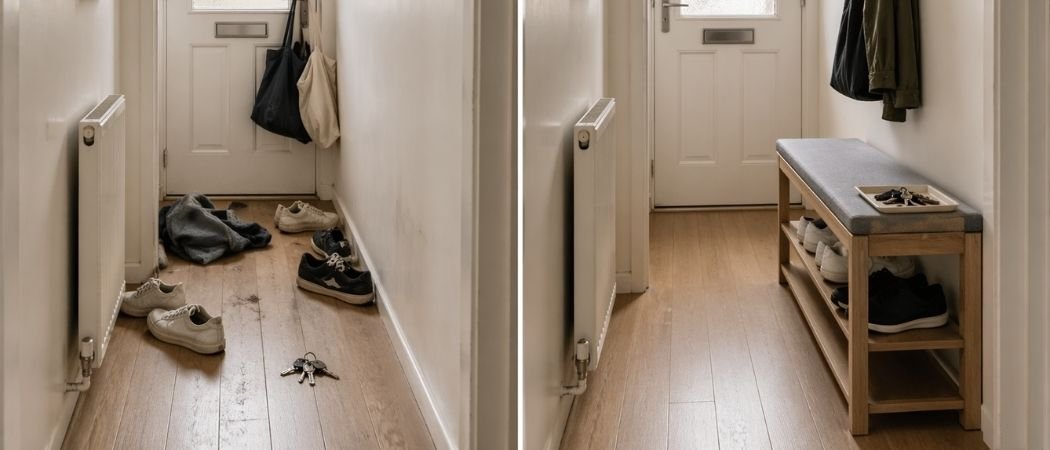
Most people reorganise their hallway with good intentions — and end up back at the same problem a few months later. Shoes on the floor, bags on the door handle, keys on the kitchen counter. The reset didn’t hold.
The issue is rarely effort. It’s that most storage decisions are made before the actual problem is properly understood. Buying a product and hoping it fits the space and the habit is not a system — it’s a guess.
This article identifies eight specific mistakes that cause entryway storage to fail in small apartments, and the fix for each one.
Mistake #1: Buying Storage Before Defining Zones
This is the most common starting point: you see a shoe rack or bench that looks like it might work, you buy it, and then you try to make the space fit around the product. The problem is that most entryways in small UK flats have more than one function — shoes go somewhere, coats go somewhere, bags and keys need a home — and a single product rarely covers all of them. When zones are not defined first, one area ends up doing too much and the system collapses.
The fix is to spend five minutes mapping the space before spending anything. Decide where shoes go, where coats and bags go, and where daily-carry items like keys and cards go. Once those zones are clear, it becomes obvious which products you need and in what order. If you are not sure where to start, the guide to how to keep your entryway clutter-free in a small apartment covers zoning in detail.
Mistake #2: Choosing a Shoe Rack That’s Too Wide for the Hallway
A shoe rack that is too wide does not just look wrong — it physically narrows the usable corridor width, making the hallway harder to move through. This is a particularly common mistake in UK flats, where hallways are often between 80cm and 110cm wide. A standard shoe rack bought without measuring can easily take up more than half that width, turning the entryway into an obstacle course.
The reliable rule is to keep any piece of furniture to a maximum of two-thirds of the hallway width. That leaves enough clearance on one side to pass through comfortably with bags or a coat. Measure the space before buying anything — width and depth both. The article on best shoe racks for small spaces covers compact formats with confirmed dimensions that suit narrow UK hallways.
Mistake #3: Using Closed Storage When Your Habits Call for Open
Closed shoe cabinets look tidy in photographs. In practice, they only stay tidy if you consistently open them, put shoes inside, and close them again — every time, without exception. If that is not how you actually behave when you walk through the door, a cabinet becomes a surface on which to pile things, with unused storage space behind the doors.
This is not a moral failing — it is a mismatch between product design and real behaviour. If you tend to drop shoes near the door and deal with them later, open storage works with that habit rather than against it. If you are genuinely consistent about putting things away immediately, closed storage is a reasonable choice. The comparison article on shoe rack vs shoe cabinet for small apartments breaks this down by use case and helps you identify which format suits your actual routine.
Mistake #4: Ignoring the Vertical Space Above Floor Level
Floor space in a small hallway is finite. Wall space, door space, and vertical height above a low unit are not — but they often go unused because the default assumption is that storage lives at floor level. A shoe rack that takes up 80cm of floor space might have 150cm of usable wall above it doing nothing.
Adding a vertical element changes the capacity of the entryway significantly without expanding its footprint. Tall stackable shoe towers, over-door organisers, and wall hooks all use height instead of floor space. In a hallway where the floor is always the bottleneck, moving storage upward is usually the most efficient fix available. If your current setup has reached its floor-space limit, the guide to best vertical shoe storage for small spaces covers the formats that work in tight UK hallways.
Mistake #5: Keeping Too Many Shoes in the Entryway
The hallway is not a wardrobe. It is a transit zone, and the storage there should reflect what you actually use daily — not serve as the primary home for your entire shoe collection. When too many pairs live in the entryway, the space fills up regardless of the system, because the volume of shoes exceeds what any reasonably sized hallway unit can hold neatly.
A practical limit for most one-bedroom flats is two pairs per person in active rotation at the entryway. Everything else — seasonal footwear, shoes worn occasionally, spares — should be stored elsewhere in the flat and rotated in as needed. This keeps the entryway functional without requiring a large unit. If the rest of the flat has no obvious storage solution for shoes, the article on how to store shoes without a wardrobe in a small apartment covers alternatives beyond the entryway.
Mistake #6: Not Creating a Dedicated Zone for Quick-Exit Items
Keys, wallet, sunglasses, headphones, transit card — these are the items that get grabbed every time you leave the flat, and they are also the items most likely to end up on the kitchen counter, the sofa arm, or the floor near the door. Without a fixed spot for them at the point of exit, they migrate around the flat and get lost.
The fix is a small, dedicated surface or container immediately inside the door. A shallow tray, a bowl, or a short shelf at roughly waist height works. It does not need to be a separate piece of furniture — many entryway storage benches include a flat top surface that serves this function directly. The key is that the spot is fixed, always empty of everything else, and positioned so using it is easier than not using it.
Mistake #7: Buying a Cabinet That’s Too Deep for the Hallway
Depth is the measurement most people forget to check. Width gets attention because it is obvious — a unit that is too wide looks wrong immediately. Depth only becomes a problem once the unit is in place and suddenly the hallway feels significantly tighter, or the unit blocks a door swing.
Standard shoe cabinets are often 35cm to 40cm deep. In a wide hallway, that is manageable. In a narrow UK flat corridor, it can reduce the effective walkway width by a third. The benchmark for narrow hallways is 35cm or under — and for very tight spaces, units closer to 25–30cm deep are worth prioritising. Always check the depth measurement on the product listing before purchasing. If you are specifically looking for slim-profile options, the guide to best narrow shoe cabinets for small entryways focuses on units designed for restricted depth.
Mistake #8: Installing a System Without a Maintenance Routine
A well-chosen storage setup solves the problem on day one. Without a reset habit, most setups drift back to disorder within weeks. Shoes get left out, the tray fills with random items, bags end up on the floor again. This is not a product failure — it is the absence of a routine.
The reset does not need to be significant. Two minutes at the end of the day or as part of a morning routine is enough if the system is well-designed — meaning every item has a clear, easy-to-reach home. If items regularly end up outside their designated spots, that is usually a signal that the system design needs adjustment, not that the habit needs more willpower. The article on how to organise shoes in a small apartment entryway covers how to structure the space so that maintenance becomes low-effort by default.
The Entryway Setup That Actually Works
For a typical narrow hallway in a small UK flat, a functional setup does not require many components — but each one needs to serve a clear purpose.
A slim open-shelf bench along one wall handles the primary job: somewhere to sit while putting on shoes, and organised storage for the two or three pairs in daily rotation. Open shelves work better than closed storage in this position because access is immediate and the habit of using it is easier to maintain.
Above or beside the bench, a small hook or rail — either wall-mounted or over-door — takes coats and bags off the floor entirely. Over-door hooks are the better option for renters who cannot drill into walls, and they use space that is otherwise completely idle.
On the surface of the bench, or immediately beside it, a shallow tray or small bowl holds keys, cards, and anything else that leaves with you every day. The tray is not decorative — it is functional, and it should be the first thing you reach for when you walk through the door.
The final element is a rotation system for shoes. Only current-season, frequently worn pairs stay in the entryway. Everything else lives in secondary storage elsewhere in the flat and swaps in as needed. This keeps the bench shelves clear enough to function without requiring a larger unit.
For a broader look at how these components fit together, the guide to best shoe storage solutions for small apartments covers the full range of formats available at different price points.
Frequently Asked Questions
Why does my hallway always end up messy even after tidying?
Usually because the storage system requires more effort to use correctly than to ignore. If putting shoes away means opening a door, lifting a lid, or navigating a full shelf, most people will stop doing it within a few days. A system that works consistently is one where the correct behaviour is the path of least resistance — items have a clear, immediately accessible home, and the default action of dropping something in the right place is easier than not doing it.
How much shoe storage do I actually need for a small flat?
For a single-person household, storage for four to six pairs in active rotation at the entryway is typically sufficient. For two people, six to ten pairs. Anything beyond current-season footwear worn regularly should be in secondary storage — under the bed, in a wardrobe, or in a dedicated box — and rotated into the entryway as needed. The goal is not to store every shoe at the entrance; it is to keep the most-used pairs accessible without creating overflow.
What’s the most common mistake when organising a small entryway?
Buying a product before defining what the space needs to do. Most entryway organisation failures start with a purchase decision made on appearance or price, without accounting for hallway dimensions, the number of items that need a home, or the daily habits of the people using the space. Getting those three things clear first — space, volume, behaviour — makes every subsequent decision easier and significantly reduces the chance of ending up back at square one.
Conclusion
Every mistake in this article is predictable, and all of them are avoidable with a small amount of planning before any money is spent. The difference between a hallway that stays organised and one that reverts to chaos within weeks is not the size of the space — it is whether the system was designed around how the space is actually used. Get the diagnosis right first, and the product choices follow naturally.