
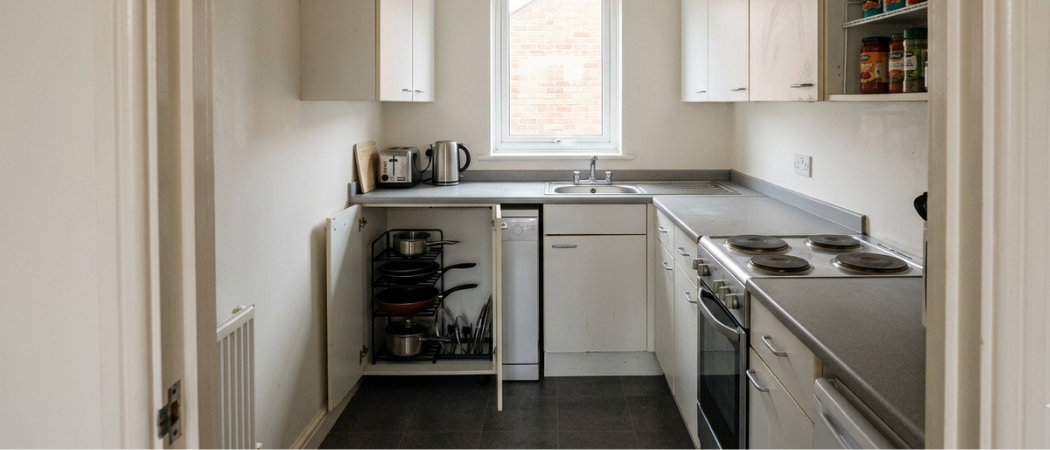
A small kitchen becomes disorganised not because it is too small, but because the available space — cupboards, worktop, under-sink — is never properly set up. Items end up where they fit rather than where they belong, and the result is a kitchen that technically has enough storage but never feels like it does.
In practice, this means finding the right pan takes longer than cooking the meal. The worktop is permanently covered because there is nowhere obvious for things to go. Reorganising means moving clutter from one surface to another without resolving anything.
The fix is a system, not more storage. This guide covers the full process — starting with an audit of what the kitchen actually contains, through a zone structure that gives every item a fixed home, and finishing with a maintenance routine that keeps it functional without ongoing effort. Products appear only where they solve a specific problem identified by the system.
Step 1 — Do the Audit Before Anything Else
Most people skip the audit and go straight to buying organisers. The result is a tidier version of the same underlying problem — the same items in the same places, now held in containers.
Start by emptying every cupboard and clearing the worktop completely. Place everything on the kitchen table or floor and group it into categories: cookware, bakeware, dry food, tinned food, spices, cleaning products, utensils, and appliances. This step is not about tidying — it is about seeing the full inventory of what the kitchen currently holds.
For each item, ask one question: how often is this actually used? Daily, weekly, monthly, or not at all? Items in the last two categories do not need to be in the kitchen. A blender used three times a year, a baking tin used at Christmas, a set of mugs that never gets touched — these are taking space from items used every day. They should either move to storage elsewhere in the flat or leave the household entirely.
A thorough audit typically reduces what needs to be stored in the kitchen by a meaningful amount. When the full contents are visible at once, it becomes clear how many items arrived over time without ever being allocated a proper place — and how many stopped being used without anyone deciding to remove them.
The principle that follows from this step is straightforward: cupboard space in a small kitchen is a limited resource. Every item that does not earn its place takes space from something that does. The audit is the process of deciding which items earn their place.
Step 2 — Define Your Zones Before Putting Anything Back
A zone is a dedicated area for one category of items. Without zones, things drift — and a kitchen without defined zones always returns to disorder within weeks of being reorganised, regardless of what products were used.
Zone 1 — Cooking zone. The cupboards and drawers closest to the hob hold pans, lids, cooking utensils, and oils. Nothing else belongs here. The logic is purely functional: the items you reach for while cooking should require the least movement to access. In a galley kitchen where the hob is at one end, this often means one base cupboard and one drawer. In a single-wall kitchen, it is typically the cupboard directly above or beside the hob.
Zone 2 — Prep zone. The cupboard above or nearest to the main worktop holds chopping boards, mixing bowls, colanders, and frequently used utensils. Everything in this zone should be reachable in one movement from the prep surface. If a mixing bowl requires walking to the other end of the kitchen, it will not get put away correctly after washing — it will stay on the worktop.
Zone 3 — Food storage zone. Dry goods, tinned food, and spices occupy one overhead cupboard in most UK flats without a pantry. Decanting dry goods into stackable containers significantly increases how much fits in a standard 30cm-deep overhead cupboard. A separate guide will cover this in detail when published.
Zone 4 — Cleaning zone. The under-sink cupboard is the cleaning zone. Cleaning products, cloths, sponges, and carrier bags belong here and nowhere else. Nothing from another zone should share this space. The under-sink area has its own specific constraints — pipes, a siphon, limited usable width — that require a different approach from the rest of the kitchen. The full process is covered in the dedicated guide to how to maximise under-sink storage in a small flat.
Zone 5 — Appliance zone. The kettle and toaster stay on the worktop if used every day. Every other appliance — blender, sandwich maker, air fryer, stand mixer — goes into a cupboard and comes out when needed. This is not about minimalism; it is about keeping the worktop functional as a prep surface rather than an appliance display.
Once zones are defined, items do not move between them. If something does not fit into a zone, it does not have a place in this kitchen — which means the audit did not go far enough, or the item needs to leave.
Step 3 — Make the Cupboards Work Harder
Most kitchen cupboards in UK flats use significantly less than their available volume. The upper half of overhead cupboards is particularly underused because there is no internal structure — items sit on the single shelf, stack awkwardly, and the space above them goes to waste.
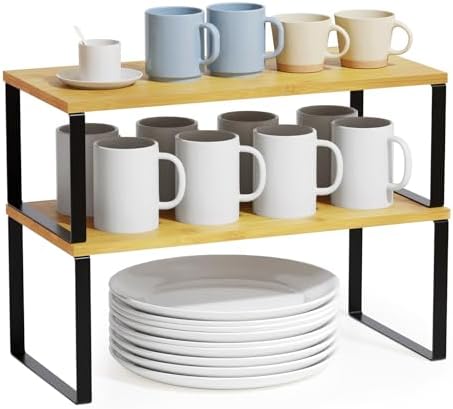
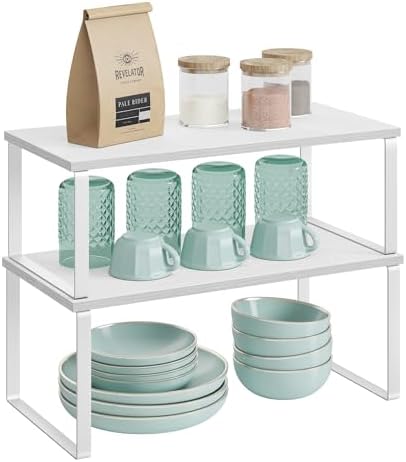
A stackable shelf riser creates a second level inside an existing cupboard without any modification to the kitchen itself. Plates sit on the cupboard floor, bowls on the riser above them. Tins on the base level, shorter jars on the tier above. The same footprint stores roughly twice the volume once the vertical space is structured. These risers are freestanding, removable, and require no tools to install.

The inside of cupboard doors is flat vertical space that most renters never use. An over-door rack fitted to the inside of a cupboard door adds storage for spice jars, foil and cling film boxes, or small cleaning items without occupying any shelf space. It hangs over the door edge with no fixings required and can be removed without leaving any marks.
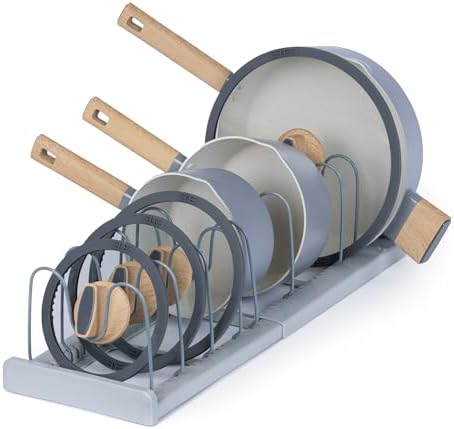
Pans stacked horizontally in a base cupboard require lifting every pan above the one you want to reach. A vertical pan rack or a set of adjustable dividers inside a base cupboard allows each pan to stand upright and be lifted out individually — a straightforward fix that makes the cooking zone significantly faster to use in daily practice.


Base cupboards in UK flat kitchens are typically 50cm deep, and items pushed to the back become effectively inaccessible. A turntable on the base shelf makes the full depth usable — items at the back rotate to the front in one movement rather than requiring the whole cupboard to be unpacked.
Step 4 — Reclaim the Worktop
The worktop is the most valuable surface in a small kitchen. Every item that lives on it permanently reduces the usable prep area — and in a kitchen with 120 to 180cm of total worktop run, that reduction is immediate and significant.
The rule for worktop allocation is the daily-use test: only items used every single day stay on the surface. Everything used less frequently than that goes into a cupboard, even if retrieval takes slightly more effort. The inconvenience of reaching into a cupboard for a blender once a week is significantly less than the constraint of having 20cm less prep space every day.
For items that do need to stay on the worktop — oils, condiments, a utensil holder — a small freestanding shelf unit above the worktop creates a second tier that lifts these items off the flat surface without requiring any wall fixings. The shelf sits on the worktop itself and uses the vertical space between the surface and the overhead cupboards.
The appliance assessment follows the same logic. Kettle and toaster used daily — they stay. A blender used once a week — it goes in the appliance zone cupboard. An air fryer used every other day — it stays on the worktop only if there is space remaining after the daily-use items are allocated. The question is always whether the item justifies its worktop footprint relative to how often it is used.
Step 5 — Add Extra Storage Only Where the System Needs It
Extra storage products come last. Adding them before defining a system creates a better-organised version of the original problem — the clutter is now in containers, but it is still clutter.
Once the audit is done, zones are defined, cupboards are restructured, and the worktop is cleared, it becomes clear whether additional storage capacity is genuinely needed. In most cases, two or three gaps remain: a zone that has more items than its allocated cupboard can hold, or a category with no obvious home in the existing layout.
A slim kitchen trolley — 40cm wide or less — is the most flexible solution for these gaps. It adds both worktop surface and enclosed storage without requiring any modification to the kitchen. In a galley kitchen, a narrow trolley can function as a dedicated food storage zone, a prep surface extension, or a home for appliances that do not fit in the existing cupboards. A full guide to the best options for small flat kitchens will be available when published.
The back of the kitchen door — if it opens inward — is usable vertical space that most renters never consider. An over-door rack fitted here can hold cleaning supplies, foil and cling film boxes, or dry goods in pouches. It requires no drilling, takes up no floor space, and adds storage in a location that would otherwise go unused. A dedicated guide to door organiser options for small kitchens will be published shortly.
Common Mistakes
Mistake 1: Buying storage products before doing the audit
The appeal of buying organisers first is understandable — it feels like taking action. But products bought before the audit solve the wrong problem. Without knowing what actually needs storing and how often it is used, there is no basis for choosing the right format, size, or number of organisers.
The audit defines what the problem actually is. A kitchen that looks like it needs more storage often turns out to need less — once unused items are removed, the existing cupboard space is frequently sufficient with better internal structure.
Mistake 2: Putting things back in the same place after reorganising
Reorganising without reassigning locations produces a temporary result. Items return to where they have always been, which means nothing structurally changes — the kitchen will look tidier for a week and return to its previous state shortly after.
The reorganisation is the moment to assign zones. Every item that goes back into the kitchen goes into its zone, not its original location. If an item was stored in the cooking zone cupboard but belongs in the food storage zone, it moves during the reorganisation — not as a later adjustment.
Mistake 3: Keeping appliances on the worktop that are not used daily
A single appliance that does not meet the daily-use threshold can occupy 20 to 30cm of worktop space permanently. In a kitchen with limited prep area, this is a significant and ongoing reduction in usable surface.
The daily-use rule needs to be applied without exceptions. An appliance used four times a week does not meet the threshold. It goes in the appliance zone cupboard and comes out when needed. The marginal inconvenience of retrieval is not comparable to the ongoing cost of reduced worktop space.
Mistake 4: Ignoring the inside of cupboard doors
The interior face of a cupboard door is vertical storage space that most small kitchen layouts never use. In a kitchen where every centimetre of shelf space is allocated, this represents a meaningful addition to available storage volume.
An over-door rack for the inside of a kitchen cupboard door costs under £15 in most cases and adds enough space for a row of spice jars, a roll of foil, or a pack of cling film. It requires no drilling and no permanent fixing. It is one of the more straightforward gaps to address in a small kitchen.
Mistake 5: Using the under-sink cupboard for general kitchen overflow
When the under-sink area becomes general overflow storage, it creates a secondary organisation problem in an already constrained kitchen. The cupboard fills up with a random mix of categories, nothing is findable, and the cleaning zone no longer functions as one.
The under-sink cupboard has a single purpose: cleaning supplies and associated items only. When it is at capacity for this category, the answer is to reduce the volume of cleaning products stored there — not to push other kitchen items in alongside them.
Mistake 6: Mixing categories within the same cupboard
When a cupboard holds items from more than one zone, it becomes difficult to locate anything quickly and the category logic breaks down within days. Finding one item means moving several others, and things gradually stop being returned to the right place.
Each cupboard belongs to one zone. If two zones are competing for the same cupboard, the audit needs to be revisited — either more items need to leave the kitchen, or the zone allocation needs to be restructured around what the available cupboards can actually hold.
Frequently Asked Questions
How do I create more storage in a small kitchen without drilling?
The most effective renter-friendly options are shelf risers inside existing cupboards, over-door racks on the inside of cupboard doors, a freestanding shelf on the worktop, and a slim kitchen trolley if floor space allows. None of these require drilling or permanent fixings. Combined, they can significantly increase the usable volume of a small kitchen without modifying any surface.
How do I organise a kitchen with only two cupboards?
Apply the zone system to a two-cupboard constraint by prioritising the two most essential zones: cooking and food storage. The cooking zone takes one cupboard — pans, lids, utensils, oils. The food storage zone takes the other — dry goods, tins, spices. Cleaning products move under the sink. Appliances that cannot fit in either cupboard either leave the kitchen or go elsewhere in the flat.
Is a kitchen trolley worth it in a small flat kitchen?
A kitchen trolley works well when the kitchen has a genuine gap in zone coverage and when the layout has enough clear floor space to accommodate it without blocking movement. In a galley kitchen, a trolley narrower than 40cm can typically be positioned at one end without restricting the corridor. In a very small single-wall kitchen, it can sometimes be positioned just outside the kitchen and rolled in when needed. It is not worth the floor space if the zone system resolves the storage problem without it.
What should I keep on the kitchen worktop in a small flat?
Apply the daily-use rule: only items used every single day stay on the worktop. In practice, this means the kettle, the toaster, and a utensil holder if it contains items used at every meal. Oils and condiments used daily can stay if a countertop shelf lifts them off the flat surface. Everything used less frequently than daily goes into a cupboard. The worktop’s primary function is food preparation — storage on it is secondary and should not compromise the prep area.
Related Guides
The zone-based approach covered in this article applies to every room in a small flat, not just the kitchen. The same principles that prevent entryway clutter apply directly here — entryway storage mistakes to avoid in small apartments covers how buying products before defining zones plays out in a different context.
The frequency-of-use principle that determines what stays in the kitchen and what moves elsewhere applies equally to other storage areas. How to store clothes under the bed without creating clutter covers the same categorisation logic applied to bedroom storage.
The under-sink cupboard follows different rules from the rest of the kitchen and has its own dedicated guide: how to maximise under-sink storage in a small flat covers the pipe and siphon constraints specific to UK flat kitchens and the products that work within them.
For a complete guide to storing food in a kitchen without a pantry, a dedicated article will be available when published.. For product recommendations covering the full range of kitchen storage solutions for small flats, a buying guide will follow.
Conclusion
A small kitchen works when it has a system, not when it has more products. The audit defines what the kitchen actually contains and removes what does not belong. The zones give every remaining item a fixed home. The structural fixes make the existing cupboards hold more within their current footprint. Without the first two steps, the third step adds structure to the wrong problem. With all three in place, the kitchen functions on its available space — and stays functional without requiring ongoing effort to maintain.
Latest Posts
- Best Shower Caddies That Actually Stay Up in Small Bathrooms
- The Best Under-Sink Organisers for Cramped Bathrooms
- The Best Over-Toilet Storage for Tiny Bathrooms
Leave a Reply