
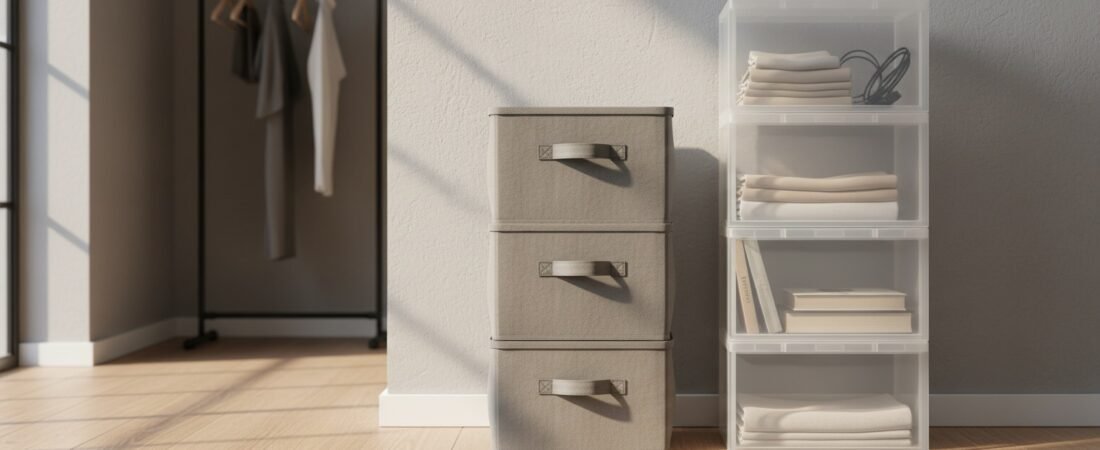
If your closet floor is slowly turning into a pile of “temporary” items, storage boxes won’t save you.
But the right stackable storage boxes might.
In small closets, floor space is limited. The wrong box makes the space feel tighter. The right one creates vertical containment without blocking movement.
This guide focuses on stackable storage boxes that actually work in small apartment closets — not bulky bins that overwhelm the space.
What Makes a Storage Box Suitable for a Small Closet?
Before choosing anything, check three things:
- Depth under 40 cm (many closets are not deep)
- Rigid structure (so stacking is stable)
- Neutral design (visual calm matters in small spaces)
If a box is too wide or too tall, stacking won’t help — it will dominate the closet.
1. Clear Plastic Stackable Boxes (Best for Visibility)
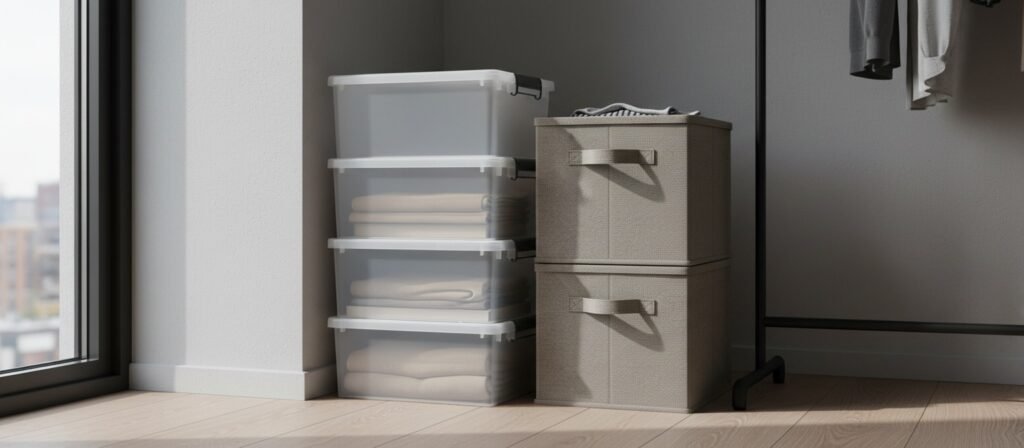
Clear plastic storage boxes are practical because you can see what’s inside without opening everything.
They work best for:
- Seasonal clothing
- Accessories
- Shoes
- Backup linens
The advantage is not just stacking — it’s friction reduction. You don’t need to unstack everything to find one item.
| Best for | Pros | Cons |
| Bottom-of-closet stacking Top shelf organization Quick rotation systems | Stable stacking Moisture protection Easy identification | Less aesthetic if overused |
In small closets, transparency often beats decorative styling.
👉 Explore clear stackable storage boxes:


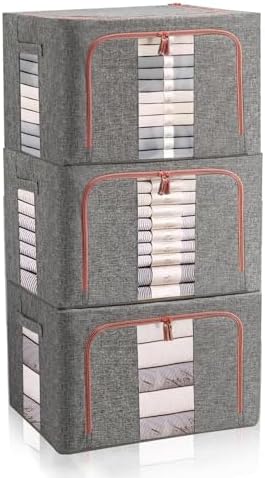
2. Fabric Stackable Boxes with Lid (Best for Visual Calm)
If your closet is partially visible (for example in a studio apartment), visual simplicity matters.
Fabric storage boxes with reinforced sides create:
-
Clean lines
-
Softer appearance
-
Less visual weight
They’re ideal for:
-
Top shelf stacking
-
Containing folded clothing
-
Shared closets
| Best for | Pros | Cons |
| Studio apartments Open wardrobe systems Neutral interiors | Lightweight Stackable when reinforced Visually minimal | Less moisture protection than plastic |
Use them consistently — mixing styles reduces the benefit.
👉 See stackable fabric storage boxes:


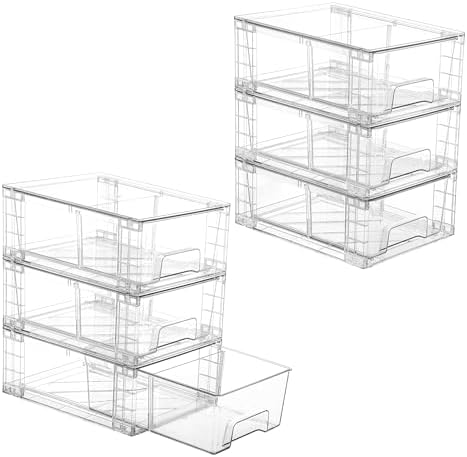
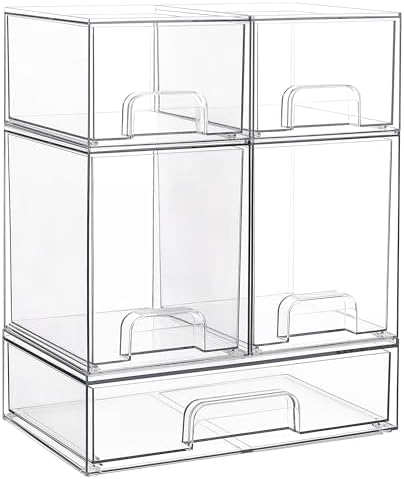
3. Slim Modular Drawer Boxes (Best for Narrow Closets)
In very narrow closets, traditional square bins block depth.
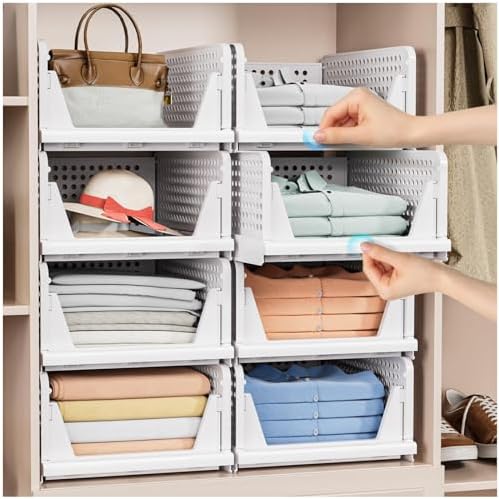
Slim modular drawer-style boxes allow vertical stacking while still maintaining front access.
This prevents the “unstack everything to reach the bottom” problem.
| Best for | Pros | Cons |
| Narrow wardrobes High vertical space Frequently accessed items | Better accessibility Efficient vertical stacking Reduced disturbance | Slightly more expensive |
For tight closets, accessibility matters more than capacity.
👉 Explore slim stackable drawer-style boxes:
When Storage Boxes Make the Closet Worse
Stackable boxes can harm small closets if:
-
They block air circulation
-
They exceed half the closet width
-
They’re stacked too high
-
They replace hanging space unnecessarily
Boxes should contain overflow — not replace structure.
If your rail is overloaded, fix that first.
How to Use Stackable Boxes Properly
In small apartments:
-
Stack only where vertical clearance allows
-
Keep heavier items at the bottom
-
Limit to one style per closet
-
Rotate seasonal items
Precision beats volume.
FAQs
How many boxes should I use in a small closet?
As few as necessary. Overstacking reduces usability.
Plastic or fabric — which is better?
Plastic for durability and visibility. Fabric for aesthetic calm.
Should I fill the entire floor with boxes?
No. Leave movement space whenever possible.
Conclusion
Stackable storage boxes don’t create space.
They create containment.
In small closets, containment is useful — but only when the box size matches the closet’s proportions.
Choose slim, stable, stackable models.
Avoid oversized bins.
And never let boxes replace structure.